
Are house sparrows invasive?
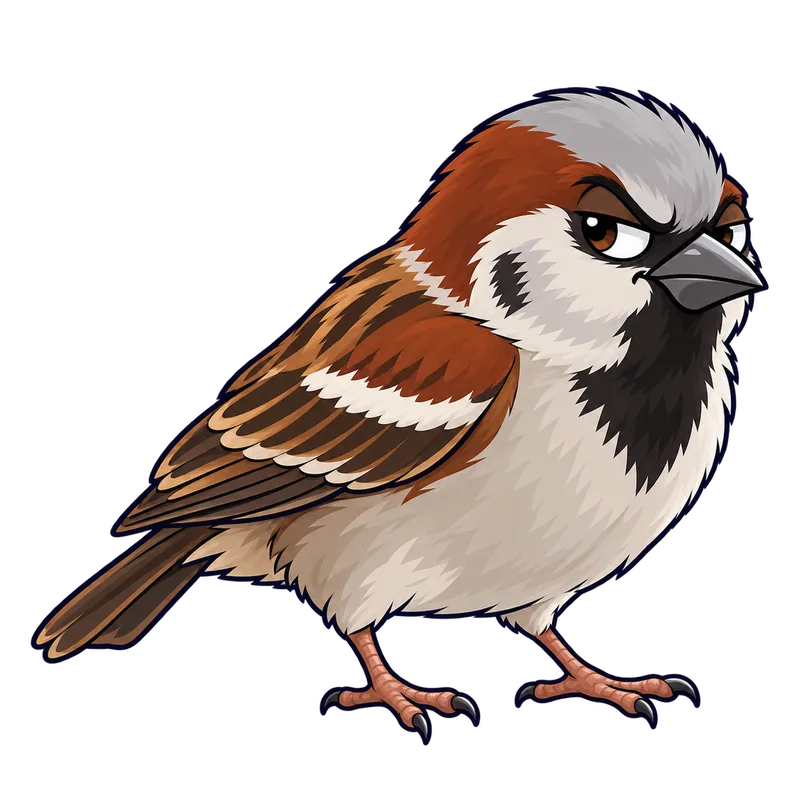
Yes, house sparrows are considered an ecologically invasive species in North America, South Africa, Australia, and New Zealand. Whether they are invasive depends entirely on your geography, because house sparrows are native and legally protected in Europe and Asia where humans brought them from in the nineteenth century.
What is actually going on
You step out onto the porch with your morning coffee and notice a sparrow frantically stuffing dry grass, bits of plastic string, and feathers into the metal housing of your outdoor light fixture. It looks like an overstuffed mailbox spilling trash out of every seam. If you live in North America, South Africa, Australia, or New Zealand, the short answer is yes. House sparrows are an introduced, non-native, and ecologically invasive species that competes aggressively with native cavity-nesting birds.
People often assume every small brown bird hopping around a parking lot or backyard feeder belongs here naturally. That is usually where the confusion starts. House sparrows are native to Europe and Asia, where they enjoy legal protection and conservation support. But when humans brought them across the ocean in the nineteenth century, the dynamic changed completely. Without their native predators and checks, they established massive wild populations in urban, suburban, and agricultural settings.
The trouble with these birds goes far beyond a messy nest on a porch light. They exhibit classic invasive traits like high reproductive rates, a flexible diet, and intense aggression toward other wildlife. During the spring breeding season, they target native cavity nesters such as bluebirds and tree swallows. They will violently usurp active nest sites, puncture eggs, kill nestlings, and even peck adult birds to death before building their own bulky nests right over the remains.
Yet, before you take any action, you have to remember that geography completely changes the rules. If a friend calls you from London or Dublin complaining about these same birds, the legal reality is the opposite. In the United Kingdom and continental Europe, house sparrows are native species protected by national conservation laws, meaning you cannot legally harm them or destroy their active nests.
How to tell for sure
Identification has to come before any control measure because native sparrows look remarkably similar to the ones you actually want to manage. If you make a mistake, you might accidentally harm a protected native song sparrow or white-throated sparrow, which violates federal and state wildlife laws.
To tell them apart, you usually need a clear line of sight and 7x to 10x magnification optics if the bird is more than a few yards away. Male house sparrows are fairly easy to spot with their chunky bodies, conical seed-eating bills, black throat bibs, grey crowns, and chestnut napes. Females are much trickier, wearing a dull grey-brown overall with a plain bill and a distinct pale buff stripe behind the eye. That female house sparrow looks strikingly like several native North American sparrows and finches. If you are standing 20 meters away in low light without binoculars and cannot get a positive ID, your control efforts have to stop right there.
You can also look for other physical clues around the property. Bird tracks feature three toes pointing forward and one smaller toe pointing backward, which easily separates perching birds from woodpeckers or waterfowl. When you inspect droppings on a ledge or sidewalk, bird feces usually feature dark digestive waste capped or mixed with white chalky uric acid.
What usually comes next
Once you confirm you are dealing with invasive house sparrows, you have to make a practical choice about how to handle them. Long-term management relies on a structured framework of prevention and habitat modification rather than just relying on quick fixes.
Think of structural exclusion like locking your front door. It is vastly easier, cheaper, and less stressful to seal a gap upfront than to chase unwanted visitors out once they have moved in. You want to seal all structural openings around soffits, eave voids, and pipe penetrations using hardware cloth or wire mesh with openings of zero point 25 inches or smaller. Cover exhaust vents and dryer vents with heavy metal screening, and install commercial stainless-steel chimney caps to keep them out of flues.
People often rely on static scare devices like plastic owls or rubber snakes to keep birds away from porch ledges. That approach usually fails within a few days because house sparrows rapidly habituate to them. Think of a fake owl like a billboard on your daily commute. The first time you pass it, you notice it. By the fourth day, your brain filters it out completely because it has not moved or threatened you. Effective deterrence requires randomness, movement, and sensory diversity.
If you manage backyard feeders, you can discourage sparrows by eliminating low-quality mixed birdseed containing millet or cracked corn. Switch to tube feeders with short perches or weight-sensitive perches that favor smaller clinging native birds over bulky sparrows. When nests already appear in structural voids, you need to remove the material repeatedly every few days during the breeding season until the birds finally give up and move elsewhere.
When to get help
Certain situations cross the line from a simple do-it-yourself chore into territory that requires professional equipment, a clinician, or an agency.
If you are dealing with a multi-story building, a slate roof, or high-elevation soffits, leave the structural netting and commercial sealing to a licensed pest control firm or wildlife control operator who has the proper lift equipment and safety harnesses. The same goes for any chemical control options, as applying unregistered repellents or using toxicants contrary to product label directions is both dangerous and illegal.
Health risks also deserve careful attention. Accumulated bird droppings in structural voids or attics harbor fungal, bacterial, and parasitic pathogens. Dry-sweeping or disturbing dry droppings without proper personal protective equipment, specifically rubber gloves and a NIOSH-approved particulate respirator, can cause serious respiratory illness from dust inhalation. If you suspect an infestation involves a mix of invasive house sparrows and protected native species sharing the same roost, bring in a professional to ensure your actions stay on the right side of the law.