
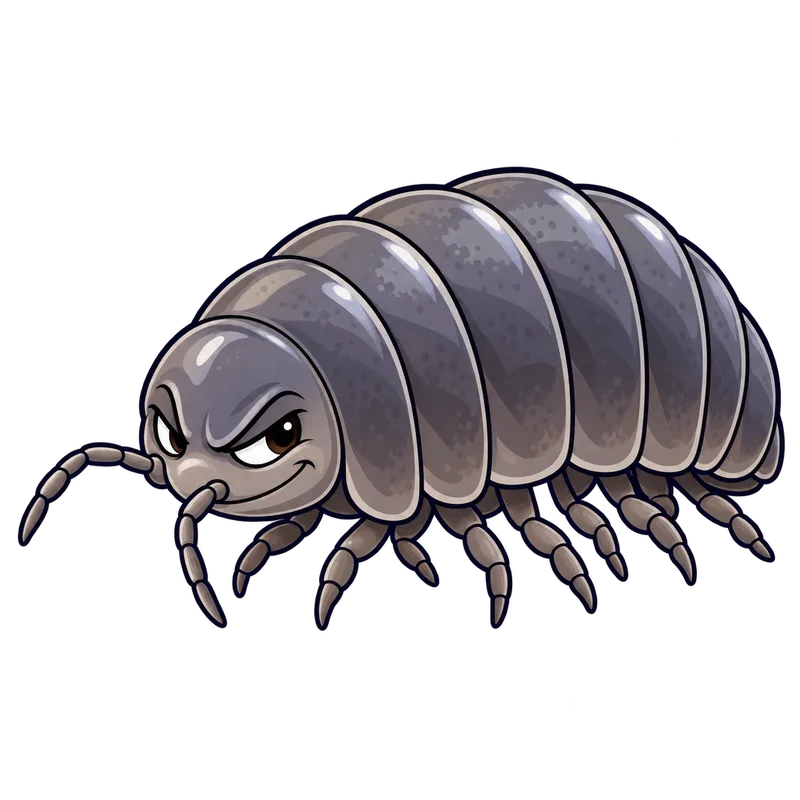
Pillbugs and sowbugs
Armadillidium and Porcellio species
- Size
- About one-fourth of an inch long
- Color
- Shades of gray to brown
- Habitat
- Damp outdoor areas beneath logs and stones
- Diet
- Decaying plant matter and rotting wood
- Life cycle
- Juveniles hatch as miniature versions of adults
Pillbugs and sowbugs are land-dwelling crustaceans, making them closer cousins to ocean-going shrimp and crabs than to any six-legged household pest. Adults reach about one-fourth of an inch long, wear a flat armored shell colored in shades of gray to brown, and stand on seven pairs of jointed walking legs that give them a distinct crawling gait.
Identity
Spotting them comes down to a quick physical test. Pillbugs, often called roly-polies, pull their overlapping plates together and curl into a tight, smooth sphere when disturbed. Sowbugs lack this folding trick and instead carry two small, tail-like appendages at their rear end that act as water-sucking tubes.
Separating them from true insects is straightforward if you count the appendages. Beetles, earwigs, and other genuine bugs always stop at six legs, while these terrestrial crustaceans possess fourteen. Millipedes and centipedes might share the multi-legged look, but millipedes sport two pairs of legs per body segment and roll into a sideways spiral, while centipedes run fast and carry visible venom claws.
Habitat & behaviour
Outdoors, these creatures demand damp conditions to survive, hiding out beneath rotting logs, flat stones, dense leaf litter, and deep landscape mulch beds that retain moisture right up against a foundation wall. They spend their nights as silent recyclers, feeding strictly on decaying plant matter and rotting wood rather than living greenery.
Wandering indoors is rarely part of some grand invasion plan and almost always amounts to a navigation error. When a hot, dry summer bakes their favorite outdoor mulch or heavy autumn rains flood their underground hiding spots, they push inside through foundation cracks, sliding door gaps, or low weep screeds to chase after humidity.
Once inside, normal room air proves fatal. Because they lack a waterproof outer coating, indoor air dries them out far too quickly, and the absence of rotting vegetation leaves them with nothing to eat. They do not reproduce inside houses, and strays usually perish in a matter of days.
Visual variations
The family album is fairly sparse regarding dramatic transformations. Juveniles hatch looking like miniature versions of the adults, sharing the same oval, flattened shape, gray-brown coloration, and fourteen-legged body plan, just scaled down.
Because they are not social insects, there are no worker castes, soldiers, or winged reproductive stages to worry about finding. Both males and females share the same general armored plate structure, differing only in subtle internal anatomy that requires microscopic inspection to sort out.
The primary visual split remains strictly behavioral and structural between the two main camps. Pillbugs show off rounded posterior plates designed to lock together during conglobation, while sowbugs end in a blunt abdomen featuring those twin terminal uropods, the tiny tail-like tubes that help them manage moisture.
Why it matters
Finding a few of these harmless wanderers in a basement or crawl space means zero structural risk to your home. They do not chew through drywall, hollow out floor joists, or damage household furnishings, and they carry no venom, bite no one, and transmit no diseases to people or pets.
Their real value lies in their role as living moisture meters. When dozens of them start showing up near the back door or laundry room, the creature is simply pointing out an environmental problem, such as a leaky pipe, a damp crawl space, or too much mulch piled directly against the siding.
Precise identification rarely demands a call to an expert unless high-volume numbers persist despite your efforts to dry out the perimeter. Management stays focused on keeping exterior moisture at arm's length by sealing foundation gaps, installing tight door sweeps, and pulling mulch and ground cover back into a clear gravel band away from the house.