
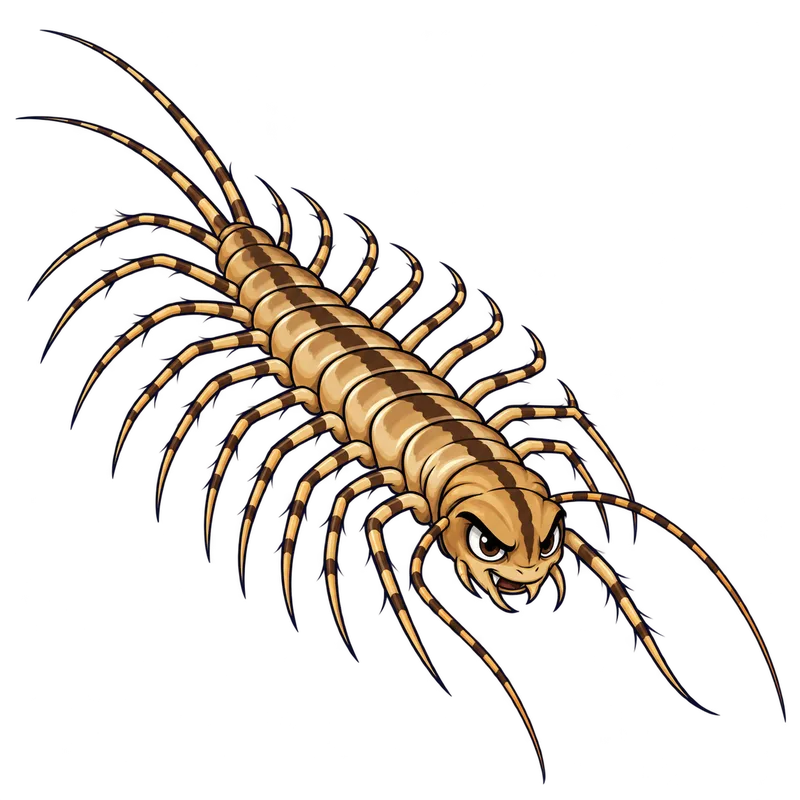
House centipede
Scutigera coleoptrata
- Size
- About 1 inch long
- Color
- Pale brown to tan with dark leg bands
- Habitat
- Damp indoor areas and dark, moist outdoor spaces
- Diet
- Living indoor arthropods such as silverfish and cockroaches
- Life cycle
- Egg to nymphal stages and adult
The house centipede carries the binomial scientific identity Scutigera coleoptrata. You are most likely to spot it blurring across a basement wall or sitting motionless in a porcelain bathtub. What catches the eye first is the sheer length of those 15 pairs of legs, which radiate outward and backward from an elongated trunk like a frantic ring of bicycle spokes.
Identity
Adults measure about 1 inch long in body length, though their sprawling legs make them look twice that size from a few feet away. Those slender legs feature distinct dark transverse banding that alternates with pale brown or tan background tones. You do not need magnification to see them, just decent lighting and steady nerves.
Up close, you will notice long, thread-like antennae waving from the head and a pair of curved venom claws, known as forcipules, tucked beneath the front segments. As a member of the class Chilopoda, this creature features exactly 1 pair of legs per visible body segment. That structural rule separates it cleanly from millipedes, which sport 2 pairs per segment and lack venomous biting claws. Spiders possess 8 legs and 2 distinct body regions, while silverfish are wingless insects with 6 legs and 3 long tail filaments.
Habitat & behaviour
Native to the Mediterranean region, this species is now entirely cosmopolitan and feels right at home in heated, humid structures across the globe. Indoors, they crowd into damp microhabitats such as cellars, crawlspaces, bathrooms, under sinks, and near floor drains. Outdoors, you find them hiding in leaf litter, beneath stones, and inside rotting logs.
They are strictly nocturnal and intensely light-shunning, which explains why turning on a kitchen light at midnight often startles one into a sudden, high-speed dash across the floor. Unlike many occasional invaders that wander inside by accident and dry out, house centipedes are fully equipped to live, hunt, and reproduce indoors year-round. Ingress from outdoors or movement into living spaces also increases during late summer and autumn as exterior habitats dry out or cool down, or during periods of heavy rain that saturate foundation soils.
Their presence inside your home is rarely a random visit. They are solitary, free-roaming predators that follow their food source. If you see one, it usually means your damp basement or bathroom is hosting a thriving population of silverfish, spiders, or small cockroaches for them to hunt.
Visual variations
Forget about wings, since this arthropod relies entirely on rapid running instead of flight to get around. You will not find social castes, queens, workers, or centralized nests either, because these centipedes lead solitary lives and simply go wherever moisture and prey happen to align.
Nymphs look remarkably like tiny adults, sharing the exact same carnivorous appetite and hunting style from their earliest days. As an immature centipede goes through successive molts, it gradually grows longer and adds more leg pairs until it finally reaches full adult size.
Sexes look largely identical to the naked eye. The real visual shift happens in the legs, which noticeably increase in length toward the rear of the body, giving the creature its characteristic teardrop silhouette when you look at it from above.
Why it matters
House centipedes cause zero structural damage. They never chew on wood, drywall, fabrics, paper, or pantry goods, meaning your home framing and clothing remain completely safe from them. In fact, they function as beneficial natural predators that suppress populations of actual household pests.
They possess modified venom claws capable of piercing skin if an individual is accidentally trapped, squeezed, or handled bare-handed. A bite produces localized pain and swelling comparable to a bee sting. They do not transmit human pathogens, and they pose no parasitic risk to domestic pets or indoor plants.
Precise identification matters mainly to spare yourself unnecessary worry and to point you toward the real issue. Seeing a house centipede indicates high indoor humidity or a hidden population of prey insects. Professional inspection and intervention are warranted when frequent centipede sightings indicate heavy underlying prey infestations or severe foundation moisture and drainage defects. Decisions regarding chemical perimeter barriers or structural treatments belong to a licensed pesticide applicator.