Whiteflies
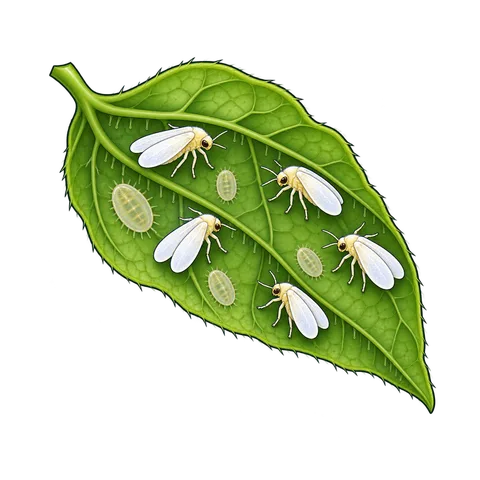
If you have ever brushed against a garden hibiscus or greenhouse tomato plant and watched a tiny cloud of powdery snow erupt into the air, you have met whiteflies. Despite the misleading name, these creatures are not true flies, but tiny, soft-bodied bugs that share a stubborn dedication to living on the undersides of leaves, where both the winged adults and their flattened, scale-like young pierce plant stems to feed on vital sap. This heavy liquid diet leads to a massive sticky byproduct known as honeydew, which quickly invites an unsightly black coating of sooty mold to ruin the foliage.
Telling whiteflies apart from other garden pests comes down to observing how they react when you approach. While aphids might crowd leaf stems in a similar fashion, they are pear-shaped and slow-moving, and armored scales do not flutter away when disturbed. Mealybugs wear messy cottony tufts instead of clean, powdery wings, and thrips prefer to scurry rather than rise in a uniform white cloud. If you spot tiny, pale oval discs glued tightly to the lower leaf surfaces alongside sticky leaves and flying white specks, you are looking at whiteflies.