Greenhouse whitefly
Trialeurodes vaporariorum
- Size
- Not established
- Color
- Pure white to pale cream
- Habitat
- Enclosed greenhouses, indoor grow rooms, and garden foliage
- Diet
- Plant sap drained from the undersides of leaves
- Life cycle
- Overlapping generations from egg through four nymphal instars to adult
The greenhouse whitefly looks less like a fly and more like a tiny, powdery moth resting quietly on your plants. You will rarely notice them until you brush against a tomato vine or an indoor hibiscus, sending up a small, fluttering cloud of pale specks that quickly resettle on the nearest leaf.
Identity
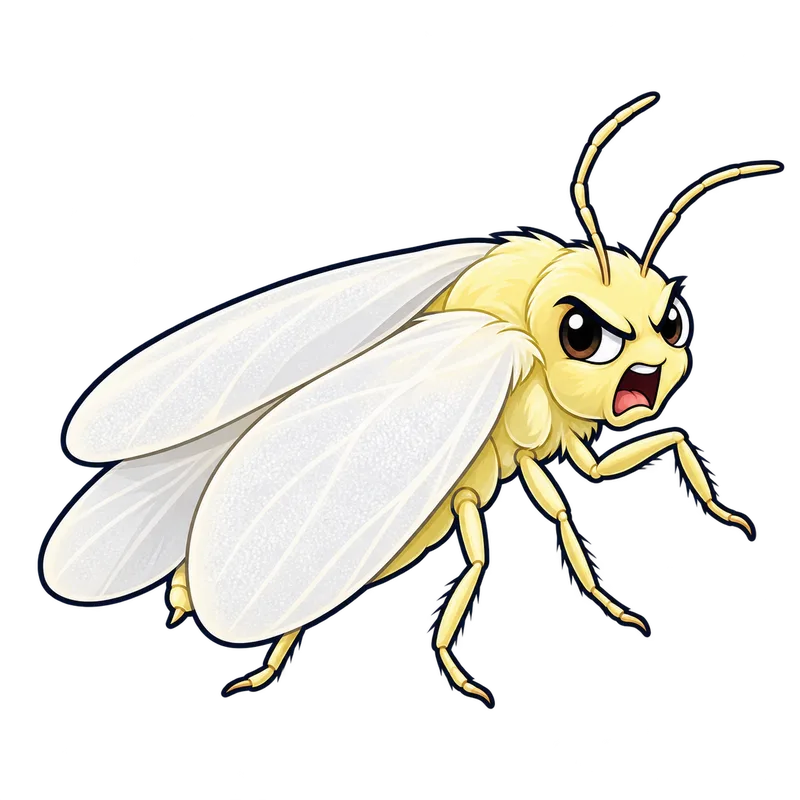
Adults are small and covered in a fine, powdery white wax that rubs off easily if you touch them. They hold their two pairs of wings roof-like over their pale bodies. While exact millimeter measurements for body length are absent from extension sources, they are visually distinct from companion pests because of that snowy coloration and their habit of resting exclusively on the lower surfaces of foliage.
Immature stages look entirely different. Once the eggs hatch, the mobile first-stage crawlers move a short distance before settling down permanently. The subsequent nymphs and pupae are translucent to pale yellow, flat, oval, and scale-like. They stick so closely to the leaf veins that you might mistake them for part of the plant itself unless you look for the subtle sheen of their bodies.
Habitat & behaviour
Greenhouse whiteflies are consummate insiders, making themselves right at home in heated greenhouses, sunrooms, indoor grow rooms, and residential windowsills where winter frost never reaches them. Outdoors, they build active populations during the warm months on vegetables like tomatoes, potatoes, and eggplants, as well as ornamentals like azaleas, gardenias, and hibiscus.
They stay out of the direct sun and heavy drafts by sheltering on the lower and mid-canopy zones, hugging the undersides of leaves. If you are trying to track them down, look at the foliage closest to the middle of the plant rather than the tender new shoots at the very top.
Like many insects, they are drawn to specific bright yellow wavelengths. This behavior makes them easy to monitor using yellow sticky cards, but it also means a brightly colored shirt in the greenhouse can occasionally attract a stray wanderer. In heated environments, they breed continuously without a winter dormancy, resulting in overlapping generations where eggs, crawlers, sessile nymphs, and winged adults all crowd onto the exact same leaf at the same time.
Visual variations
The life cycle skips the resting cocoon stage of a butterfly, but the body shapes still shift dramatically as the insect matures from one form to the next.
Adult females lay their tiny eggs directly onto the undersides of young leaves, keeping a balanced gender ratio with the males. There are no social castes in these colonies, just independent adults going about their business.
Once hatched, the first-stage nymph takes a brief walk before losing its mobility entirely. The second, third, and fourth larval stages flatten out against the leaf surface, shedding their legs and antennae as they feed nonstop. The final immature stage, often called the pupa, is slightly thicker and scale-like, getting the insect ready to transform into a winged adult.
Nature occasionally leaves distinct clues on these immatures. When a tiny parasitic wasp lays an egg inside a whitefly pupa, that pale scale turns a solid, unmistakable dark brown or black. If the colony runs into natural fungal pathogens, individual nymphs develop opaque, bright centers that look remarkably like tiny fried eggs.
Why it matters
An infestation means your plants are hosting a relentless crew of sap-drainers. As both adults and nymphs pierce the foliage to feed, they draw out plant juices and leave behind yellowing foliage, stunted growth, puckered leaves, and premature leaf drop.
While they feed, they excrete a clear, sticky waste product called honeydew. This substance drips down the plant, coating lower leaves and fruit in a sticky glaze that soon attracts black sooty mold fungus, cutting off sunlight and making the plant look as though someone dusted it with chimney soot.
Fortunately, greenhouse whiteflies pose no direct threat to humans or pets. They do not bite, sting, or carry human pathogens. If you need professional help, turn to a licensed applicator when dealing with severe crop infestations near harvest, or when a persistent indoor population overwhelms the biological controls you have put in place.