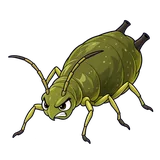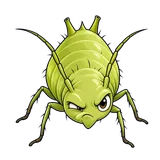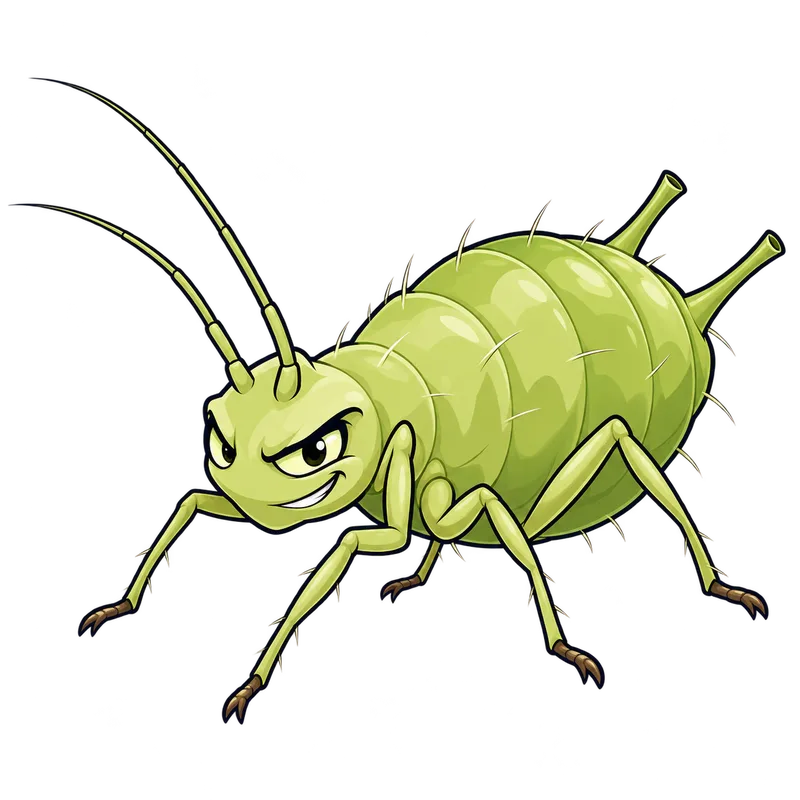
Green peach aphid
Myzus persicae
- Size
- Approximately 1/10 inch or 2.54 mm long
- Color
- Green, gray, brown, pink, red, yellow, or lavender
- Habitat
- Agricultural, horticultural, and ornamental plants
- Diet
- Plant phloem sap
- Life cycle
- Parthenogenesis in summer, eggs in winter
The green peach aphid is a remarkably adaptable sap-sucking insect that you will usually find clustered by the dozens on the tender, lower surfaces of garden leaves. To confirm what you are looking at without guessing, you need to get close, specifically using a 10x magnifier lens to inspect the undersides of the foliage. Through that lens, an adult appears as a small, soft-bodied, pear-shaped insect measuring approximately 1/10 inch or 2.54 mm long.
Identity
While its name promises green, these pests are remarkably inconsistent in their wardrobe. Depending on the specific host plant and the time of year, individuals within the same colony can show up in shades of gray, brown, pink, red, yellow, or lavender, alongside the more common green and black forms. They feature a pair of slender, 6-segmented antennae on the head and a pair of distinctive tubular cornicles projecting backward from the rear of the abdomen.
Mixing them up with other garden residents is easy if you do not know what to look for. Mites lack those abdominal cornicles entirely and often spin fine silken webbing while causing leaf bronzing. Psyllids look somewhat similar at a glance, but their adults jump instantly when disturbed, and their nymphs secrete white sugary wax scales rather than liquid droplets. Leafhoppers have wedge-shaped adults that fly off in a hurry and nymphs that crawl sideways like tiny crabs, leaving behind stippling rather than sticky residue.
You might also cross paths with other aphid species that target the same plants. The rosy apple aphid brings a pink body and causes extreme leaf curling and puckered fruit. The woolly apple aphid hides inside a conspicuous, cottony white waxy mass on bark and roots. The green apple aphid and the spirea aphid wear a brighter green and crowd tightly onto young rosaceous shoots. Strawberry root aphids tend to stay blue-green and underground near roots with heavy ant attendance. Black peach aphids feature a dark, shiny body. None of these look-alikes share the exact combination of color versatility, pear-shaped softness, and distinctive siphuncles found on this species.
Habitat & behaviour
This species has cast a remarkably wide net for dining. It behaves as a polyphagous pest, meaning it feeds on a massive roster of agricultural, horticultural, and ornamental plants. You will find colonies established on fruit crops like citrus and strawberries, a sprawling list of vegetables including cabbage, tomatoes, peppers, potatoes, cucurbits, and lettuce, specialty crops like cannabis, and greenhouse ornamentals such as petunias, peonies, and zinnias.
Feeding happens strictly through piercing-sucking mouthparts. The aphid drives its beak into the plant phloem tissues to tap into the sugary sap flowing inside. This activity is concentrated on the abaxial surface, which is the underside of the leaves, as well as on tender growth tips, flower buds, and developing stems. Because plant sap is exceptionally rich in sugars but relatively low in the specific proteins insects need, they must ingest massive quantities of it to survive. They excret the excess liquid as a clear, sticky waste product called honeydew, which drips down to coat lower leaves and nearby fruit surfaces.
This honeydew serves a secondary purpose for local wildlife, particularly ants. Certain ant species maintain mutualistic relationships with the colonies, attending them regularly, carrying wingless individuals to uninfested stems, and actively defending them from predators in exchange for sweet honeydew.
Seasonally, these insects track the weather closely. They are active throughout the growing season, kicking off their outdoor life cycle in early spring as soon as new plant foliage emerges. Population surges typically hit their stride during late spring and mid-summer when succulent plant growth is most abundant. Warm summer temperatures significantly accelerate their life cycle, allowing nymphs to mature rapidly. In regions blessed with mild winter conditions, the insects bypass their usual egg stage entirely, with wingless adult females persisting and continuing to feed around plant bases or root crowns throughout the colder months.
Visual variations
Colonies of the green peach aphid do not consist of identical clones doing the exact same job. They display clear polymorphism, meaning different physical forms appear depending on the season, crowding levels, and life stages.
The most common residents of summer foliage are the wingless females, known as apterae. These individuals are soft-bodied, pear-shaped, and measure about 2.54 mm long. They carry three pairs of walking legs, slender antennae, and those telltale tubular cornicles pointing backward from the abdomen. They do not wander far, spending their entire lives firmly anchored to a feeding site.
When a plant becomes overcrowded or its quality begins to decline, the colony shifts gears and produces winged females, known as alatae. These migratory adults develop two pairs of delicate, transparent, membranous wings that fold tent-like over their abdomens. Their sole purpose is to take flight, leave the crowded host plant behind, and disperse to new crops or migrate between winter and summer host species.
Reproduction undergoes a dramatic shift as the calendar turns. Throughout the spring and summer, overlapping generations consist entirely of females that reproduce without mating, a process called parthenogenesis, and they give birth directly to live nymphs rather than laying eggs, a trait known as viviparity. A single adult female lives for 2 to 3 weeks and produces 20 to 25 live young during that span, which helps explain how a few stray insects turn into an infestation in a matter of days.
As autumn approaches, changing day lengths and dropping temperatures prompt the colony to produce winged females that return to primary host foliage. These migratory females give birth to a generation of sexual males and females. Once they mature, they mate on the host plants, and the fertilized females deposit tiny, oval, shiny black eggs onto stems and foliage to survive the winter freeze.
Why it matters
An aphid infestation leaves unmistakable physical signatures on your plants, though the pests themselves pose no direct health risk, bite hazard, or sting hazard to humans, pets, or livestock.
The direct damage comes from sheer numbers draining plant vitality. Continuous sap extraction causes distinct symptoms on foliage, including yellowing, curling, puckering, and general stunting of young leaves and shoots. Indirect damage often proves more frustrating. The dripping honeydew coats everything beneath the colony, quickly becoming an ideal breeding ground for black sooty mold fungus. This dark coating blocks sunlight from reaching the leaves, sharply reducing photosynthesis and ruining the visual appeal of harvested fruit. Furthermore, this species serves as a major biological vector for destructive plant viruses, transmitting pathogens that cause severe stunting, yield loss, and eventual plant decline in crops like potatoes, peppers, and strawberries.
Despite the visual distress a curling leaf can cause, small, localized aphid populations rarely require an aggressive response. Beneficial insects, particularly parasitic wasps, frequently suppress small colonies naturally. You can spot this happening by looking for aphid mummies, which are swollen, bronze-colored, papery husks left behind when a wasp larva internalizes and kills the aphid. Spraying broad-spectrum chemicals at the first sign of a few insects often destroys these beneficial allies and makes the underlying problem worse.
Cultural management plays a massive role in keeping populations manageable. Over-fertilizing plants with nitrogen is a classic misstep that produces lush, succulent foliage growth, essentially serving as an open invitation for a population explosion. If you are managing commercial crops or high-value orchards, professional monitoring becomes necessary to calculate economic action thresholds, such as treating apple foliage when colonies infest an average of more than four leaves per shoot while fewer than 20 percent of those colonies harbor active natural enemies. Any chemical or botanical controls applied must strictly follow the registered product label directions, including specific pre-harvest intervals.