
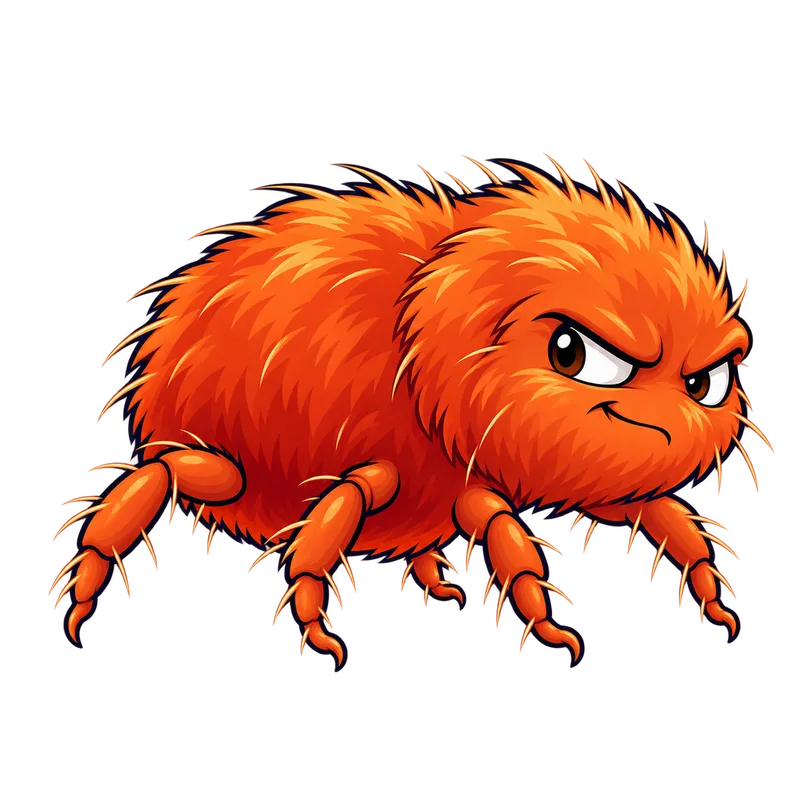
Chiggers
Family Trombiculidae
- Size
- Larva: less than 0.2 mm; Adult: under 1 mm
- Color
- Light, semitransparent, yellowish, reddish, or dark brown
- Habitat
- Soil, leaf litter, overgrown lawns, and brushland
- Diet
- Larvae feed on vertebrate tissue fluids; adults eat small arthropods
- Life cycle
- Egg, prelarva, larva, three nymphal stages, and adult
Chiggers are the tiny, parasitic larvae of mites belonging to the family Trombiculidae, and you usually only discover them after a walk through overgrown grass leaves you scratching for days. While adults and older nymphs possess eight legs and hunt harmlessly in soil leaf litter, the larval stage that actually causes trouble has only six legs. At less than zero point two millimeters long, these larvae are practically invisible to the naked eye.
Identity
Spotting one clearly requires a hand lens or microscope providing ten to forty times magnification. Under that lens, they reveal an oval, unsegmented body with pale or semitransparent coloration before a meal, which shifts to yellowish or dark brown after feeding. People often confuse them with ticks or bed bugs because of the miserable itch that follows, but their microscopic size rules out a casual visual spot check.
Habitat & behaviour
These mites prefer disturbed habitats, overgrown lawns, brushland, and forest fringes where wild hosts like rodents, birds, and lizards roam. Larvae climb onto low vegetation such as grass blades and wait in a questing posture for a passing host. When someone brushes past, the larva transfers to the clothing or skin and crawls upward until it hits an obstruction like a sock band, belt line, or underwear elastic.
It then settles into soft skin folds to feed on dissolved skin cells and tissue fluids for up to two days on humans, never burrowing beneath the skin despite what the resulting swelling might suggest. You might wonder how something so small causes such an intense reaction. The larva injects digestive enzymes that break down skin cells, and your body mounts an immune response to those fluids, creating hardened bumps and relentless itching.
Visual variations
Throughout their life cycle, these mites shift significantly in leg count, anatomy, and habit. The cycle begins with an egg that hatches into a prelarva, which then develops into the active, six-legged larva responsible for vertebrate parasitism. After feeding externally on a host, the larva drops to the ground and transforms through three distinct nymphal stages into an adult.
Adults and nymphs grow to under one millimeter in length, develop eight legs, and cover their oval bodies in short setae. Unlike the wandering larvae, these mature stages stay in the soil and leaf litter as free-living predators of small ground-dwelling arthropods, showing no interest in vertebrates. Watching a pale, six-legged larva transform into a velvety, eight-legged adult hiding in garden soil shows how much a single creature can change its lifestyle.
Why it matters
An encounter with chigger larvae usually results in persistent itching and red, raised papules caused by localized dermatitis. North American chiggers are not documented vectors of human pathogens, though excessive scratching can breach the skin and lead to secondary bacterial infections. In contrast, specific species in northern Australia and parts of Asia can transmit scrub typhus, a potentially serious bacterial illness characterized by a dark scab at the bite site, fever, headache, and a generalized rash.
Because chigger distribution in soil is patchy, broadcast pesticide sprays across a lawn are generally ineffective, making personal protection and host management the primary ways to handle them. Knowing what you are dealing with keeps you from wasting time on lawn treatments that cannot reach them.
Similar species
 Twospotted spider miteTetranychus urticae
 Concrete / sidewalk mitesBalaustium species
 Oak leaf itch mitePyemotes herfsi
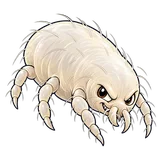 House dust mitesDermatophagoides species
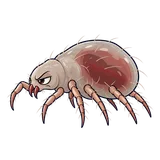 Bird mitesDermanyssus and Ornithonyssus species
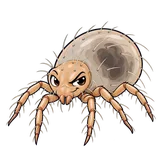 Tropical rat miteOrnithonyssus bacoti