
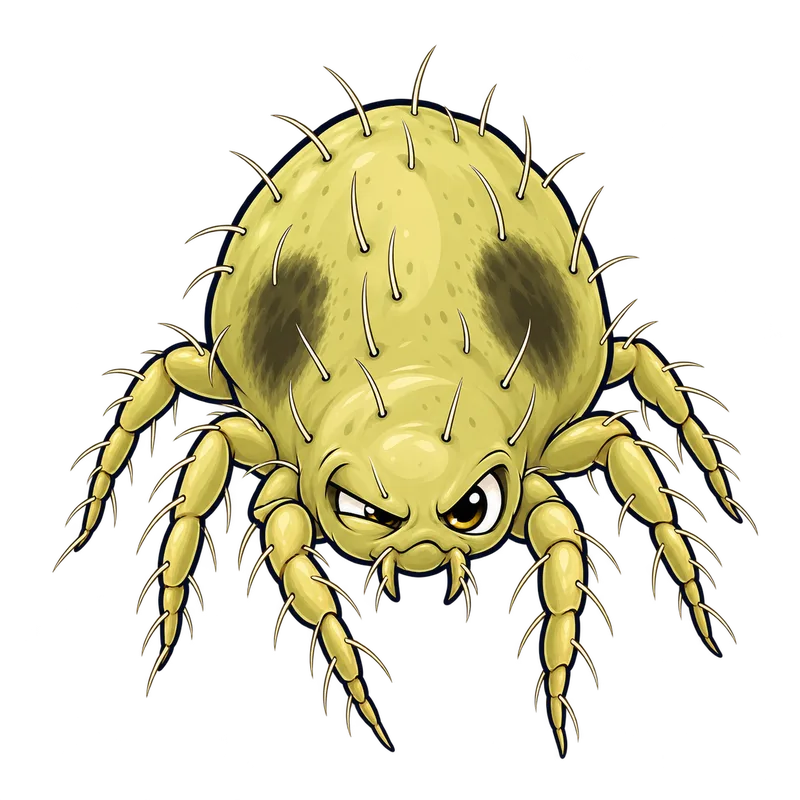
Twospotted spider mite
Tetranychus urticae
- Size
- About 1/50 of an inch (~1 mm)
- Color
- Pale green, yellow, or straw with two dark side spots
- Habitat
- Undersides of leaves on garden plants, crops, and greenhouse foliage
- Diet
- Plant cell sap
- Life cycle
- Egg to adult in 5 days at 75°F, up to 10 generations yearly
The twospotted spider mite, scientifically known as Tetranychus urticae Koch, is a ubiquitous phytophagous arachnid found across the United States, Canada, and temperate regions globally. You will rarely spot one by scanning the top of a garden leaf. Instead, you notice the damage first, which looks like a fine, pale stippling or bleaching across the green surface. When you turn the leaf over, you are looking at creatures measuring roughly 1 mm or 1/50 of an inch long. To the naked eye, they appear as tiny, slow-moving specks that might be mistaken for dust until you notice they are clustered within a veil of fine silk webbing.
Identity
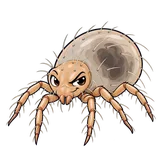
Confirming what you are looking at requires a basic hand lens offering 10x to 20x magnification. This brings out the eight jointed legs of the adults and nymphs, along with the two dark patches on either side of the straw-colored or greenish body. Those prominent spots are actually accumulations of food in the digestive tract, which gives the creature its most reliable field mark. Larvae hatch with only six legs, but they quickly molt into the eight-legged form. Without magnification, you are mostly guessing based on the stippling damage and the presence of webbing on the lower leaf surfaces. This species must be distinguished from the European red mite, which features brick-red adult females with distinct white hairs on prominent tubercles and lacks the two dark lateral spots. It also differs from eriophyid and rust mites, which are microscopic, cigar-shaped, possess only two pairs of legs, and never produce silk webbing.
Habitat & behaviour
These mites live almost exclusively on the undersides of leaves across an enormous range of host plants, from greenhouse tomatoes and backyard strawberries to shade trees and ornamental roses. They are strictly plant-eaters, meaning they feed on living tissue rather than structural wood or household provisions. They puncture individual plant cells with needle-like mouthparts to extract cell contents, which leaves behind the characteristic stippling. Weather dictates their rhythm. Outdoors, they remain active from spring through fall, but populations flare dramatically during hot, dry summer months between June and August. High heat accelerates their development, while dry conditions reduce the humidity that naturally suppresses them. Overfertilizing garden beds with nitrogen can also trigger a population surge because it accelerates soft vegetative growth, providing richer nutrition for the colony. As autumn cools down, mated adult females seek out sheltered spots in plant debris, winter weeds, or greenhouse frames to overwinter. When spring warmth returns, they migrate back to fresh foliage, walking between leaves, hitchhiking on equipment and workers, or spinning tiny silk threads to catch the wind and balloon to new plants.
Visual variations
Spider mites are arachnids rather than insects, so you will never see them grow wings. Their bodies shift through clear physical stages that mostly change in size and leg count. Everything starts with round, see-through or pale yellow eggs tucked safely inside the silk webbing on the underside of a leaf. The tiny larva crawls out of the egg with six legs and starts feeding right away. It soon molts into a protonymph and then a deutonymph, gaining the full set of eight legs while the dark side spots start showing as they drink plant sap. Adult females grow to about 1 mm in length with a plump, rounded shape, pale green or yellow coloring, and those unmistakable dark patches on their sides. When autumn temperatures drop or food starts running low, those overwintering females can turn an orange-reddish color. You do not have to deal with social hierarchies or nests with queens, since every single mite just looks out for itself.
Why it matters
A heavy spider mite infestation can take a healthy garden plant and turn it into a bronze, shriveled husk in just a couple of weeks. That light yellow speckling eventually runs together into massive dead patches, leaves dry up and fall off early, and thick webbing starts choking the growing tips of the plant. Even though their damage looks devastating, these creatures do not bite, sting, or bother people or house pets. If you develop a rash or skin irritation, do not blame the mites, and check in with a doctor or poison control center instead. They pose zero threat to your dogs or cats either, though you still need to be careful with any sprays you use in the yard. Reaching for broad-spectrum chemical insecticides like bifenthrin or carbaryl usually backfires in a big way because those products wipe out helpful predatory mites while letting the twospotted spider mites survive, which triggers an even worse population rebound soon after. You only really need a specialist with a microscope for commercial quarantine checks on regulated species, but handling a backyard breakout successfully comes down to protecting natural predators and sticking strictly to soft, targeted contact controls permitted by the product label.
Similar species
 Concrete / sidewalk mitesBalaustium species
 Oak leaf itch mitePyemotes herfsi
 House dust mitesDermatophagoides species
 Bird mitesDermanyssus and Ornithonyssus species
 Tropical rat miteOrnithonyssus bacoti
 Clover mitesBryobia species