

Concrete / sidewalk mites
Balaustium species
- Size
- Unrecorded in sources
- Color
- Unrecorded in sources
- Habitat
- Unexposed masonry and sun-baked concrete
- Diet
- Not established
- Life cycle
- Not established
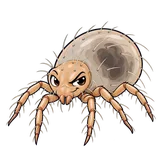
You are probably looking at a tiny, bright red speck moving with surprising purpose across a sun-warmed patio or a stretch of driveway. To the naked eye, it is little more than a moving dot of pigment. If you pull out a standard hand lens offering 10x magnification, you might make out an unsegmented arachnid body plan, meaning the head, thorax, and abdomen are fused into a single oval mass. They lack wings entirely, just like all members of their class, and they have no antennae.
Identity
Strictly speaking, the scientific name often tossed around for these backyard wanderers does not appear in standard environmental reference libraries, leaving a distinct gap in formal taxonomic metrics. When scientists evaluate tiny red mites collected from masonry and sunlit hardscapes, they often find a mix of harmless plant-feeders and opportunistic predators rather than a single neatly defined species.
To tell them apart from other tiny critters, look at the legs and behavior. Unlike insects, which wear six legs and distinct body segments, adult mites possess eight jointed legs. If the speck is less than zero point two millimeters long and has only six legs, you are likely looking at a newly hatched larva rather than a mature adult. Clover mites share that reddish hue and the habit of crawling over concrete, but they tend to be strictly plant-feeders that leave a green or red smear if crushed, whereas other environmental mites are predatory or parasitic.
Habitat & behaviour
These creatures love thermal mass. They show up on sun-baked concrete, brick walls, rock gardens, and stone pavers, especially during the warmer stretches of spring and summer. They are driven by temperature and light, seeking out the radiant heat bouncing off masonry surfaces where they can bask or hunt for tiny prey.
They do not build nests, and they do not spin webs. Instead, they wander across hardscapes as solitary arachnids, picking their way through the microscopic crevices of concrete and mortar joints. When the sun dips low or temperatures spike toward uncomfortable extremes, they tuck themselves away into narrow expansion joints, under loose paving stones, or deep within the rough texture of brickwork.
Wind plays a massive role in their daily drama. Because these mites are exceptionally light, thermal updrafts easily catch them and carry them through the air. It is entirely common for a gust of wind to lift outdoor environmental mites from surrounding trees or masonry and deposit them directly onto exterior walls, where they slip through window screens and end up indoors without ever crawling across the threshold.
Visual variations
Wings are entirely out of the question for mites, as they never develop them at any point in their existence. Their life history unfolds through distinct physical phases, starting from a tiny spherical egg tucked away securely inside a protected masonry crack.
When hatching occurs, the first active stage is the larva, which makes do with just three pairs of legs. After feeding and growing, the mite molts into a nymph, acquiring its fourth pair of legs and looking very much like a miniature version of the adult, just smaller and sexually immature. Adults feature the full complement of eight legs and the characteristic unsegmented body.
Unlike ants or bees, mites have no social structure, so you will never find workers, soldiers, or queens. They live entirely solitary lives. Some related outdoor species exhibit extreme sexual dimorphism, where the pregnant female undergoes massive abdominal expansion to carry her developing brood internally, while the tiny males emerge first to mate and then die without ever taking a meal. On hardscapes, however, most of the wandering red specks you notice are simply active adults or nymphs scouting for a meal or a warmer patch of stone.
Why it matters
Finding a cluster of tiny red specks crawling over your back patio usually means little for your home structural integrity, but it can trigger plenty of unwarranted panic. These outdoor wanderers do not eat wood, chew drywall, or damage electrical wires, so your house framing remains entirely safe from them.
The real confusion happens when people mistake these harmless or predatory wanderers for biting itch mites or bird parasites that drift in from nearby trees or abandoned nests. If you are experiencing unexplained skin irritation, remember that microscopic mites cannot be diagnosed by a description of a mark on your skin. When bites or widespread rashes occur, you should consult a clinician or poison control center rather than trying to match the mark to a bug.
If large numbers of outdoor mites are migrating indoors or you need to separate a harmless plant-feeder from a biting species, a professional pest management technician or a local university extension specialist can examine physical samples under high magnification. Otherwise, their presence on an exterior wall is usually just a brief seasonal event tied to temperature shifts and sun exposure, requiring nothing more than a damp cloth or a garden hose to wash them away from an entryway.
Similar species
 Oak leaf itch mitePyemotes herfsi
 House dust mitesDermatophagoides species
 Bird mitesDermanyssus and Ornithonyssus species
 Tropical rat miteOrnithonyssus bacoti
 Clover mitesBryobia species
 ChiggersFamily Trombiculidae