Firebrat
Thermobia domestica
- Size
- 11 to 15 mm long
- Color
- Mottled brown and gray
- Habitat
- Indoor spaces above 90 degrees Fahrenheit
- Diet
- Starches, paper, and high-protein matter
- Life cycle
- 19 to 43 day egg incubation, continuous adult molting
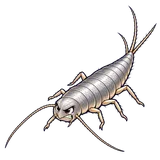
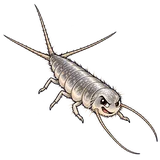
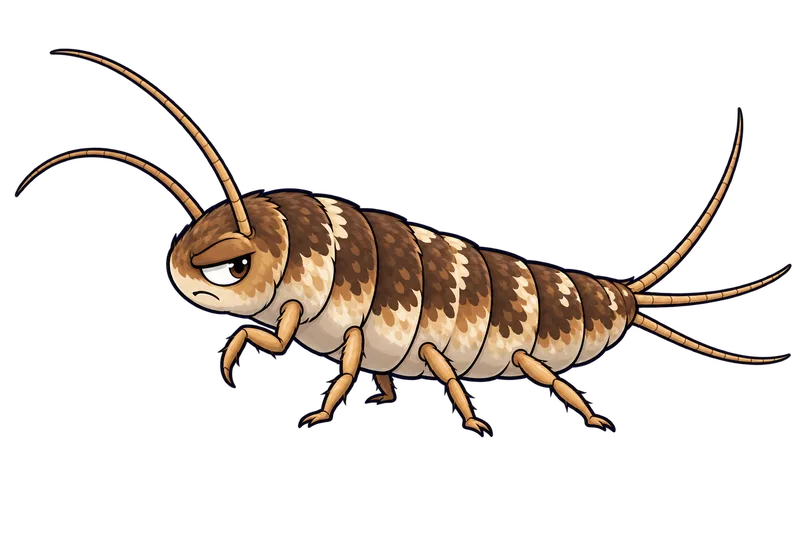
The firebrat, known scientifically as Thermobia domestica, is a wingless insect that looks remarkably like something built out of spare clock parts and dust. Measuring 11 to 15 mm in length, its body is flattened and tapers toward the rear, letting it slip through gaps you would swear nothing could cross. The easiest way to spot one from a short distance is the way it moves, darting across a surface with a sudden, fish-like wiggle when a light clicks on. If you get close enough to squint at it without magnification, you will notice its most defining feature: antennae that stretch out longer than its entire body. Three long, bristle-like tails project from the tip of its abdomen, consisting of two outer cerci and a central median thread. The color is a mottled mix of brown and gray, created by a dense blanket of tiny scales that flake off at the slightest touch. This earthy pattern separates it instantly from the uniform silver shine of the common silverfish. If you mistake it for a silverfish, you are likely looking at the creature in the wrong room. Silverfish prefer the damp chill of a bathroom floor, while firebrats demand genuine heat.
Habitat & behaviour
Finding a firebrat usually starts with a late-night trip to the basement or the utility room, flipping on the overhead light, and watching a strange, scaly shape scramble away from a warm appliance. These insects are strictly nocturnal and intensely photophobic, meaning they spend daylight hours tucked deep inside dark, tight cavities. They are what biologists call thermophilic, which is a polite way of saying they love extreme heat. While most household pests wilt in hot conditions, firebrats thrive in ambient temperatures exceeding 90 degrees Fahrenheit. You will find them gathered around the base of furnaces, inside boiler rooms, along steam pipes, tucked into hot water heater closets, or baking beneath roofing shingles in poorly ventilated attics. Their attraction to these zones is all about microclimate and survival. They eat starchy materials, paper, bookbindings, and even high-protein items like dead insects or pantry crumbs, but they can also go weeks without food if the temperature is right. They do not wander out into the open unless something disturbs their harborage or their population gets crowded enough to spill over into adjacent rooms.
Visual variations
Firebrats keep the same basic shape from the moment they hatch until the end of their multi-year lifespan, as they undergo a very straightforward, primitive style of development without any dramatic metamorphosis or pupal stage. Eggs are tiny, oval, and whitish when laid, tucked away in batches of about 50 inside deep, warm crevices. When a nymph finally emerges, it looks like a miniature, pale replica of the adult, minus the scales. It is smooth and almost translucent at first. As it feeds and grows, shedding its skin through a long series of molts, those brown and gray scale tufts gradually develop across its back. Unlike many other insects, firebrats never grow wings at any stage in their lives. They do not have castes or social hierarchies either, preferring a solitary or loosely aggregated life rather than working together in a colony. Males and females look nearly identical at a casual glance, but a closer look at the rear reveals subtle clues. Females carry a distinct, elongated ovipositor projecting from the underside of the abdomen, which they use to guide eggs into tight gaps. Males lack specialized internal copulatory organs, relying instead on an indirect courtship dance where they deposit a silk-wrapped sperm packet for the female to retrieve.
Why it matters
Spotting a firebrat in your home means you have a localized hot spot where high temperatures and starchy food sources intersect, though it rarely signals a structural disaster. Their feeding habits cause slow, cosmetic surface damage to paper, wallpaper paste, cereal boxes, and starched textiles, leaving behind irregular etched patches rather than gaping holes. They cannot chew through wood framing, electrical wiring, or modern building materials. They do not bite, sting, or carry disease pathogens, and they pose no threat to household pets. However, in heavy infestations, the accumulation of shed skins and waste particles can sometimes trigger allergies or irritate asthma in sensitive individuals.