
Silverfish vs firebrats: what environment helps distinguish them?
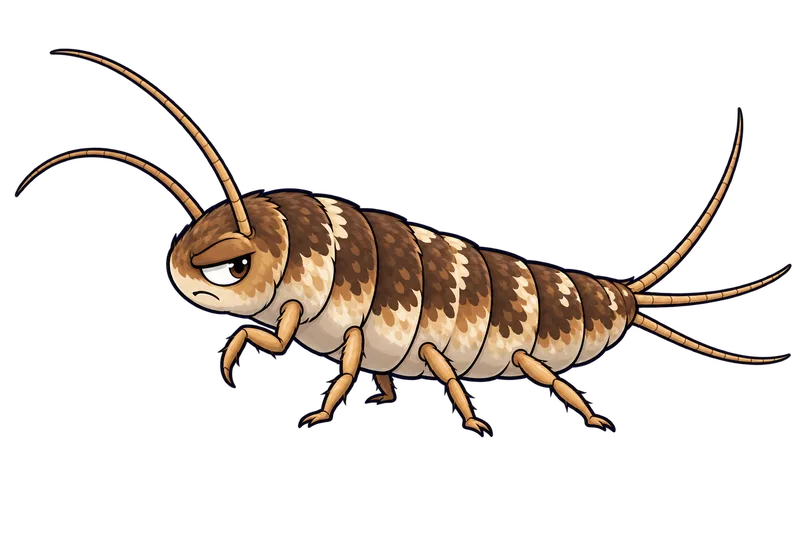
The environment helps distinguish common silverfish and firebrats because common silverfish thrive in cool, highly humid locations like basements, whereas firebrats strictly require high-temperature microenvironments above ninety degrees Fahrenheit near furnaces or boilers. Temperature and dampness tell the whole story since these insects are physiologically tied to their specific microclimates.
What is actually going on
You walk down to the basement on a Tuesday night to switch out the laundry, flip on the overhead light, and spot a fast-moving, flat, metallic insect darting across the concrete floor right into a dark gap near the baseboard. You might wonder if you are dealing with a standard silverfish or something that prefers a completely different kind of climate. The short answer is that the environment tells the whole story. Common silverfish thrive in cool to ambient, highly humid locations like basements, bathrooms, and crawl spaces, whereas firebrats strictly require high-temperature microenvironments above ninety degrees Fahrenheit near furnaces, boilers, ovens, and steam pipes.
Picture two roommates with opposite climate preferences who refuse to share a thermostat. A common silverfish is the roommate who wants the unheated cellar kept cold and dripping with moisture, usually needing a relative humidity between seventy-five and ninety-five percent to feel at home. A firebrat, on the other hand, is the heat seeker that packs its bags and moves directly into the boiler room or the small cavity behind the kitchen oven, refusing to reproduce or grow unless the air stays seriously hot.
You might object that both bugs look remarkably similar at a glance, so how can temperature and dampness alone tell you what you are looking at. The reason this works is that these insects are physiologically tied to their microclimates. Their soft bodies and moisture-dependent needs leave them stranded. If you find a wingless, fast-skittering pest roaming a damp, unheated basement floor, it is almost certainly a silverfish. If you pull off the access panel to a water heater closet and spot one sprinting away from the pilot light, you are looking at a firebrat.
How to tell for sure
At-home eye observation usually starts with where you found the creature, but you can back that up with a quick look at its colors and physical build. Common silverfish usually feature uniform, lustrous, silvery-metallic scales that look a bit like tiny fish scales or metallic sequins, and their antennae are about equal to their total body length. Firebrats usually feature a mottled appearance created by patches and tufts of brown and grey scales, giving them a dusty, salt-and-pepper look, and their antennae extend noticeably longer than their bodies.
You also have to keep an eye out for a third player that likes to blur the rules, which is the grey or long-tailed silverfish. Unlike the common basement variety, this larger cousin is drier-tolerant and loves modern centrally heated homes. It will happily roam across dry living room carpets, hallway floors, and upper bedrooms where the air sits well below sixty percent relative humidity.
If you want to move past a rough guess, a ten-times magnification hand lens helps you look closer at the scale tufts and bristle structures along the back. However, when you need absolute certainty on the exact species inside a commercial building or an unusual room, specialist specimen or DNA analysis is usually necessary. If you are worried about bites or skin marks, remember that these insects do not bite humans or transmit disease pathogens, so you should refer any unexplained skin lesions or allergic symptoms to a medical professional.
What usually comes next
The single most practical decision you can make once you identify the pest is to fix the underlying climate of the room rather than running out for a can of bug spray. If you are dealing with silverfish in a damp basement, your main weapon is a dedicated dehumidifier set to keep the relative humidity below fifty percent, which effectively halts egg development and stops reproduction in its tracks. If you are dealing with firebrats near a heating unit, you need to eliminate excess heat sources, repair damaged pipe insulation, and improve ventilation around the boiler enclosure.
Chemicals alone will not solve the problem if the room stays damp or blistering hot, because new populations will just move right back in to take the place of the old ones. Along with managing the temperature or humidity, clearing out cardboard storage boxes that trap moisture and replacing them with sealed plastic bins cuts off their favorite food sources and hiding spots. Vacuuming baseboards regularly with a high-efficiency particulate air vacuum also sweeps away leftover starches, cast-off skins, and dust that keep them fed.
When to get help
There are times when do-it-yourself adjustments are not enough, and you need to bring in outside expertise to handle the situation safely and correctly. You should call a pest control professional when infestations persist despite active dehumidification, or when widespread grey silverfish populations require specialized crack-and-crevice baiting strategies across an entire modern home. A licensed pesticide applicator is required whenever restricted-use insecticides, commercial building perimeter barriers, or complex structural treatments are necessary under local regulations.
You should also consult an archival conservator when valuable historical documents, rare books, or museum textiles show active feeding damage, because standard household pest control measures can easily ruin delicate artifacts. Finally, persistent silverfish or firebrat activity often acts as a reliable alarm bell for chronic structural moisture, which frequently invites toxic indoor mold growth and wood decay. If you experience persistent mold concerns, severe allergic reactions, or respiratory distress from insect dust accumulations, contact a clinician or healthcare provider right away.