Common silverfish
Lepisma saccharinum
- Size
- 7 to 10 mm
- Color
- Silvery-metallic light to dark grey
- Habitat
- Damp, cool indoor areas like basements and bathrooms
- Diet
- Starches, sugars, cellulose, and high-protein matter
- Life cycle
- 2 to 3 years average lifespan
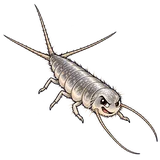
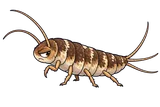
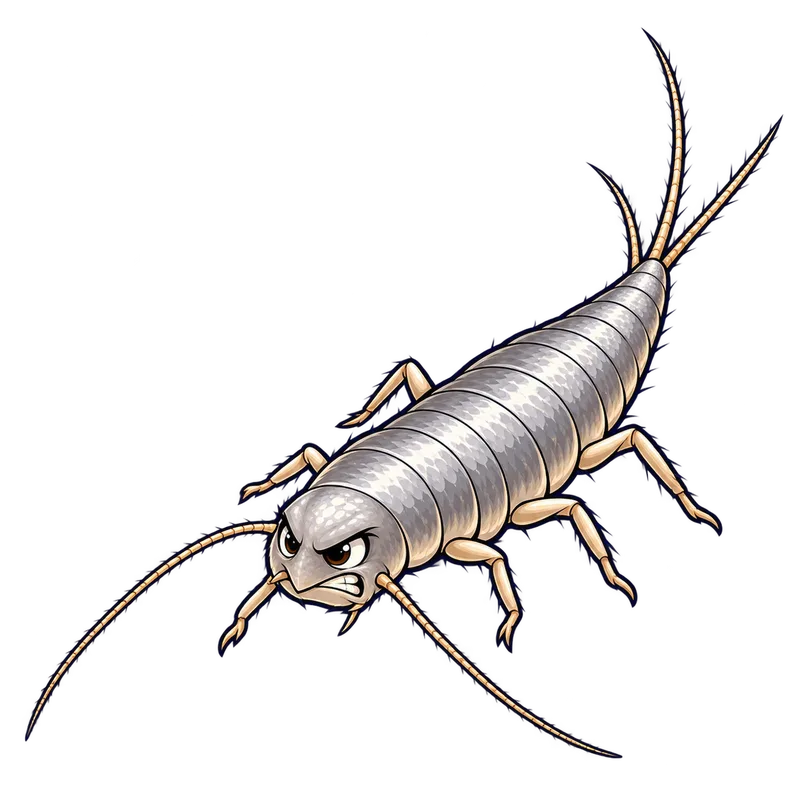
The common silverfish is a primitive, wingless insect that you usually spot skittering across a bathroom floor or darting out from a dark stack of old cardboard boxes in the basement. Adults measure between 7 and 10 mm in length from the head to the tip of the abdomen, though some extension sources note individuals reaching up to 12 mm, and British literature records overall lengths up to 15 mm when including the tail filaments. Their most striking feature is a dense covering of delicate, overlapping scales that give the body a metallic, silvery-grey sheen. If you happen to trap one under a glass, you will notice a teardrop or carrot-shaped body that is flat enough to slip into hairline cracks between baseboards and drywall.
Identity
At the rear end, three long, thread-like appendages extend from the eleventh abdominal segment. Two lateral cerci angle outward, while a central median caudal filament points straight back. The head features two long, thread-like antennae that match or slightly exceed the body length, alongside two small compound eyes that are widely separated. You will not find any ocelli, which are simple eye spots, distinguishing them from other insects. When you try to pick one up, those silvery scales rub off immediately on your fingers like fine dust, leaving behind a dull body.
Habitat & behaviour
Silverfish are strictly nocturnal and intensely photophobic, meaning they scramble for the nearest dark shadow the moment you flip on a light switch. Their movement is a rapid, side-to-side wiggling dart that looks remarkably like a tiny fish swimming through air, which is how they earned their common name. They require high ambient relative humidity, thriving best when moisture levels sit between 75% and 95%. If the humidity drops below 50% or 60% for very long, both adults and nymphs dry out and die, and egg development halts entirely.
You will find them concentrated in cool, damp microclimates such as crawl spaces, unfinished basements, around plumbing penetrations, behind bathtubs, and under laundry room sinks. Indoors, they feed on starches and carbohydrates. They produce their own digestive enzymes to break down pure cellulose, allowing them to eat paper, book bindings, wallpaper paste, and starched fabrics. They also seek out proteins like dead insects, glue, and occasionally pet food. While they can survive for weeks without food, and sometimes over a year if liquid water is available, they cannot reproduce or survive long-term in dry, modern, centrally heated rooms.
Visual variations
You will not find wings at any stage of their life cycle, since silverfish belong to an ancient, wingless group of insects that never bothered to evolve flight. Newly hatched nymphs appear as tiny, pale, whitish ghosts of the adults, entirely missing the metallic scales and darker coloring that show up later. As those nymphs grow up, they push through a series of molts. Unlike most insects, silverfish keep on molting even after they reach adulthood, shedding their skins across a lifespan that usually runs from 2 to 3 years, and can stretch to 8 years when conditions are just right.
Sexual differences are subtle and take a close look to spot. You will not find social castes here the way you would with ants or termites. Females carry a distinct, hardened tubular organ at the rear of the abdomen for laying tiny, oval, whitish eggs deep inside narrow cracks or between paper folds. Males skip this structure and rely instead on a slow courtship dance where they spin a silk thread and leave behind a sperm packet for the female to track down and pull into her body.
Why it matters
Spotting a silverfish in your house is usually just an aesthetic nuisance instead of a structural emergency. They lack any ability to chew through house framing, drywall, electrical wiring, or modern plastics, meaning your home is safe from the sort of destruction termites bring. Their mouthparts are built for scraping rather than tunneling, so any harm to your belongings happens slowly and only on the surface. Left alone in damp spaces over long stretches, they might graze on vintage starched clothing, old wallpaper paste, book bindings, and gelatin-based photographic prints. Modern digital pictures, synthetic clothes, and clean modern fabrics get completely ignored.
As for health, silverfish never bite, sting, or spread diseases, and they carry no venom or irritating body fluids. During massive, long-running infestations, the buildup of shed skins and waste can sometimes add to indoor dust allergies, but casual encounters bring zero medical risk. Finding a silverfish simply acts as a living warning light telling you that a particular corner of your house has a moisture problem that needs your attention.