
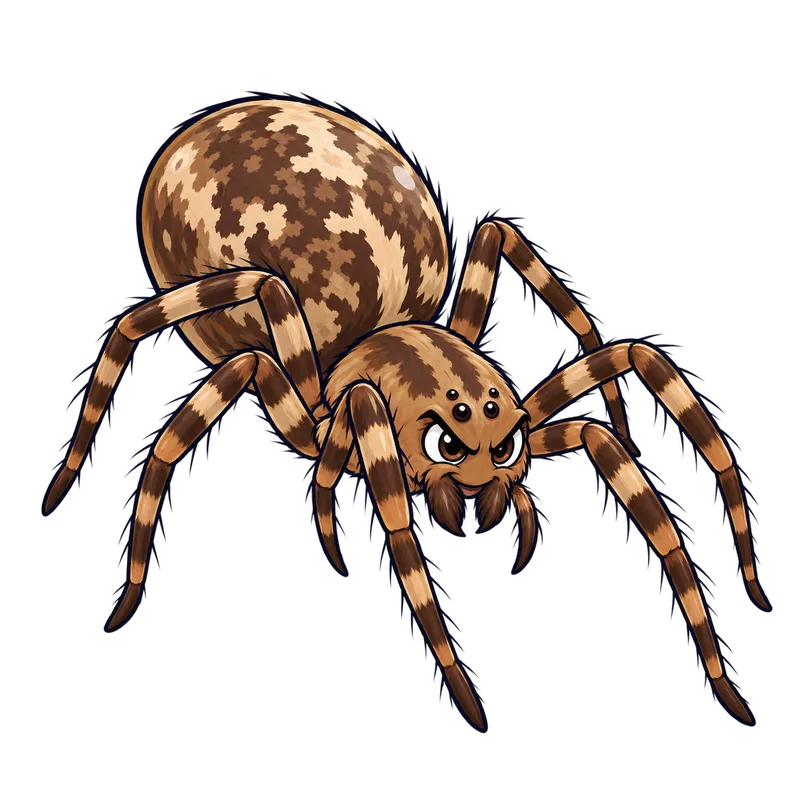
Common house spider
Parasteatoda tepidariorum
- Size
- Not established
- Color
- Not established
- Habitat
- Dark and sheltered indoor spaces
- Diet
- Insects and small arthropods
- Life cycle
- Not established
You are likely looking at Parasteatoda tepidariorum when you spot a medium-sized arachnid hanging upside down in the dim corner of your basement or tucked up against the frame of an unused window. Because exact millimeter dimensions for this species are absent from standard source profiles, sizing it requires comparing its general build to other common indoor crawlers. It belongs to the comb-footed spider family, meaning it shares the classic arachnid blueprint of eight jointed legs attached to a cephalothorax, which connects by a narrow waist to an unsegmented, high and globular abdomen. It lacks wings entirely, as all spiders do at every stage of their lives.
Identity
To the naked eye at a distance of a few feet, you will notice its habit of swaying in a messy, three-dimensional web rather than running across the floor like a wolf spider. If you bring a 10x magnification hand lens closer, you can pick out the tiny comb-like bristles on its hind legs that give the family its name, along with an arrangement of eight eyes grouped tightly on the front of the head. That eye count matters because it immediately rules out six-eyed wanderers like the brown recluse.
Habitat & behaviour
This species prefers the quiet, undisturbed corners of human structures where air currents are low and prey is steady. You will find them in attics, crawl spaces, wall voids, garages, and behind heavy furniture. They do not wander across carpets to hunt. Instead, they invest their time in building irregular, tangled webs designed to snag anything foolish enough to fly or crawl into their territory.
What pulls them indoors is usually a drop in autumn temperatures. As the outdoor air cools, these spiders slip through tiny structural gaps and settle into the climate-controlled shelter of a home, where they can remain active through the winter months. They are remarkably timid and reclusive. When a broom brush brushes too close or a hand moves near the web, the spider's first instinct is to drop out of the web or retreat into a dark crevice, not to stand its ground.
Visual variations
Spiders do not form social colonies with worker or soldier castes, meaning every individual you encounter operates as a solitary hunter living out its own independent life. Throughout its development, the creature goes through a series of molts, stepping entirely out of its old skin several times before it finally reaches full adult size. Young spiderlings emerging from their silken egg cases frequently display lighter or more translucent color patterns that steadily darken as they mature into adults.
When you look at an adult male and female next to each other, the visual differences show up mostly in the shape of the abdomen and the front appendages. Females carry a much deeper, rounder, and more voluminous abdomen built specifically for holding eggs, while males remain noticeably smaller and narrower. Males also sport longer legs relative to their overall body size and feature visibly swollen tips on their palps, which are the small feelers near the mouth used during mating. Wings are entirely absent across all of these variations and throughout every single life stage.
Why it matters
Finding a common house spider in your living space simply means you have a quiet tenant that feeds on nuisance insects like flies and mosquitoes, acting as a natural pest control agent without costing a dime. They cause zero structural damage to wood, wiring, insulation, or indoor plants. Their presence poses virtually no risk to human health, as they are not medically significant creatures and their venom is remarkably mild.
A bite happens almost exclusively when a spider is trapped directly against human skin, such as being squashed inside a shoe or caught tightly in folded bedding. If you happen to feel a nip, it typically results in nothing more than minor localized pain, slight redness, or mild swelling that clears up on its own within a day or two. For any bite that causes unusual, spreading, or severe symptoms, or if you simply cannot be sure what caused a skin wound, reach out to a healthcare professional, urgent care clinic, or your local Poison Control center at 1-800-222-1222.
The most common point of confusion involves telling this species apart from the black widow or the brown recluse. Black widows are shiny black with a distinct red or orange hourglass on the underside of their rounded abdomen, a warning marking completely absent on the common house spider. Brown recluses feature a uniform light brown body marked with a dark violin shape on the head and possess six eyes instead of eight. Yellow sac spiders are paler, greenish-yellow, and build silken tube retreats in wall corners rather than messy tangle-webs. None of these look-alikes share the same gentle disposition as the common house spider hanging quietly in your basement.
Similar species
 Wolf spidersFamily Lycosidae
 Jumping spidersFamily Salticidae
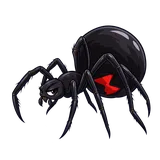 Southern black widowLatrodectus mactans
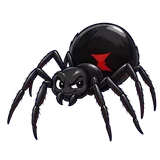 Western black widowLatrodectus hesperus
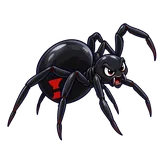 Northern black widowLatrodectus variolus
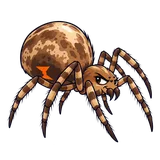 Brown widowLatrodectus geometricus