
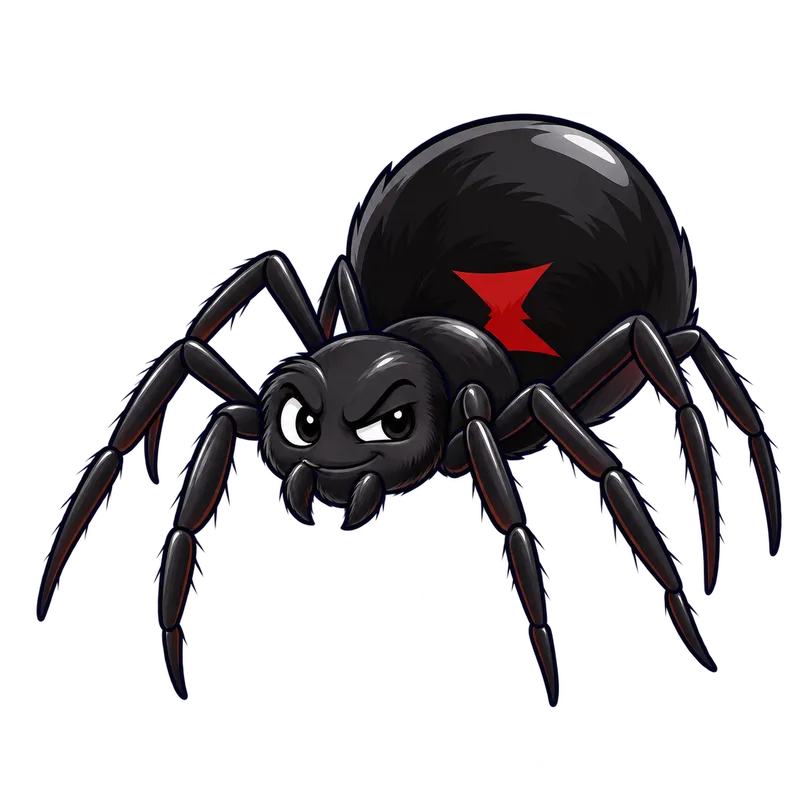
Western black widow
Latrodectus hesperus
- Size
- 3 to 13 mm long
- Color
- Jet-black or dark gray with red markings
- Habitat
- Dark outdoor spaces and unheated structures
- Diet
- Small insects captured in tangle webs
- Life cycle
- Egg to adult in approximately 1 year
The Western black widow is instantly recognizable once you know where to look, though you rarely need a magnifying glass to do it. The mature female is a heavy-bodied creature measuring 8 to 13 mm in length, sporting a high-gloss, jet-black, globular abdomen. Turn her over, and you will find the famous diagnostic mark: a bright red, orange, or yellow-orange hourglass, sometimes appearing as two point-to-point triangles or a single dot, stamped right onto her ventral surface. The dorsal back remains a smooth, unpatterned, glossy black. Males are much smaller, scaling in at 3 to 6.5 mm, and feature an elongate brown or black body decorated with white, red, or orange streaks and spots. People frequently confuse these spiders with the false black widow, a common cellar dweller that shares the same dark, globular shape and messy cobweb habits. The easiest way to tell them apart without getting too close is the belly. The false black widow completely lacks the red ventral hourglass. You might also mistake them for the brown recluse in regions where their ranges overlap, but recluses are light brown to tan with a violin-shaped mark on the head and six eyes arranged in pairs, unlike the eight eyes and dark, shiny silhouette of the widow. Yellow sac spiders and hobo spiders also cause brief moments of panic in dark corners, but neither possesses the glossy black finish or the telltale red marking underneath.
Habitat & behaviour
Finding one of these spiders usually involves reaching into a dark, forgotten corner of the garage or shifting a stack of firewood that has sat undisturbed since last autumn. They are obligate insectivores that rely on flying and crawling bugs stumbling into their domain, which explains their choice of real estate. Outdoors, they favor secluded microhabitats near the ground. Look beneath stones, inside hollow tree stumps, under timber decks, inside rodent burrows, around water meter boxes, and beneath building eaves. Indoors, they retreat to cluttered, unheated basements, crawl spaces, utility closets, and garages. They build an irregular, three-dimensional, non-symmetrical tangle web measuring about 1 foot in diameter. These messy, crisscrossing comb-footed webs lack the neat geometry of an orb weaver, functioning instead as a structural net designed to snag passing beetles, flies, and mosquitoes. Activity picks up as temperatures climb past 70 degrees Fahrenheit. When autumn arrives and the air cools, these spiders frequently seek thermal shelter inside human structures, migrating from outdoor woodpiles into the warm gaps of foundation walls and garage corners. Despite their fearsome reputation, they are timid, nocturnal, and resolutely reclusive. When disturbed, they typically drop from the web or retreat rather than attack.
Visual variations
As arachnids, these spiders have no wings at all, moving entirely on foot or by casting silken threads into the wind as tiny spiderlings to travel. They also have no social structure, living entirely alone until mating season forces a brief meeting. Growing from an egg to a fully formed adult brings dramatic shifts in color and markings. A female begins life inside an off-white, round to oval silk egg case built through spring and summer. One female can spin up to 21 of these cases in her life, holding several hundred eggs inside each that hatch after 8 to 30 days. When the young emerge, they bear no resemblance to the adult female. Freshly hatched spiderlings feature light orange, white, gray, or brown bodies marked by bright red, yellow, or orange stripes and spots across the back. Through 4 to 9 molts over summer and autumn, these bright juvenile patterns slowly disappear. The body grows darker with each shed skin, leading to the distinct differences between adult males and females. Mature females take on their solid, shiny black look with the red belly mark, while males keep their smaller frames, stretched brown or black bellies, and patterned backs. The male jaws and fangs stay very small and usually cannot pierce human skin.
Why it matters
Finding a Western black widow near your living space means you share a yard with a strong venomous hunter, though meetings are completely accidental. Bites almost always happen by accident when someone presses or traps a spider against bare skin inside a shoe, a shirt, a garden glove, or a box, or when a female guards her egg case. The venom holds strong nerve toxins called latrotoxins that impact the nervous system of mammals. A bite usually begins with a sharp prick like a pin, followed by mild local redness and one or two tiny puncture spots. Within 30 minutes to 2 hours, widespread symptoms known as latrodectism can set in, bringing deep radiating pain, strong muscle cramps, and a rigid stomach. Unlike urban legends, the venom of a black widow is purely a nerve toxin and never causes rotting skin, open sores, or tissue death. If a bite occurs, clean the area well with soap and water, place an ice pack or cold cloth over the spot, raise the limb, and check your tetanus shot records. Anyone dealing with spreading pain, severe muscle spasms, trouble breathing, or whole-body symptoms needs to get checked right away at an emergency room or urgent care facility, or call Poison Control. A specific horse-derived antivenom exists for severe cases treated in a hospital. When dealing with these spiders, proper identification is required before trying any manual removal or cleanup steps like clearing old boxes or sealing foundation gaps. If you plan to use chemical treatments around foundations or crawl spaces, a licensed pesticide applicator must apply the product strictly following the label instructions.
Similar species
 Northern black widowLatrodectus variolus
 Brown widowLatrodectus geometricus
 Brown recluseLoxosceles reclusa
 Mediterranean recluseLoxosceles rufescens
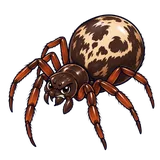 Noble false widowSteatoda nobilis
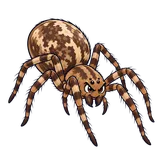 Common house spiderParasteatoda tepidariorum