
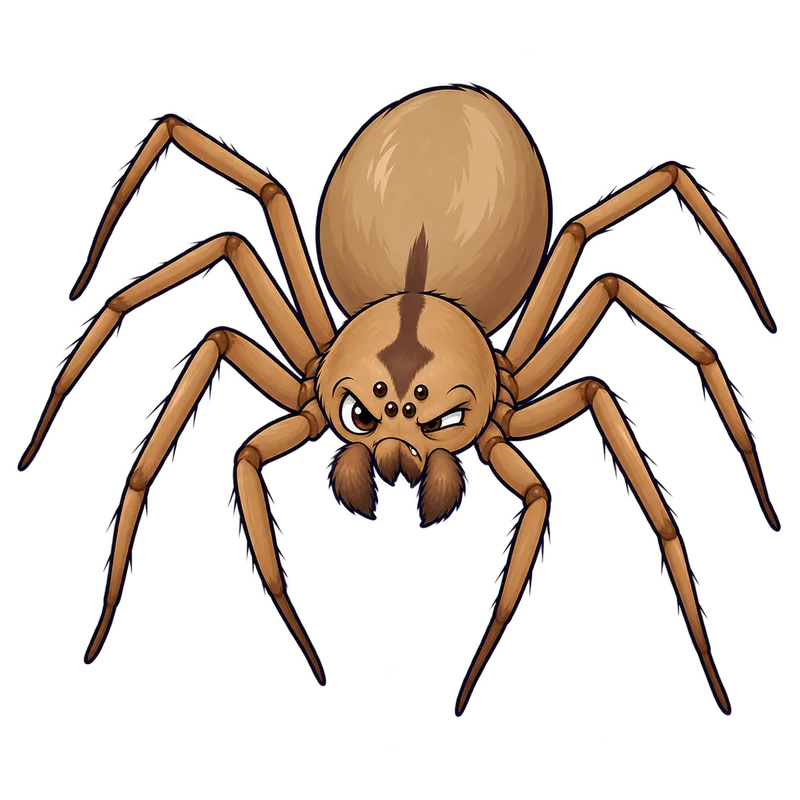
Brown recluse
Loxosceles reclusa
- Size
- 1/4- to 3/4-inch body length
- Color
- Yellowish-brown to grayish-brown with dark violin mark
- Habitat
- Dark, undisturbed indoor spaces and outdoor debris
- Diet
- Insects attracted to structures
- Life cycle
- Up to 2.5 years of adult longevity
The brown recluse is not a monster waiting to jump out from behind the wallpaper, though its reputation suggests otherwise. It is a shy creature that prefers the back corners of your basement over a confrontation. Identifying one starts with looking at its face rather than its body, though you will want a magnifying glass or at least good lighting to do it safely. Most spiders carry eight eyes, but the brown recluse sits in a very small club of arachnids with only six eyes. They are arranged in three pairs, known as dyads, spaced slightly apart on the front of the head.
Identity
Right behind those eyes sits the famous dark brown violin-shaped marking on the cephalothorax, which is the fused head and chest section. The neck of that fiddle points backward toward the abdomen. Be careful not to assume every spider with a mark on its back is a recluse, since plenty of harmless cellar spiders and orb-weavers carry confusing patterns. The legs give you another clue: they are uniformly light brown, completely smooth, and lack the dark bands or stiff spines you see on many other common house spiders. The abdomen is a solid, dull shade of tan or grayish-brown, covered in a fine layer of short hairs without any stripes, spots, or chevrons breaking up the monotony.
Habitat & behaviour
If you are bumping into these spiders, you are usually looking in places humans rarely visit. Outdoors, they hide under woodpiles, beneath heavy rocks, inside old logs, and deep within dense piles of yard debris. Indoors, they favor the quiet gloom of crawl spaces, unfinished attics, dark closets, and the spaces behind heavy furniture. They spin loose, flat, sheet-like webs that look more like untidy scraps of silk than the neat geometric wheel webs you sweep off your porch.
They are strictly nocturnal hunters. When the sun goes down, they leave their daytime retreats to wander in search of small insects. They do not chase down prey across open floors for sport, preferring a sit-and-wait strategy or short, deliberate stalks in the dark. Infestations in homes usually start when a box or piece of furniture is moved from an infested garage, shed, or storage unit straight into a living area, bringing the resident spiders along for the ride. Native populations center throughout the southern and midwestern United States, and these spiders do not live in Washington State, Oregon, or northern California.
Visual variations
Adult brown recluses are entirely wingless, so you will never watch one take flight across the room no matter how startled you might be. Males and females share the same dull coloration, the six eye arrangement, and the signature fiddle mark, keeping the sexes looking almost identical unless you put them under a microscope.
Young spiderlings look quite different from their parents when they first hatch. A tiny spiderling emerging from its silken egg case does not yet carry the dark violin marking on its back. That fiddle pattern is missing entirely at birth and develops gradually through successive molts as the spider grows toward adulthood. Recluses do not build colonies, so you will never dig up workers, soldiers, or queens dividing up tasks. They are solitary hunters from the moment they hatch, tolerating each other only long enough to mate.
Why it matters
A brown recluse cannot bite you through open air or lunge at your hand from across a shelf. Their fangs are quite small, meaning they can only deliver venom if they are accidentally trapped hard against human skin. That usually happens when pulling on a pair of heavy boots left undisturbed in the garage, reaching deep into a cluttered storage box, or rolling over on a spider trapped in the bed sheets.
The bite itself often feels like a mild pinprick or goes entirely unnoticed at first. Within an hour, localized pain, redness, and swelling can set in, sometimes developing a small white blister. The vast majority of bites heal completely within eight weeks without any dramatic complications. The dreaded tissue breakdown, where skin decays into an open sore, actually occurs in less than 10 percent of all bites. Most skin lesions attributed to spiders are actually bacterial infections, such as MRSA, or other medical issues, and a photograph or skin wound alone can never confirm a spider species. If you suspect a bite, wash the area with soap and water, apply a cold pack, elevate the limb, check your tetanus status, and call the Poison Center Helpline at 1-800-222-1222 for immediate guidance. Positive physical identification by an expert is required before undertaking chemical treatments, and product labels govern all pesticide applications while decisions regarding restricted chemical treatments belong exclusively to a licensed applicator.
Similar species
 Mediterranean recluseLoxosceles rufescens
 Noble false widowSteatoda nobilis
 Common house spiderParasteatoda tepidariorum
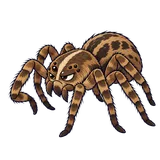 Wolf spidersFamily Lycosidae
 Jumping spidersFamily Salticidae
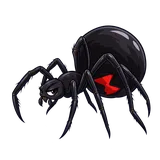 Southern black widowLatrodectus mactans