
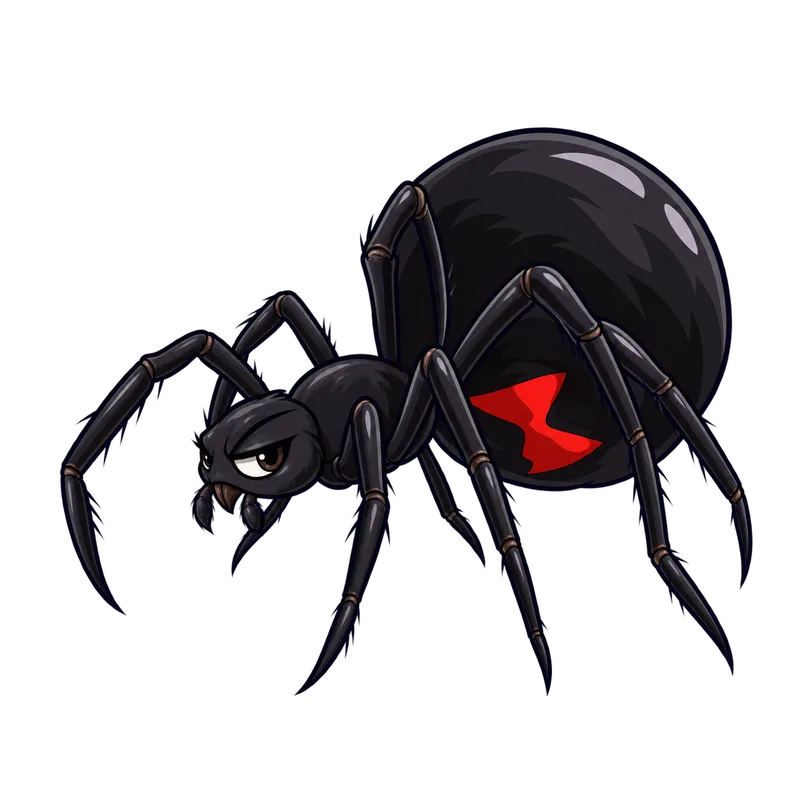
Southern black widow
Latrodectus mactans
- Size
- 8 to 13 mm (females), 3 to 4 mm (males)
- Color
- Glossy jet-black with a red or orange ventral hourglass
- Habitat
- Dark, sheltered microhabitats indoors and outdoors
- Diet
- Insects captured in coarse, tangled webs
- Life cycle
- Spring egg deposition, 4 to 9 nymphal molts
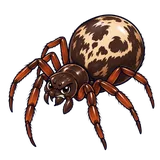
The southern black widow is unmistakably glossy, sporting a deep jet-black body that catches the light like a polished stone. Female body length spans 8 to 13 mm, excluding a leg span that easily fills the palm, while males stay much smaller at 3 to 4 mm. Turn a mature female over, and you will see the classic bright red or orange hourglass marking stamped onto the underside of her globular abdomen. That ventral mark can range from a crisp, connected hourglass shape to two separate triangles or even a single red dot. The upper surface of her abdomen remains entirely solid black without dorsal spots. By contrast, young spiderlings and immatures wear a gray or brown coat peppered with white, orange, and yellow stripes and spots, slowly shedding those juvenile colors through 4 to 9 molts until they darken into their adult black armor.
Identity
People often mix up the southern black widow with its northern cousin, Latrodectus variolus. The northern variety usually sports a split or broken hourglass on its belly alongside a neat row of red spots marching down the top midline of its back, a pattern the southern species skips entirely. False black widows, which belong to the genus Steatoda, also cause confusion because they are dark, shiny, and round. However, false black widows completely lack bright red or orange hourglass markings on their underside. If you look closely at the front of a false black widow, its body segments form a distinct side view resembling the letter D, which sets it apart from the smooth, globular profile of a true widow. The brown recluse is another frequent suspect when people find bites, but it looks entirely different: it is uniformly tan or brown with six eyes arranged in pairs and a dark violin shape on its back, whereas the black widow has eight eyes, builds irregular three-dimensional webs, and wears that unmistakable glossy black coat.
Habitat & behaviour
When outdoor temperatures climb past 70 degrees Fahrenheit, these spiders become active, preferring warm months for hunting and web building. They construct a coarse, tangled, non-symmetrical web about 1 foot across in dark, hidden corners. Outdoors, you will find those webs tucked beneath stones, stacked inside firewood piles, tucked into hollow tree stumps, or hidden inside water meter boxes and under building eaves. Indoors, they seek out dry, undisturbed clutter, making homes in basements, crawl spaces, unheated garages, sheds, and attics.
They are strictly nocturnal and intensely reclusive creatures. They spend their days tucked deep within the shelter of their web retreats, waiting for wandering insects like flies to stumble into the sticky silk threads. They are anything but aggressive. When someone accidentally disturbs a web, the spider's first instinct is to scramble backward into a hiding spot rather than attack. Bites almost always happen because a spider was trapped or pinched directly against human skin, such as when someone reaches blindly into a dark corner, grabs an uninspected cardboard box, or slides their bare foot into a work boot left out in the garage.
Visual variations
Spiders do not have wings, so you will never see a flying widow crossing your path. Instead, distinct differences show up clearly between the sexes and across developmental stages. A mature female is built like a heavy, glossy sphere with long, spindly legs and strong fangs capable of piercing human skin. An adult male is about half her size, much slenderer, browner, and far less globular, featuring red or white spots on his abdomen and fangs too small to pose a medical threat to humans.
The life cycle starts in spring when a female produces up to 21 silken, spherical egg sacs, each holding a few hundred eggs. Inside that protective silk casing, the eggs incubate for 8 to 30 days before tiny spiderlings emerge. Freshly hatched spiderlings are orange, white, or light gray with bold dorsal stripes. As they feed and grow through their successive molts over the spring and summer, their bodies gradually darken. By the time they reach maturity, they have traded their colorful juvenile patterns for the solid jet-black finish of the adult stage, ready to overwinter in sheltered cracks and emerge the following spring.
Why it matters
Finding a black widow around your house means you have a top-tier predator quietly eating pest insects near your foundations, but it also brings the risk of a defensive bite. The venom is a potent neurotoxin that causes a condition known as latrodectism, which triggers intense muscle cramps, abdominal pain, sweating, and nausea within hours of a bite. Despite common folklore, black widow venom is not a cytotoxin, meaning it does not cause local tissue necrosis, rotting skin, or open ulcers. Unexplained skin sores are almost always caused by bacterial infections like staph or by other environmental factors, not spider bites.
If you suspect a black widow bite, wash the area thoroughly with soap and water, apply a cold pack to manage local pain and swelling, and seek immediate medical evaluation by a clinician or your local Poison Control Center at 1-800-222-1222. Never attempt to cut the skin, apply a tourniquet, or try to suck out the venom. Tetanus boosters are also evaluated since puncture wounds carry that risk, and severe clinical cases can be treated with a dedicated equine antivenom under a physician's care. Managing these spiders around structures relies on practical habits, such as wearing heavy gloves when handling firewood, shaking out stored shoes, keeping window screens tight, and using a vacuum or broom to clear webs out of outbuildings before they become established harborages.
Similar species
 Western black widowLatrodectus hesperus
 Northern black widowLatrodectus variolus
 Brown widowLatrodectus geometricus
 Brown recluseLoxosceles reclusa
 Mediterranean recluseLoxosceles rufescens
 Noble false widowSteatoda nobilis