
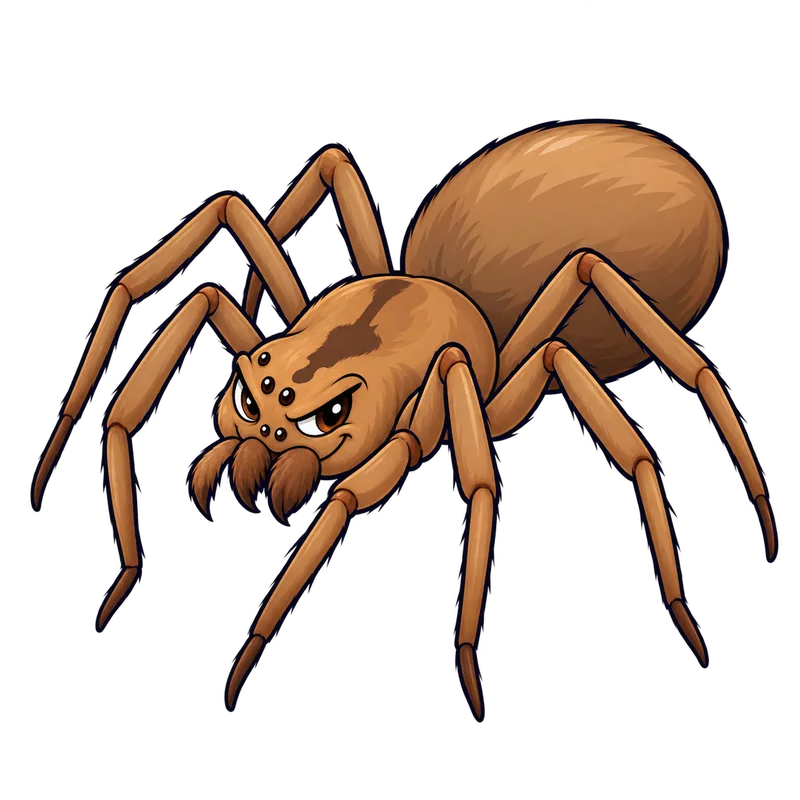
Mediterranean recluse
Loxosceles rufescens
- Size
- 7 to 12 mm body length
- Color
- Yellowish-brown with a dark violin mark
- Habitat
- Dark, dry shelters and indoor wall voids
- Diet
- Crawling insects
- Life cycle
- Up to two and a half years
The Mediterranean recluse is an introduced European species that has quietly made itself at home in parts of the southern United States and urban areas like New York. With an adult body length measuring 7 to 12 mm, or roughly 1/4 to 3/4 inch, these spiders do not look particularly menacing at first glance. Their legs stretch out significantly further than their bodies, which tends to make a wandering specimen look much larger against a baseboard than the measurements suggest.
Identity
Overall coloration ranges from a yellowish-brown to a lighter shade across the cephalothorax and legs, while the abdomen stays a uniform, unpatterned gray-brown or light brown. The most famous calling card is the dark brown, violin-shaped mark resting on the back of the cephalothorax right behind the eyes, with the neck of the violin pointing backward toward the rear of the spider.
To confirm what you are looking at, you will want a hand lens with ten times magnification. Most spiders carry eight eyes, but the recluse family relies on an arrangement of precisely six equal-sized eyes, split into three distinct pairs that form a slight semicircle. At that same close range, you should check the legs. They are uniformly colored and covered in fine hairs, completely lacking the heavy spines or dark banding common on other household wanderers.
Habitat & behaviour
Outdoors, these spiders prefer dark, dry shelter under loose tree bark, deep inside woodpiles, or beneath flat rocks and structural debris. Their active season runs from March through October. Indoors, however, climate-controlled buildings offer steady warmth, meaning populations can stay active year-round in basements, crawl spaces, attics, and wall voids.
They do not spin classic orb webs to catch flying insects. Instead, they build loose, flat sheet webs or simple silk linings tucked away in dark corners. These are strictly used as daytime hideouts and egg-laying stations, not as hunting traps. When night falls, they leave these retreats to hunt crawling insects across floors and walls.
Infestations usually start when a spider or a silken egg sac hitches a ride indoors on cardboard storage boxes, secondhand furniture, or lumber brought up from an infested garage or shed. Despite living in close proximity to people, they are profoundly timid. They possess very small fangs and cannot bite through human skin without mechanical counterpressure. Bites almost always happen because a spider was accidentally trapped against someone's skin inside a shoe, a fold of stored clothing, or the bed sheets.
Visual variations
As arachnids, these spiders lack wings entirely at every stage of their lives. Their physical structure is split into two main sections connected by a narrow waist. The upper section, or cephalothorax, carries the eyes and that distinctive fiddleback pigment pattern, while the oval abdomen remains unsegmented and covered in short, fine pubescence.
Females and males look remarkably similar in color and body plan, though a gravid female carrying eggs will show a noticeably more robust abdomen. Social castes do not exist in this species, as they are solitary creatures that only cross paths to mate.
The life stages bring a notable shift in appearance. Newly hatched spiderlings emerge from off-white, round silken egg cases that measure about 20 to 50 eggs apiece. These young spiderlings start out much paler, and crucially, they completely lack the dark violin mark on their backs. That marking develops gradually through successive molts as the spider grows toward maturity over a lifespan that can reach up to two and a half years.
Why it matters
The presence of Mediterranean recluses in a building means you are sharing space with an animal capable of delivering a cytotoxic venom containing sphingomyelinase D, an enzyme that breaks down mammalian tissue. Yet, density does not equal danger. Hundreds of individuals can inhabit the dark recesses of a warehouse or wall void without a single human encounter if the spiders remain undisturbed.
When a bite does happen, the initial prick is often painless. Within hours, localized pain, swelling, and a small blister can form. While tissue necrosis is heavily associated with these spiders in popular culture, it actually occurs in less than 10 percent of verified bites. Most encounters resolve as minor localized irritation. In rarer cases, systemic symptoms like fever, nausea, or joint pain can develop, which calls for immediate medical evaluation or a call to the Poison Control Helpline at 1-800-222-1222. First aid should stay simple: wash the area with soap and water, apply an ice pack wrapped in cloth, elevate the limb, and ensure your tetanus booster is up to date within the last five to ten years. Never try to cut the wound or suction out venom.
If you are trying to figure out whether a critter in your hallway is a recluse or an innocent bystander, you need to rule out several common look-alikes. Native brown recluses share the same physical traits and require specialist microscopic examination of their genitalia to tell apart from the Mediterranean species. Yellow sac spiders are pale yellow or greenish with darker leg tips, possess eight eyes instead of six, and lack any violin mark while building silken sac retreats in corners. Hobo spiders also have eight eyes, patterned legs, and funnel-shaped webs, and modern research has shown their venom does not cause human skin necrosis. False black widows feature a dark, globular abdomen without a violin mark and eight eyes, while wolf spiders are large, hairy, and active ground hunters with three rows of eyes. Finally, cellar spiders and harvestmen, often called daddy long legs, either lack venom entirely or possess mouthparts too small and weak to threaten humans. Remember that a skin lesion or photograph can never identify a pest; a physical specimen inspected under magnification is the only way to be sure.
Similar species
 Noble false widowSteatoda nobilis
 Common house spiderParasteatoda tepidariorum
 Wolf spidersFamily Lycosidae
 Jumping spidersFamily Salticidae
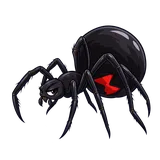 Southern black widowLatrodectus mactans
 Western black widowLatrodectus hesperus