
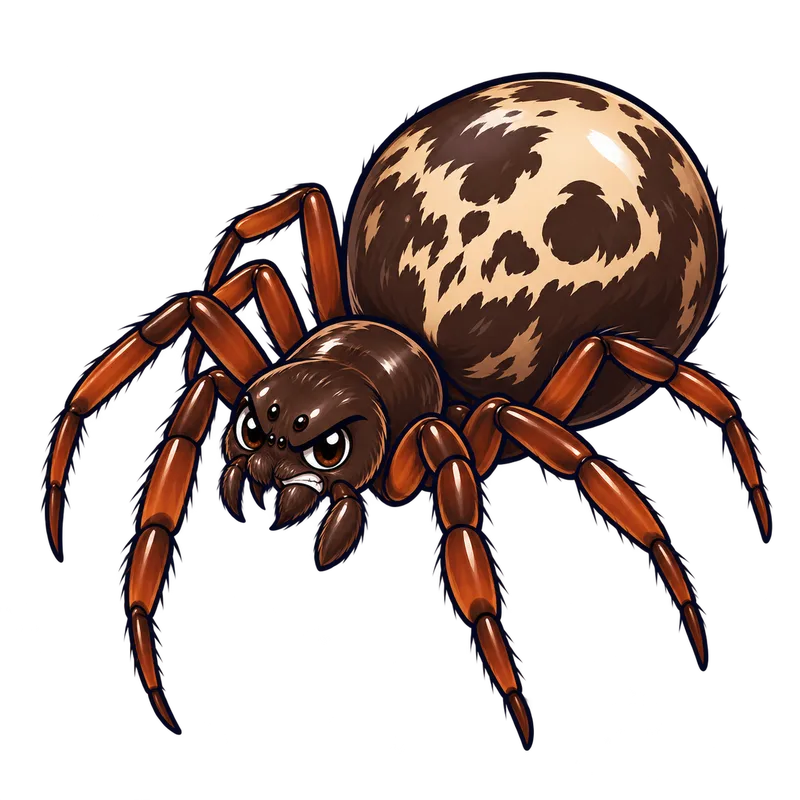
Noble false widow
Steatoda nobilis
- Size
- Not established
- Color
- Dark brown to blackish
- Habitat
- Human structures, sheds, basements, wall voids, and cupboard corners
- Diet
- Insects and other small arthropods
- Life cycle
- Eggs hatch into spiderlings that molt to maturity
You are likely looking into the noble false widow because you found a dark, round-bodied spider tucked into the corner of your garage or near a window frame, and you want to know if it is the dreaded black widow. To the naked eye at a distance of a few feet, the spider presents a globose, dark brown to blackish abdomen and spindly legs. It lacks any red or orange hourglass on its belly, which is your first clue it is not a true widow.
Identity
If you get close enough with good lighting, you will notice the front section of the body holding the legs and eyes has a distinct shape. The rear margin of this section forms a relatively straight line that mirrors the blunt front face of the abdomen. Other comb-footed spiders usually have more rounded or oval front sections.
However, telling this particular species apart from other false widows, such as the cupboard spider, takes more than a glance. A lay reader can easily note the messy tangle-web and the general shape, but confirming the exact species requires a hand lens or a microscope to examine the reproductive structures. Do not try to flip a live spider over to inspect its underside markings with your bare fingers. Catch it in a glass jar instead if you really need an expert to settle the question.
Habitat & behaviour
This spider prefers the company of humans, or at least the dry, sheltered nooks we build for ourselves. You will find its messy, three-dimensional tangle-webs tucked away in dark corners of basements, sheds, outbuildings, wall voids, and deep inside closets. It is a creature that has adapted very well to living around people and buildings.
Activity picks up when insects are abundant, but you are most likely to spot an increase in movement during cooler autumn months. As the weather turns, these spiders wander indoors looking for warmth and shelter, which explains why you suddenly find them near window frames, eaves, and cluttered storage boxes.
They are sit-and-wait hunters. They do not roam the floors looking for prey. Instead, they sit quietly in their web waiting for a wandering fly, mosquito, or other small arthropod to blunder into the sticky silken threads. They are timid and non-aggressive by nature. When a broom handle brushes against their web, they generally retreat or drop rather than stand their ground.
Visual variations
Since it is a spider, it never grows wings at any point in its life. The females sport that deep, rounded belly that makes comb-footed spiders look so heavy and distinct. Males stay smaller and much slimmer, sporting a narrower rear end and tiny breeding tools near their front parts that look a bit like miniature boxing gloves when you zoom in close.
There are no workers or queens here because these creatures prefer a solitary lifestyle instead of sharing a colony. Eggs hatch into tiny spiderlings that basically look like miniature adults, and those youngsters shed their outer skins through multiple molts as they work their way toward full size.
Why it matters
Spotting one of these spiders indoors means you have a quiet roommate picking off stray flies, though it also brings a minor chance of a defensive nip. They tend to bite only when they get squeezed against bare skin inside a shirt or blanket, or when someone pinches them while rummaging through old storage boxes.
Some confirmed false widow bites lead to a set of whole-body effects called steatodism. This reaction can trigger sharp, brief pain spreading out from the bite spot, plus some muscle twitches, queasiness, and tiredness. You should wash the mark thoroughly with soap and water, put a cold pack on it, and keep the limb raised. Call for emergency medical help right away if you notice pain spreading fast, severe muscle cramps, trouble breathing, or any sign of a serious allergic reaction.
Never assume a random skin sore or red mark came from a spider. Most skin issues have nothing to do with spiders and usually trace back to bacterial infections, viruses, or other health conditions. If you think you were bitten, talk to a doctor or call poison control instead of trying to figure out the wound on your own.
Similar species
 Common house spiderParasteatoda tepidariorum
 Wolf spidersFamily Lycosidae
 Jumping spidersFamily Salticidae
 Southern black widowLatrodectus mactans
 Western black widowLatrodectus hesperus
 Northern black widowLatrodectus variolus