Oriental rat flea
Xenopsylla cheopis
- Size
- Less than 4 mm
- Color
- Brownish
- Habitat
- Rodent nests, burrows, subfloor voids, and crawl spaces
- Diet
- Vertebrate blood for adults, organic debris and dried blood for larvae
- Life cycle
- Complete metamorphosis across egg, larva, pupa, and adult stages
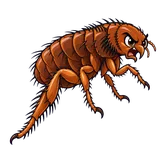
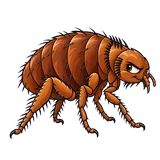
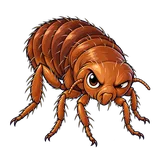
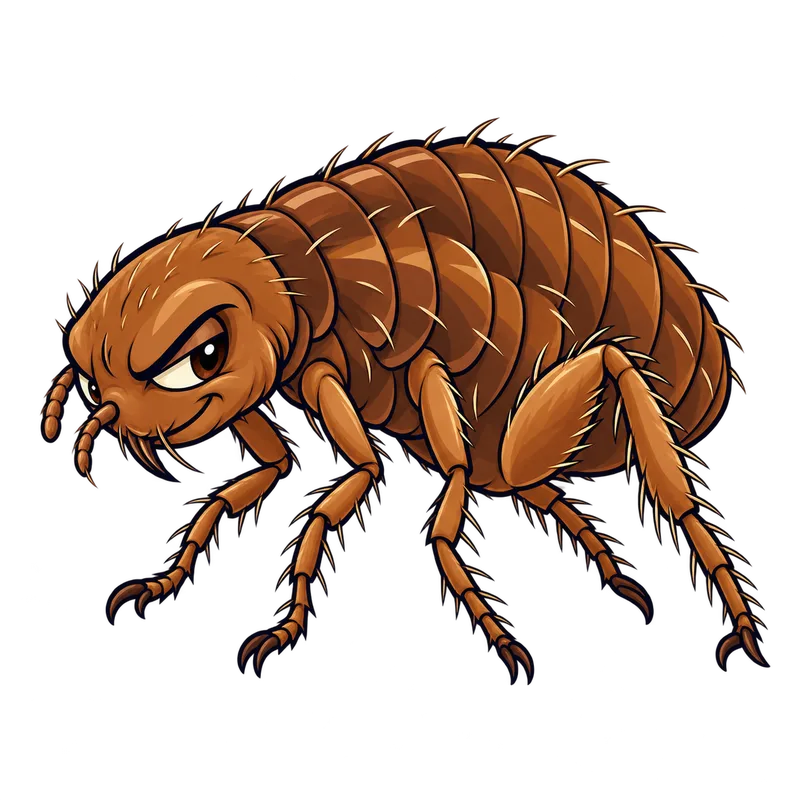
The Oriental rat flea, scientifically known as Xenopsylla cheopis, is a small, wingless insect measuring less than 4 mm long. To the naked eye, it looks like a tiny, brownish speck moving through carpet fibers or animal fur. Its body is compressed laterally, meaning it is flattened from side to side rather than top to bottom. This narrow profile lets the creature slip easily between the dense hairs of a rodent host.
Identity
Its most noticeable physical trait is a pair of disproportionately enlarged hind legs. These limbs are built for powerful jumping, allowing the insect to leap almost 30 cm in a single bound to reach a passing host. Telling this species apart from other tiny household pests requires high magnification and expertise. Definitive identification demands that a medical entomologist or diagnostic laboratory examine fine anatomical structures under a microscope. Attempting to identify this flea, or any other biting pest, by looking at skin marks or photographs is unreliable because individual human immune reactions vary too widely for a rash or a welt to serve as proof of what bit you.
Habitat & behaviour
This species lives in close association with domestic and wild rodents, primarily inhabiting their nests, burrows, and resting sites. In homes and commercial buildings, it tends to set up shop in subfloor voids, crawl spaces, attics, and cluttered indoor areas where mice or rats have established populations. Unlike pests that roam freely across a house, these adults stay on or very near their hosts. They are obligate blood-feeders, meaning both males and females rely entirely on vertebrate blood to survive.
Activity patterns are tied closely to the presence of a host. When rodents move around, the fleas feed and reproduce. A dangerous behavioral quirk occurs when host rodents die or are removed through trapping or poisoning. Once the animal dies and its body cools, the starving fleas abandon the carcass and start searching for alternative blood sources, which often leads them to bite humans and companion animals. In vacant buildings, pupae can remain dormant inside protective silk cocoons for extended periods. Sudden human or animal activity in a long-empty space provides triggers like physical vibration, body heat, and light changes, which stimulate a mass emergence of hungry adults.
Visual variations
You will not find distinct social classes or winged versions here because this insect keeps things simple and brutal at every stage. Both adult sexes share that same brownish, flattened shape and subsist on blood, even if a lab technician has to squint through a lens at tiny genital differences to tell boy from girl. The young stages look nothing like the adults, starting as small, oval, whitish eggs that drop right off the host and into floor cracks or rugs.
Hatching turns those eggs into legless, worm-like scavengers that hate the light and skip blood entirely in favor of floor dust and dried blood waste dropped by the adults. Those growing larvae eventually spin a silk cocoon to become pupae, wrapping themselves in sticky outer layers that gather dust and vanish into carpet fibers. When the adult finally pushes its way out of that cocoon, it carries downward-pointing mouthparts for piercing skin and those massive hind legs built for jumping.
Why it matters
Finding these insects indoors is a loud warning bell that you have mice or rats living in the walls, the crawl space, or the attic right now. When they bite people, they usually go for the lower legs between the knee and ankle, leaving behind itchy red spots and swollen wheals soon after they feed.
The real trouble goes far beyond annoying bites because this specific creature served as the primary historic vector for bubonic plague, a disease driven by the bacterium Yersinia pestis. They also carry murine typhus via rickettsial bacteria that enter the bloodstream when people scratch flea feces or crushed bugs into open skin. Anyone dealing with nasty bite reactions, infected skin from scratching, fever, or general illness after exposure needs to talk to a doctor or reach out to poison control right away.
Clearing out an infestation safely takes trained professionals because you have to wipe out the rodents and treat the structure at the same time using licensed pest control operators. Any product you put on a family pet needs a veterinarian's sign-off, and you should call public health officials if wild animals are part of the equation.