
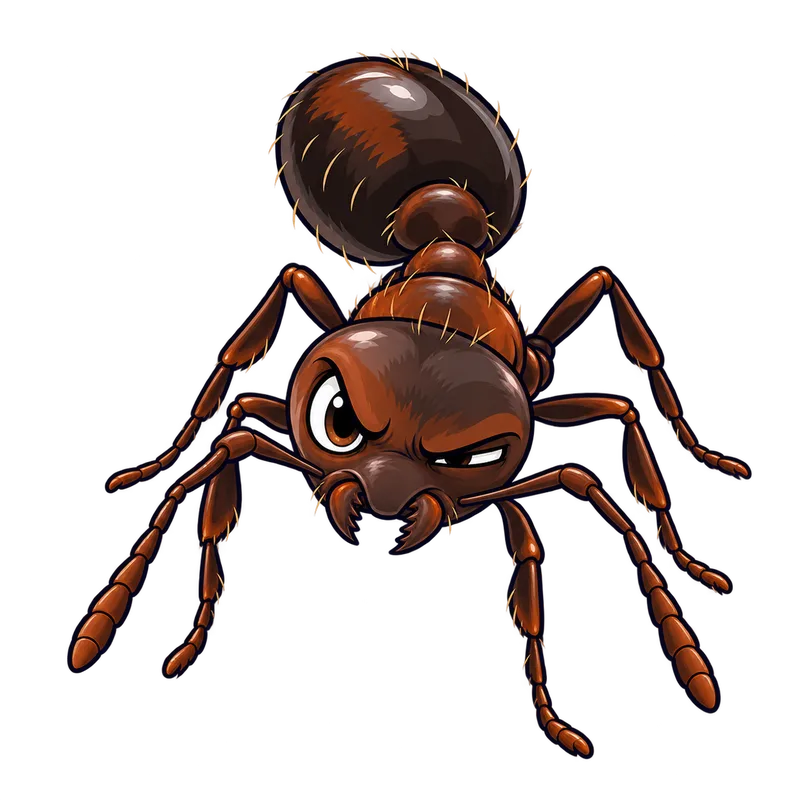
Black imported fire ant
Solenopsis richteri
- Size
- 2.1 to 6.0 mm
- Color
- Dark brown to jet-black
- Habitat
- Open areas, lawns, pastures, and earthen mounds
- Diet
- Omnivorous scavenger
- Life cycle
- Complete metamorphosis from egg to adult
You will not get far trying to name this ant by squinting at it from a standing position. The workers are dark brown to jet-black insects, but color alone is a trap because hybrid colonies and related species blur the lines. To know for certain that you are looking at the black imported fire ant, or its close red relative originally brought over from South America like Brazil and Uruguay, you need a hand lens or a stereomicroscope providing at least 10x magnification.
Identity
Look past the legs and head to the narrow waist. Fire ants have two distinct bumps, known as pedicel nodes, sitting between the thorax and the swollen gaster. Single-node ants like carpenter ants or Argentine ants need not apply here. Field photographs are notoriously unreliable for species confirmation, and a mark on your skin tells you nothing at all about the insect that caused it.
Habitat & behaviour
These ants are architects of the open sun. You will run into them most often in pastures, manicured lawns, golf courses, and cleared roadsides where they build characteristic domed earthen mounds. These mounds are not just piles of loose dirt. They act as thermal regulators, keeping the subterranean colony warm when the weather turns and cool during the peak heat of summer.
Activity peaks during the warm months of spring, summer, and autumn. Workers constantly scour the soil surface and underground tunnels for food, as these insects are omnivorous scavengers. Walk across a mound while mowing the lawn or walking the dog, and you will quickly understand why they earned their common name. Hundreds of workers pour out of the earth in an instant, climb any vertical surface they touch, anchor themselves with their mandibles, and deliver repeated stings.
Visual variations
Life inside the colony follows a complete metamorphosis through egg, larva, pupa, and adult stages, producing a strict caste system. Sterile female workers make up the bulk of what you see on the surface. All female fire ants, whether sterile workers or egg-laying queens, possess a functional stinger. That stinger is an anatomical modification of the tube insects normally use to lay eggs.
Males show up seasonally for reproduction. They possess wings for the nuptial flight, but they lack a stinger entirely and are completely harmless in terms of defense. Workers are strictly wingless throughout their lives, while virgin queens and males start with two pairs of membranous, unequal wings. Once a young queen successfully mates during a seasonal flight, she sheds those wings, digs a chamber in moist soil, and founds a new colony by herself.
Why it matters
The presence of these ants means dealing with a potent defense mechanism unlike that of most other stinging insects. While bees and wasps rely on protein-based venoms, fire ant venom is composed of potent alkaloids with only a trace of protein. That chemical makeup is responsible for the immediate, intense burning sensation when you are stung, followed within 24 hours by itchy, sterile pustules that can linger for days.
For sensitized individuals, the venom can trigger severe allergic reactions requiring immediate emergency medical care. Any reader experiencing stings accompanied by widespread hives, facial swelling, tightness in the throat or chest, difficulty breathing, dizziness, or nausea must be directed immediately to emergency medical care, an urgent care facility, or poison control. On the structural side, however, homeowners can breathe easier about one specific fear. Fire ants do not consume structural timber or tunnel into sound wood, meaning they pose no threat to the framing of your house, unlike termites or carpenter ants. Large-scale mound management across agricultural pastures, public parks, sports fields, or residential properties is a decision that belongs to a licensed professional applicator or an agency, and the registered product label strictly governs all chemical pesticide applications without exception.
Similar species
 Odorous house antTapinoma sessile
 Pavement antTetramorium immigrans
 Pharaoh antMonomorium pharaonis
 Argentine antLinepithema humile
 Ghost antTapinoma melanocephalum
 Yellow crazy antAnoplolepis gracilipes