
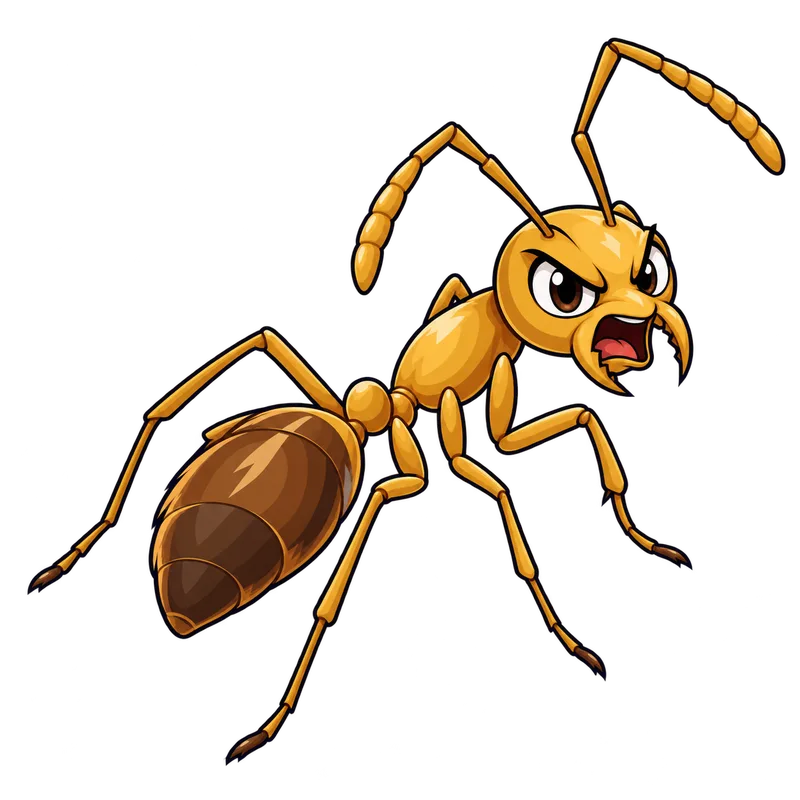
Yellow crazy ant
Anoplolepis gracilipes
- Size
- Not established
- Color
- Yellow to yellowish-brown
- Habitat
- Rainforests, woodlands, and agricultural landscapes
- Diet
- Omnivorous, including honeydew and invertebrates
- Life cycle
- Complete metamorphosis with polygynous colonies
The yellow crazy ant is Anoplolepis gracilipes, a formicine ant known for frantic, zigzag running and colonies that can swell into super-colonies. Most readers will not meet it in a United States kitchen; it is a high impact invader in tropical Australia, Christmas Island and the wider Indo-Pacific, while the crazy ants established in parts of the US are usually other species.
Identity
The name is confirmed as Anoplolepis gracilipes, but the common name is where the trouble starts. In the US, crazy ant can also mean the tawny crazy ant, Nylanderia fulva, or the longhorn crazy ant, Paratrechina longicornis, so a fast brown ant in Texas is not automatically this ant.
At arm's length, yellow crazy ant workers look pale yellow to yellowish-brown, slender and almost delicate, with very long legs and antennae. The giveaway behavior is the movement: workers dart, stop, change direction and swarm in dense, agitated trails rather than marching in a tidy line. That can put you in the crazy ant neighborhood, but it cannot prove the species from a photo or a quick look.
Real separation happens with magnification. A hand lens or microscope is used to check the 12-segmented antennae without a club, the single erect node on the narrow waist, the absence of a stinger, the circular acidopore at the tip of the gaster, and the arrangement of stout hairs on the thorax. Suspected specimens should be brushed into a sealed vial with 70% isopropyl alcohol or ethanol and sent to an extension diagnostic laboratory or state entomologist.
The look-alikes earn their keep here. Tawny crazy ant workers are reddish-brown and about 2 mm, roughly 1/8 inch, with two pairs of erect standing hairs on the mid-thorax under high magnification; they are the usual problem across Texas, Florida, Mississippi, Alabama, Louisiana and Georgia, and they do not spray aerial plumes of formic acid. Longhorn crazy ants are grayish-black to jet black, about 1/8 inch, with absurdly long legs and antennae, long coarse body hairs and an elongated thorax, and they turn up in urban areas of the Southeast and California. Odorous house ants are dark brown to black, 1/16 to 1/8 inch, about 2.4 to 3.3 mm, with a flattened waist node hidden under the gaster and a rotten coconut or blue cheese smell when crushed. Argentine ants are mid- to dark brown, about 3 mm, smoother and less hairy, with one erect node; they bite when disturbed but do not spray formic acid.
Habitat & behaviour
This ant prefers warm, moist spaces with plenty of cover. Nests usually sit in the soil, under leaf litter, inside decaying wood, within natural cavities, beneath rocks, or under yard and orchard debris where dampness stays put. In Australia, you find it in the tropical rainforests on Christmas Island and the coastal savanna woodlands of northeast Arnhem Land, and it also moves easily into crops, orchards, and horticultural plantings.
The colony setup explains why they cause so much trouble. These ants are polygynous, meaning multiple egg-laying queens share a single nest system, and invasive populations can form massive super-colonies where workers and queens from different nests live together without fighting. Worker densities can climb as high as 20 million ants per hectare. They mostly spread through local budding, where queens and workers walk outward with the brood to start a new spot, though they also travel long distances by hitchhiking in infested soil, potted plants, timber, machinery, and cargo.
Their diet is broad and opportunistic. Workers hunt for protein by eating invertebrates and small animals, but they also seek out carbohydrates by tending scale insects and aphids to harvest honeydew. That protection racket shields sap-sucking pests from their natural enemies and can quickly cause crops to decline. When they feel threatened or go on the attack, workers do not sting because formicine ants rely on an acidopore, which is a small nozzle at the rear of the body used to spray formic acid that can burn, blind, and suffocate prey or intruders. That chemical defense is how a swarm can take down animals as large as land crabs.
Visual variations
The life cycle follows complete metamorphosis through four stages: egg, larva, pupa, and adult. The egg, larva, and pupa stay tucked safely inside the nest, meaning the animal you actually see is almost always the adult worker, a sterile female built specifically for running, foraging, and spraying. Workers share the same slender build, long legs, long antennae, and yellow to yellowish-brown coloring, but color alone is an unreliable clue because lighting, age, and preservation can easily trick the eye.
Queens make up the reproductive caste and stay deep inside the protected core of the nest rather than marching out on the trail unless the colony is disturbed or budding. In heavy infestations, you might find thousands of queens instead of just one central monarch. Winged reproductive forms do exist in this family of ants, but reliable measurements for the queens and males of this species are not available, so you should never use wing details as a field mark at home. The takeaway is simple: workers are the ones you see, queens are the hidden engine, and the brood stays out of sight until you open the nest.
Why it matters
A confirmed yellow crazy ant infestation is not just a mild kitchen annoyance, but rather a major ecological and biosecurity event. On Christmas Island, these super-colonies have been linked to the death of up to 20 million red land crabs, a loss that drastically reshaped the rainforest floor and canopy processes. Native invertebrates get pushed out, sap-sucking plant pests get reliable bodyguards, and homes, sheds, poultry areas, and livestock zones can be completely overrun by swarming workers.
The health risk comes from chemistry rather than a sting. The formic acid spray can irritate or burn skin and poses a serious danger to eyes, affecting both people and domestic pets, poultry, or livestock. If your eyes or skin are exposed, flush the area promptly and contact a medical clinician, urgent care, or poison control, and do not try to diagnose or treat a chemical burn on your own.
Nailing the exact identification is crucial before anyone discusses control, especially since the United States look-alikes have different ranges and require different management, and because super-colonies of Anoplolepis gracilipes are far beyond a simple hardware-store fix. Broad-scale baiting should always be left to licensed applicators and biosecurity agencies, treating every product label as the absolute law. The good news is that agency programs in the Northern Territory have successfully wiped out this ant from 26 locations covering more than 295 hectares, with native invertebrates and local fauna bouncing back to recolonize the area within 1 to 2 years after a successful treatment.
Similar species
 Tawny crazy antNylanderia fulva
 Longhorn crazy antParatrechina longicornis
 Little black antMonomorium minimum
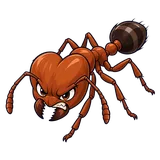 Bigheaded antPheidole megacephala
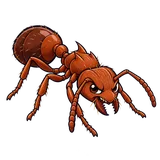 European fire antMyrmica rubra
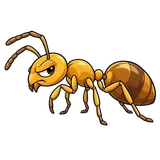 Yellow meadow antLasius flavus