
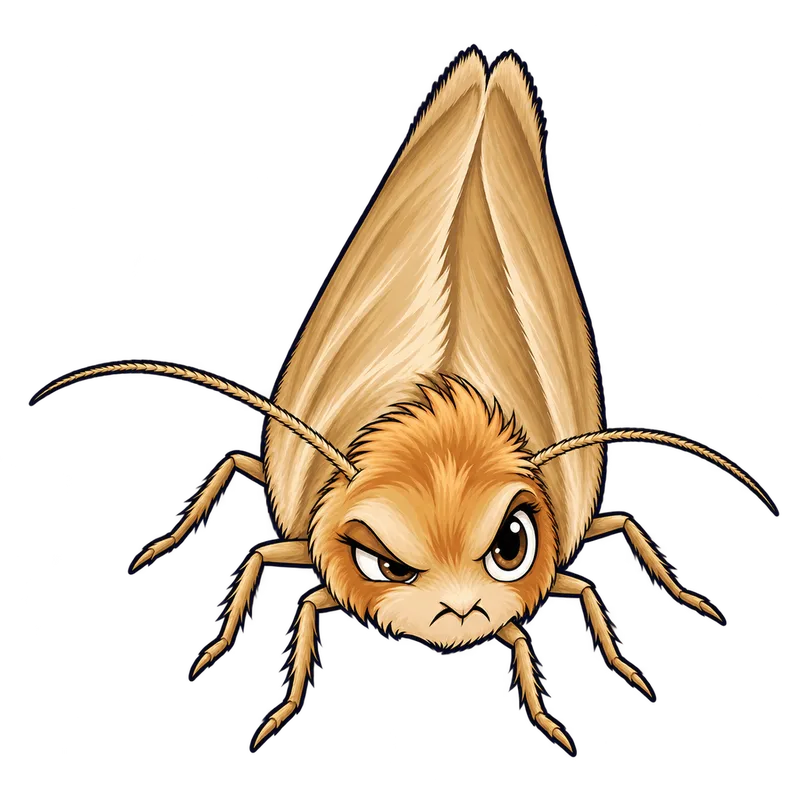
Webbing clothes moth
Tineola bisselliella
- Size
- 5 to 8 mm long
- Color
- Uniformly yellowish or buff
- Habitat
- Closets, attics, and dark wool storage
- Diet
- Wool, fur, feathers, and animal fibers
- Life cycle
- Complete metamorphosis, 1 to 4 generations per year
You are probably looking at a webbing clothes moth if you spot a tiny, straw-colored insect scurrying away from a dark corner of your wardrobe rather than flying toward the ceiling light. At roughly 5 to 8 mm long, or about 1/4 inch, it is a delicate creature that folds its narrow, unspotted wings flat over its back when it settles down. If you look closely with a magnifying glass, the most reliable field mark is a small, distinct tuft of reddish hair sitting right on top of its head. That reddish crest separates it instantly from other small household moths, which usually sport patterned or dusky gray wings.
Identity
People frequently confuse them with casemaking clothes moths or even pantry pests like Indian meal moths. The casemaking variety wears three dark spots on each forewing and drags a portable silken case around like a tiny sleeping bag. Webbing clothes moths never carry a case. Instead, their caterpillars spin stationary silken tubes or flat sheets directly onto the fabric they are chewing. If you see a moth fluttering lazily around your living room lights in the evening, it is almost certainly a pantry pest or an outdoor visitor. Webbing clothes moths despise light and will do everything in their power to stay hidden in the dark.
Habitat & behaviour
These moths seek out quiet, undisturbed environments where natural animal fibers sit undisturbed for months. Closets, bureau drawers, attics, and storage trunks make ideal homes. You might also find them tucked beneath heavy furniture, along baseboards where pet hair accumulates, or even inside piano felts and old upholstered chair padding. They prefer the dark, and they thrive best in modern, centrally heated buildings where temperatures stay comfortable year-round, allowing them to breed continuously instead of waiting for summer.
What draws them in is not just the presence of wool or cashmere, but the promise of a good meal laced with organic soils. While a freshly laundered wool sweater is certainly vulnerable, a sweater with an invisible trace of perspiration, body oils, milk, beer, or food stains is practically an invitation to dinner. The larvae need those extra nutrients from organic soiling. Clean synthetic fibers like polyester and nylon, or pure plant fibers like cotton and linen, hold no nutritional value for them at all. However, if a cotton cover is stuffed with goose down or wool felt, or if a synthetic blend is heavily soiled, the caterpillars will happily chew right through the outer material to reach the animal protein inside.
Visual variations
You are not looking at a complex colony here, just the four predictable stages of complete development. The adult is the slender, golden-buff moth with that reddish head tuft and a rather lazy, fluttering flight. Adult females drop batches of up to 100 soft, translucent white eggs directly onto fabric, and those eggs are so fragile that ordinary vacuuming or even a stiff brush destroys them on contact. They hatch into the stage that does all the heavy lifting and all the damage, which is the caterpillar.
The caterpillar looks nothing like the moth that laid it. It is a creamy-white crawler with a dark brown or black head, growing up to 1/2 inch long when it is fully fed. As it crawls over your woolen garments, it spins fine silken threads to build flat protective sheets or feeding tunnels right on the surface. It also leaves behind tiny, hard pellets of waste known as frass. Since the caterpillar digests the colored fibers, those droppings match the dye of the sweater or carpet it just ate. People often mistake this sand-like frass for actual moth eggs, but the droppings are hard and tinted, while real eggs are soft and pearly white.
Why it matters
These insects do not bite, sting, or carry diseases, so your health and your family are entirely safe from them. The real casualty here is your wallet or your sentimental attachment to old textiles. The adult moths have weak, useless mouths and never eat a thing, but their offspring have an appetite that makes quick work of heirloom woolens, cashmere pullovers, Persian rugs, fur coats, taxidermy mounts, and museum displays.
When you spot irregular holes in animal-fiber textiles alongside fine silken webbing and colored droppings, you are looking at an established infestation. While a minor wardrobe problem often clears up with thorough vacuuming, hot laundering, dry cleaning, or leaving items in zero degree cold for a few days, deep infestations are a different beast. If the caterpillars are breeding beneath wall-to-wall carpets or inside the subflooring, or if you are trying to save irreplaceable historical artifacts, you need a professional. Commercial pest control companies can handle whole-house treatments, and museums rely on specialized heat chambers or cold storage vaults to stop the damage without ruining the textiles.
Similar species
 Casemaking clothes mothTinea pellionella
 Sod webwormsFamily Crambidae
 Squash vine borerMelittia cucurbitae
 Imported cabbagewormPieris rapae
 Tomato hornwormManduca quinquemaculata
 Tobacco hornwormManduca sexta