
How big do brown widow spiders get?
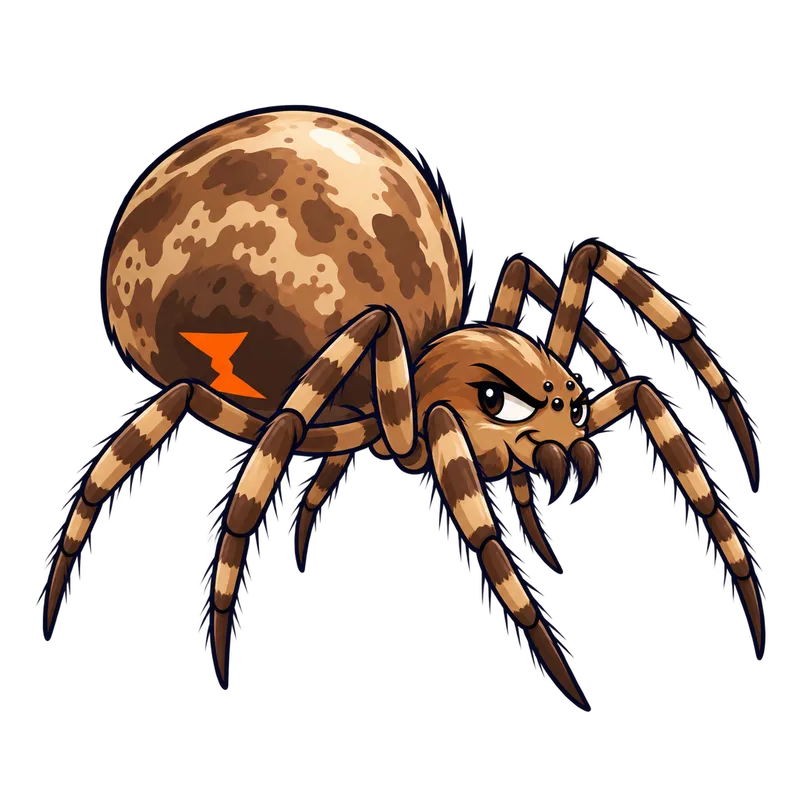
Brown widow spiders vary in size depending on their sex, with mature females measuring about half an inch in body length. Adult males are much smaller, growing to only 3 to 4 mm long. Their overall leg span can make them look much bigger than their actual measurements.
What is actually going on
You are standing in the garage, reaching up onto a high shelf to grab an old camping lantern, and out of the corner of your eye, you spot a spider tucked away in the shadows. Naturally, you freeze. It has a round, bulbous belly and a tangled web that looks like a messy knot of coarse silk. You pull your hand back and wonder just how big this thing actually gets, especially if it happens to be a brown widow.
When people talk about the size of a brown widow spider, or its close relatives in the widow family, they usually picture something massive because of how the creature's legs stretch out. But scientists do not measure spiders by their leg span, because a slight shift in posture can throw off the numbers entirely. Instead, they measure strictly from the front of the head region to the tip of the abdomen, leaving the legs completely out of the equation.
For a mature female widow spider, that official body length usually sits around 8 to 13 mm, which is roughly half an inch. If you want a quick mental picture, compare her round body to the width of a standard aspirin tablet or a small shirt button. She is compact, but her spherical abdomen packs a surprising amount of visual weight, especially when she is carrying eggs.
Males, on the other hand, are a completely different story. An adult male widow spider is downright tiny, measuring only 3 to 4 mm in body length. That makes him roughly a quarter of the size of the female, possessing a narrow, slender body and long legs that help him wander in search of a mate. Because he is so small, his mouthparts are generally too weak to pose any threat to a person, which usually comes as a relief to anyone peering into a dark corner of a shed.
How to tell for sure
Telling a brown widow apart from other spiders usually comes down to a few distinct visual cues, though you usually have to look past the initial panic to see them. Mature females usually present a mottled mix of brown, tan, and gray tones, often featuring geometric patterns on their backs, accompanied by an orange or yellowish hourglass shape on the underside of the abdomen. That hourglass is often brighter and less uniformly red than the famous warning mark of a southern black widow.
People frequently overestimate the size of these spiders because of their leg span. Those long, spindly legs stretch out like the ribs of an open umbrella, making a half-inch body look twice as large when the spider is resting flat against a wall or hiding inside the toe of a garden boot. If you judge size by the legs alone, you will easily talk yourself into believing you are looking at a giant.
You will also usually find them in specific, undisturbed hiding spots rather than out in the open. They prefer to build coarse, irregular, three-dimensional tangle webs close to the ground in places like woodpiles, beneath outdoor tables, inside hollow tree stumps, or tucked away in meter boxes. If the web looks like a messy, sticky trap rather than a neat, symmetrical wheel, you are likely looking at the work of a cobweb spider.
It helps to keep in mind that immature females and males look quite different from the fully grown adults. Juveniles often sport lighter brown, white, or gray stripes and spots, which leads many people to mistake them for entirely different species of harmless household spiders.
What usually comes next
When you spot a widow spider near your living space, you generally have to make a practical choice between leaving a low-traffic outdoor area alone and clearing out harborage zones where daily contact is likely. If the spider is living deep in a woodpile at the far corner of the yard, the simplest approach is often to let it be while you adjust your habits.
If that woodpile is right next to the back door, however, you need to change how you interact with the space. The most reliable way to avoid an accidental encounter is to wear heavy leather work gloves and closed-toe shoes whenever you reach into dark storage areas, move stacked firewood, or clean out the crawl space. Shaking out your gardening boots and outdoor towels before using them is a simple habit that stops a hiding spider from getting compressed against your skin.
When you decide to clear spiders out of an area, you can vacuum regularly around door frames, windowsills, and floor edges, making sure to seal and throw away the vacuum bag immediately afterward. Moving heavy clutter, stone heaps, and firewood away from your exterior walls also removes the dark, damp hiding spots these spiders rely on. If you choose to use an insecticide, the product label will tell you whether a direct contact spray or a residual barrier is appropriate for the specific situation, and you must follow those directions to the letter.
When to get help
There are moments when a do-it-yourself approach no longer makes sense and you need to bring in outside help. If you are dealing with a heavy, entrenched infestation around the structure of your home, or if egg sacs are turning up inside living areas, a licensed pest control operator should handle the treatment.
On the health side, a widow spider bite demands prompt attention because the venom contains potent neurotoxins that trigger severe nervous system reactions. If you are bitten, you will usually feel an initial pinprick followed by dull aching, and within a short time, pain can begin radiating toward your chest, abdomen, or lower back. Severe muscle cramps, abdominal rigidity, sweating, and difficulty breathing are classic signs that require immediate medical intervention.
Never try to cut the wound or suck out the venom. Instead, wash the bite site with soap and water, apply a cold pack, elevate the limb if possible, and contact poison control immediately or head straight to an emergency room. High-risk individuals, such as young children, older adults, and anyone with pre-existing heart conditions, need professional medical evaluation right away if a bite is suspected.