
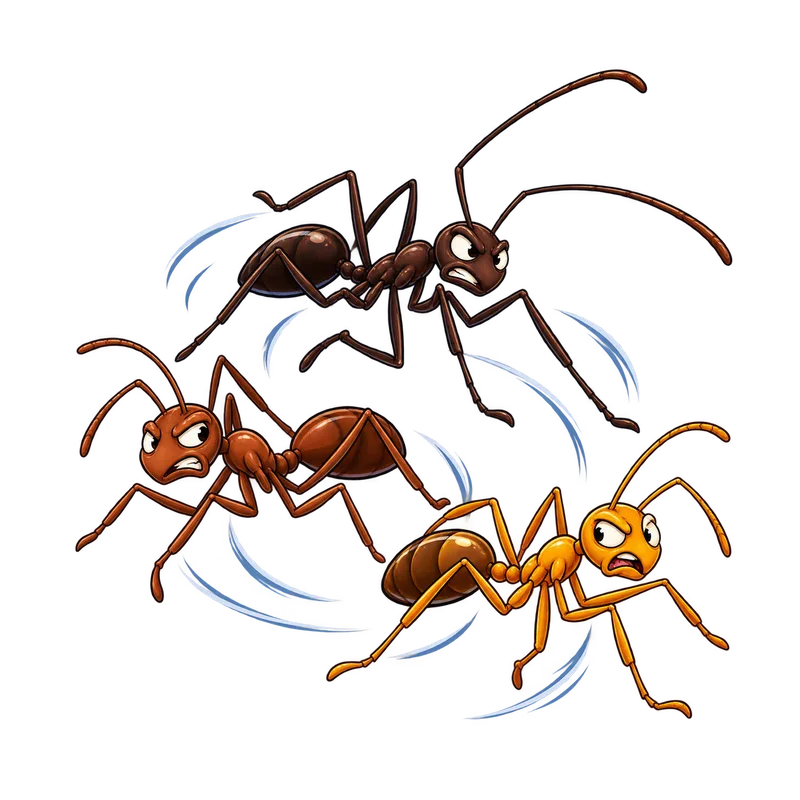
Crazy ants
Nylanderia, Paratrechina and Anoplolepis species
- Size
- 1/8 inch (approximately 2 mm)
- Color
- Uniformly reddish-brown to orange-brown
- Habitat
- Moist leaf litter, mulch, thatch, and structural voids
- Diet
- Honeydew, insects, and sweet household foods
- Life cycle
- Complete metamorphosis through egg, larva, pupa, and adult
Crazy ants are not one species but a shared name for several fast, erratic ants in the Formicinae group, the ants that spray acid from the tail instead of stinging. In the United States a reader is most likely to meet the tawny crazy ant, Nylanderia fulva, across Texas, Florida and the Gulf Coast states, or the longhorn crazy ant, Paratrechina longicornis, in the Southeast, California and heated buildings farther north; the yellow crazy ant, Anoplolepis gracilipes, is mainly an Australian and Pacific biosecurity problem rather than a normal US household ant.
Identity
The name describes the gait, not a tidy identity. Workers are small, about 1/8 inch or roughly 2 mm for the tawny and longhorn species, and all the workers in a colony look the same size, with no big soldier caste. Tawny workers are uniformly reddish brown to orange brown and look slightly matte because the body carries many standing hairs over a finer down. Longhorn workers are grayish black to jet black, with noticeably longer legs, longer first antennal segments and a more stretched thorax. Yellow crazy ants are yellowish to brownish yellow.
With the naked eye, the useful clues are behavior and context: same sized runners, frantic zigzag movement, no soil mound, loose foraging bands that can reach 4 inches wide, and in heavy tawny infestations, brown drifts of dead workers along foundations and patio corners. A 10x to 20x hand lens adds the structural checks: one small waist node, antennae with 12 segments and no clubbed tip, no stinger, and a round acidopore fringed with hairs at the tip of the abdomen. Confirming tawny crazy ant against close relatives such as Nylanderia pubens is laboratory work, because it depends on exactly two pairs of erect bristles on the middle thorax and sometimes male genitalia.
The usual mix ups are worth separating. Ghost ants are smaller, about 1.3 to 1.5 mm, sharply two toned with a dark front and pale rear, and smell like rotten coconut when crushed. Odorous house ants are brown to black, have a flattened node hidden under the abdomen and also give a rotten coconut or blue cheese smell. Argentine ants are smooth and hairless above, with one visible upright node and less chaotic trailing. Fire ants are the important safety contrast: workers vary in size, have two waist nodes, clubbed antennae, obvious soil mounds and a real stinger that leaves burning pustules.
Habitat & behaviour
These ants like moisture, shelter and edges, not a neat crater in the lawn. Outdoors they nest in leaf litter, decaying organic matter, turf thatch, mulched beds, under rocks, bricks, paving stones, landscape timbers, fallen limbs, loose bark, palm bases, potted plants, compost bags, lumber stacks, trash cans and debris piles. Around buildings they use wall voids, slab gaps, pipe penetrations, hot water lines and outdoor electrical enclosures, which is why the same colony can seem to be in the pantry one week and inside the air conditioning disconnect the next.
Their foraging looks like spilled ball bearings: quick starts, sudden turns and loops rather than a disciplined file. When food is good they still form trails, often following concrete expansion joints, walls, baseboards, fences and utility lines, but the individual ants appear to have missed the meeting about walking straight. They eat almost anything available, with a strong pull toward liquid sugar from aphids, scale insects, mealybugs and whiteflies, plus nectar, fruit juice, household sweets, dead insects, spiders and meaty or fatty scraps.
Season and geography explain a lot. Tawny crazy ant activity slows around 50 degrees Fahrenheit and largely stops near 45 degrees, then resumes as spring warms, with populations exploding from summer into fall; in the Gulf states that can mean grass that looks as if it is flowing. Natural crawling spread is steady but not teleportation, roughly 800 to 1,300 feet per year. The long jumps are human assisted: nursery stock, mulch, straw, yard waste, compost, hay bales, construction material, garbage and recreational vehicles carry queens and brood across county and state lines.
The colony structure is the part people underestimate. These ants can have many queens and many connected nests, with unrelated workers tolerating one another in a supercolony. Instead of relying mainly on dramatic mating flights, tawny and longhorn crazy ants commonly spread by budding, meaning a queen walks off with workers and brood and sets up a satellite nest nearby. That is why an infestation can seem to vanish after a spray and then reappear from the untreated surroundings as if the property were being refilled from an invisible reservoir.
Visual variations
Workers are the form almost everyone sees: wingless, same sized within a species, long legged and built for running. There is no minor worker and major soldier split to help with identification, so a trail of identical runners is normal rather than a sign that the colony is immature.
The reproductive forms change the picture. Males and virgin queens have functional wings before mating or colony budding. Queens are much larger than workers, about twice the worker length in tawny crazy ant, roughly 4 mm against a 2 mm worker, with a sturdier thorax and an enlarged, darker abdomen built for egg production. Males are slimmer and more delicate, and their value is mostly for specialists because species level confirmation can require microscopic examination of genital structures. After establishment, queens shed their wings, so a dealated queen looks like a much larger, wingless, heavy abdomened version rather than a flying ant.
Color separates the group at a glance better than size does. Tawny crazy ant workers are reddish brown and hairy enough to look dull rather than glossy. Longhorn crazy ant workers are black and almost leggy, with an elongated middle body that makes them look stretched. Yellow crazy ant workers are pale yellow to brownish yellow, though for a US reader that name should raise a travel or biosecurity question more than a backyard assumption.
The immature stages stay hidden in the nest. Eggs are minute, whitish and clustered. Larvae are pale, legless grubs that workers feed. Pupae of tawny crazy ant are naked, meaning they do not spin a silk cocoon before the adult emerges. If someone sees only pale crumbs being carried during a nest disturbance, those may be brood being rescued, not food.
Why it matters
Crazy ants are mostly a severe nuisance and infrastructure problem rather than a medical emergency. They cannot sting, but they can give a brief pinprick bite and release defensive formic acid from the acidopore; scratched bites can become infected, and any spreading rash, unusual reaction or persistent skin problem belongs with a clinician, urgent care or poison control if pesticide exposure is involved. They are not known as human disease carriers, but that is not a reason to handle swarms barehanded.
The household consequence that deserves respect is electrical. Workers seek warm narrow cavities in breaker boxes, outdoor outlets, transformer cabinets, traffic signal controls, pump housings and HVAC switchgear. When one ant is shocked, alarm chemistry can draw more ants into the same space, and packed bodies can bridge contacts, clog mechanisms and short equipment. Ants inside live electrical hardware are an equipment hazard first and an ant problem second, so a qualified electrician or licensed pest professional should be involved rather than spraying into energized parts.
In gardens and farms the damage is often indirect. By guarding honeydew producing aphids, scale, mealybugs and whiteflies from predators, crazy ants can drive outbreaks, sooty mold, sap loss and plant decline. Heavy rural infestations can distress pets, poultry and livestock, with small birds or chickens at risk of suffocating in extreme swarms and cattle irritated around eyes, nostrils and hooves; those cases call for a veterinarian. Ecologically, dense supercolonies can displace native ants and other ground arthropods, and tawny crazy ant can even push out red imported fire ants where the two overlap, which is not the favor it might sound like.
Precise identification matters before control because lookalikes behave differently and because budding supercolonies make simple perimeter spraying a short lived answer. If dead ants keep piling up despite cleaning, trails enter living spaces from outdoors, baits are ignored for weeks, or ants are inside equipment, that is the point to stop guessing and get a licensed applicator or extension diagnostic service to confirm the species and assess the colony network.
Similar species
 Black carpenter antCamponotus pennsylvanicus
 Red imported fire antSolenopsis invicta
 Black imported fire antSolenopsis richteri
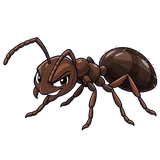 Odorous house antTapinoma sessile
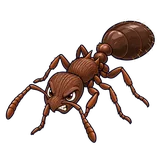 Pavement antTetramorium immigrans
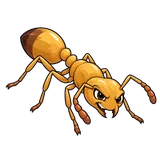 Pharaoh antMonomorium pharaonis