
Do crazy ants bite?
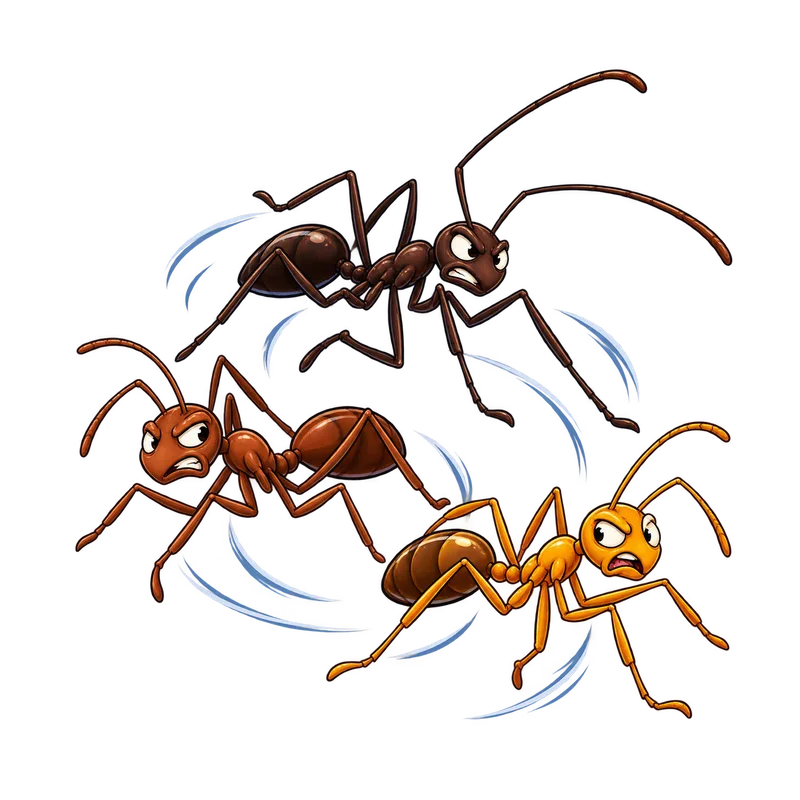
No, crazy ants do not bite in the way that stinging ants do. Instead of using a stinger, female crazy ants use their chewing mouthparts to deliver a minor pinch while simultaneously spraying defensive formic acid onto your skin. This chemical splash causes mild irritation or itching rather than a painful wound.
What is actually going on
Imagine you are out in the yard on a warm afternoon, wearing shorts and sandals while pulling a few weeds around the flower bed. Suddenly, you feel a sharp, tiny pinch on your ankle, and you look down to see a loose cloud of small, reddish-brown ants darting around erratically like pinballs.
To answer the question right away: no, crazy ants do not sting. If you are picturing the fiery, burning welt left by a fire ant, you can breathe a sigh of relief. Crazy ants do not possess a stinger. Instead of a stinger, female crazy ants have a specialized circular nozzle at the rear end of their bodies called an acidopore. When they crawl onto human skin by the dozens, they can bite you with their chewing mouthparts, but this mechanical nip delivers only a minor, brief pinch.
Where does that stinging sensation come from, then? Think of a fire ant as carrying a tiny hypodermic needle that injects venom, while a crazy ant carries a miniature squirt gun at its rear end. Simultaneous with or immediately after giving you a tiny nip with its jaws, the crazy ant curves its abdomen forward and sprays defensive formic acid directly onto your skin. In most human encounters, this chemical splash results in mild, localized irritation or itching that fades quickly, rather than a lingering, painful wound.
How to tell for sure
Before you try to deal with these insects, you usually need to figure out what you are looking at, because guessing based on a skin reaction will get you nowhere. A skin lesion or a photograph of a red mark can never identify an insect pest, as skin reactions are non-specific and can easily stem from mites, spiders, bed bugs, or even plant contact.
For a basic visual check in the yard, look at how the ants move. Unlike garden-variety ants that march in disciplined, straight, single-file lines, crazy ants scurry around in wide, loose trails with a frantic, zig-zagging motion. Workers are monomorphic, which means they are all a uniform size of about one-eighth of an inch, or two millimeters, roughly matching the thickness of a coin.
If you grab a ten-power hand lens, you can usually spot a single petiole node, which is the narrow waist segment between the thorax and the abdomen, and twelve-segmented antennae without a club at the tip. This immediately separates them from fire ants, which feature two distinct waist nodes. However, confirming the exact species, such as distinguishing a tawny crazy ant from closely related native lookalikes, usually requires collecting a specimen in seventy percent isopropyl alcohol and sending it to a university extension laboratory for high-resolution microscopic examination of body hairs.
What usually comes next
When an infestation reaches the point where millions of workers are covering your patio or piling up like brown sawdust along your sliding door tracks, you generally have to make a practical choice about how to manage them. Many homeowners reach for an over-the-counter contact spray from the hardware store, hoping for a quick fix.
That approach usually leads to frustration. Standard retail sprays typically kill only the foraging workers exposed on the surface, leaving multiple queens and millions of underground nestmates completely unharmed. The ants usually reappear within a few days because a single spray does nothing to disrupt a massive supercolony. Furthermore, federal and state pesticide laws require you to follow every instruction printed on the product label precisely, meaning you cannot legally mix custom chemical cocktails or apply products off-label.
If you are dealing with a light dusting of ants near a windowsill, routine cleaning, sealing exterior gaps with caulk, and removing moist yard debris like leaf litter can help reduce their numbers. When populations grow large enough to swarm your yard or threaten electrical equipment like air conditioning units and circuit breakers, self-treatment is rarely effective. Long-term control usually requires hiring a licensed pest management professional who can implement a comprehensive strategy using non-repellent perimeter treatments.
When to get help
There are times when a casual household nuisance crosses the line into a situation requiring outside expertise. If ant populations cover large outdoor areas, nest inside structural voids, or invade electrical boxes and meter panels, you should bring in a licensed professional. Accumulating ants inside electrical utilities create genuine fire and shock hazards, and you should always turn off the power at the main breaker before inspecting any infested electrical housing.
On the medical side, if you or a family member experiences localized swelling, severe itching, direct eye exposure to ant spray, or systemic allergic reactions such as difficulty breathing, dizziness, or widespread hives, do not try to treat it at home. Direct the affected person immediately to a qualified clinician, an urgent care center, or your regional poison control center for proper evaluation and care.