
How big are fire ants?
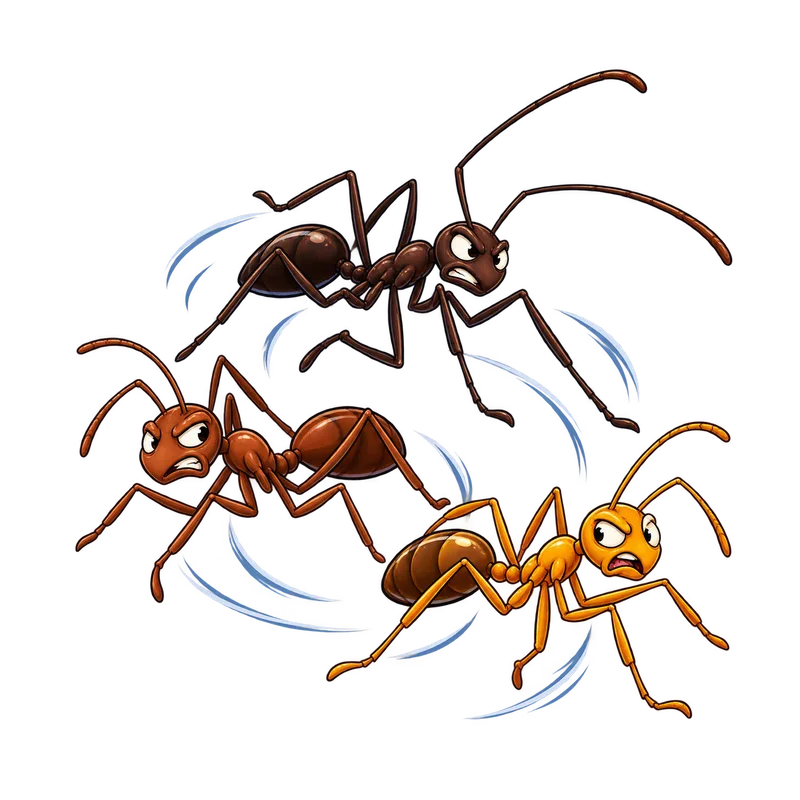
Fire ant workers run from 1/16 inch to 3/16 inch long, which is roughly 1.6 to 5 mm, and all of those sizes can come out of the same nest. Queens and winged males are noticeably larger than even the biggest workers.
What is actually going on
Picture a sunny afternoon. You kneel down by a mound of loose soil in the lawn, and a line of reddish-brown ants is busy hauling something back home. Something looks off: some of them are barely more than specks, and others are clearly three times bigger, all marching in the same trail. So how big are fire ants, exactly?
The short answer: workers run from about 1/16 inch to 3/16 inch long, roughly 1.6 to 5 mm, and all of those sizes can come out of the same nest. Fire ants are what entomologists call polymorphic, which simply means one colony produces workers in a continuous spread of sizes. The smallest, called minors, are about the size of a sharpened pencil tip. The biggest, the majors, top out around a fifth of an inch. In between you get every intermediate size, like a family walking down the sidewalk with the adults, the teenagers and the little kids all in one group.
That size mix is not a defect. It is the whole design. The big majors do the heavy work: foraging, defending the nest and storing liquid food in their expandable stomachs. The tiny minors stay inside and nurse the eggs and larvae. So if you see different-sized reddish ants sharing one trail, you are not looking at two species cooperating. You are looking at one well-organized workforce.
Two exceptions are worth knowing. First, a brand-new colony tells a different story. When a lone queen starts a nest, she raises her first brood entirely on her own body reserves, and those first workers, called minims, come out unusually small and all roughly the same size. For the first few months a young colony can look like a single-size ant, which fools people. Second, the royalty is bigger. Queens and the winged males are noticeably larger than even the biggest workers, the males darker in color with oddly small heads for their bodies. If you ever spot a chunky winged ant near a mound after a warm rain, that is the next generation leaving home, not just a big worker.
How to tell for sure
Size alone will not nail the identification, because plenty of other small reddish ants exist. The size variation is your first clue, though. Most of the ants people confuse with fire ants are monomorphic, meaning every worker comes out the same size. Tawny crazy ants are all about 1/8 inch, ghost ants are minute at around 1.3 to 1.5 mm, odorous house ants run a fairly even 1/16 to 1/8 inch, and pharaoh ants are tiny at about 1/32 inch. So a trail of identical ants usually points away from fire ants, and a trail of mixed sizes usually points toward them. Usually is doing some work in that sentence, because a very young colony, as mentioned, can break the pattern.
For a confident call, catch a few workers and look at them under a 10x hand lens, the way you would check the fine detail on a coin. Three things matter. The waist should have two distinct little bumps, two nodes between the middle body section and the rear section, where carpenter ants, crazy ants and Argentine ants have only one. The antenna should have 10 segments ending in a two-segmented club, like a tiny two-bead tip. And the rear end carries a functional stinger, which is why the sting burns and why the white pustules show up a day later. Red imported fire ants are reddish-brown with a shinier, darker rear section, and the black imported fire ant found in the Mid-South shares the same size range and build.
The mound helps too. An undisturbed fire ant mound has no entrance hole on top. Workers come and go through side tunnels that surface a foot or more away, which is why poking the top seems to summon ants from nowhere. If you want a low-risk field test, extension services have long used the greasy potato chip trick: lay one on the lawn near a suspected nest and check back in half an hour. Fire ants find oily, protein-rich food fast and recruit a crowd along a scent trail. Just keep your fingers clear of the welcoming committee.
What usually comes next
Once you have figured out what is out in the yard, the main choice comes down to spreading bait over the lawn or trying to treat individual mounds, and the biology of the insects practically makes that decision for you. Here is something that surprises most homeowners: adult fire ants cannot swallow solid food. They have a built-in filter in the throat that stops solid bits, meaning they live strictly on a liquid diet. Solid bits get dragged back to the older larvae, which act like the colony's processing units, breaking down the food and spitting up a nutrient-rich liquid that feeds the rest of the workers and, most importantly, the queen.
That feeding habit is why broadcast baits are so effective. Forager ants scoop up the tiny poisoned particles, the larvae process them, and the toxic ingredient finally makes its way to the queen through this shared food chain. Drenching or spraying a single mound on your own often just upsets them. The queen usually sits too far down to touch, and colonies with several queens will simply split apart and build new nests nearby when disturbed. You can easily turn one headache into three by pouring a kettle of hot water over a mound. Whatever commercial treatment you use, read the label carefully and follow it to the letter, since those directions are legally binding and thoroughly tested.
A few basic yard maintenance habits help keep things manageable in the interim: keep outdoor food sealed, fix dripping outdoor faucets, trim shrubs away from exterior walls, and get rid of sap-sucking insects on your garden plants, because fire ants love to harvest their sweet secretions. One more quirk worth knowing is that during hot, dry weather, mounds can seemingly disappear from the surface while the colony simply retreats deeper underground where it is cool. If you happen to be shifting dirt, sod or potted plants around, remember that agricultural quarantine rules restrict moving these items out of infested areas. Pests travel much farther in a delivery truck than they ever could on their own legs.
When to get help
Certain scenarios go well beyond standard weekend yard work, and calling in backup is the smartest move. As for your health, fire ant stings are notoriously painful and distinct from ordinary bug bites. They burn like fire right away and typically turn into itchy white pustules that stick around for days. A handful of stings on your leg is painful but usually treats itself with time. If you get stung many times at once, notice swelling that spreads, or experience whole-body symptoms like dizziness, trouble breathing or a swollen face and throat, treat it as a medical emergency. Seek immediate help or call poison control, and do not gamble on whether the reaction will fade.
For property issues, bring in a licensed pest control operator when the infestation covers too much ground for a DIY approach. Multiple mounds scattered across a large yard often point to a complex infestation with several queens, which requires specialized products. Ants invading your home through wall voids or beneath flooring also call for professional tools, as does any lingering doubt about identification, since distinguishing fire ants from harmless cousins sometimes requires a laboratory microscope. A particularly weird warning sign involves electrical gear: fire ants are strangely attracted to current and regularly nest inside utility meters, air conditioning units and junction boxes, where they chew wiring and cause short circuits. If you find ants swarming an electrical panel, back away and let a professional handle it.
So, to circle back to your question. The ants in that lawn trail measure anywhere from 1/16 inch to roughly 3/16 inch, the queen is larger, and finding those mixed sizes marching together remains one of the best field clues you can have. Check their size, look at them through a lens, and let the bait do the heavy lifting.