
What are black fire ants?
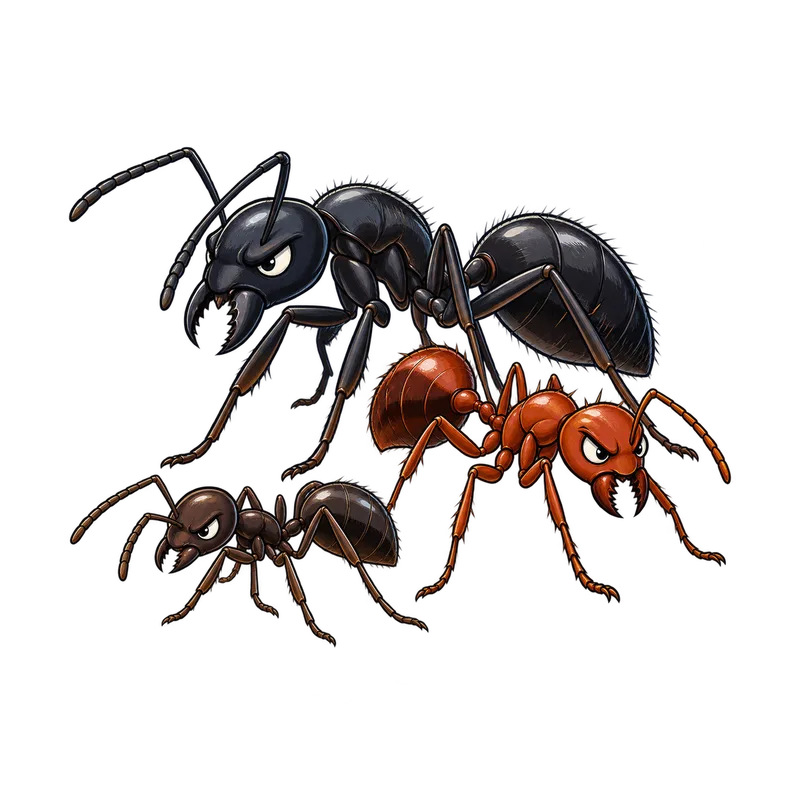
Black fire ants are aggressive, mound-building pests originally brought over from South America that have settled across the Southern United States. They feature a narrow waist with two distinct nodes and possess a stinger that injects a specialized venom. This venom destroys skin cells and causes a sterile, fluid-filled pustule to form within twenty-four hours.
What is actually going on
You are out mowing the lawn on a warm Saturday afternoon, step slightly off the smooth grass into an unassuming patch of loose dirt, and suddenly feel a sharp, pricking sensation across your ankles. Within seconds, your skin feels as though someone pressed a lit cigarette against it, and before you can even make it back to the porch, a cluster of angry red bumps starts appearing. You are dealing with black fire ants, aggressive mound-building pests originally brought over from South America that have settled comfortably across the Southern United States.
These insects are eusocial, meaning they live in highly organized colonies featuring a queen, winged reproductive males and females, and sterile female workers who handle the day-to-day defense of the nest. Unlike many other common ants you might find trailing across your kitchen counter, fire ants do not just bite with their mandibles. They anchor themselves with their jaws and use a stinger at the rear to inject a specialized venom straight into your skin.
What sets this venom apart is its unique chemistry. While most stinging insects rely on protein-based venoms, fire ant venom consists almost entirely of oily, toxic alkaloids. When those alkaloids enter your skin, they destroy epidermal cells, trigger an intense burning pain, and cause the body to form a sterile, fluid-filled pustule within twenty-four hours. It is less like a traditional insect sting and more like a microscopic chemical burn.
While they thrive outdoors in pastures, golf courses, parks, and sunny lawns, their presence changes how you use your yard. They do not just wander around looking for crumbs. They excavate extensive underground galleries, pushing soil upward to form those familiar mounds that pop up overnight. Disturbing one of those mounds triggers a coordinated defensive response from hundreds of workers, making casual yard work a genuinely painful experience if you miss the warning signs.
How to tell for sure
Trying to identify an ant while it is actively running across your shoe is nearly impossible, so you usually need a stationary specimen and a bit of magnification to know what you are looking at. If you manage to catch one and place it under a ten times hand lens, look closely at the narrow waist section connecting the thorax to the abdomen. Fire ants possess two distinct nodes on that waist, which separates them from one-node ants like carpenter ants or Argentine ants.
Another telltale sign is the physical structure of the nest. Fire ants build prominent dirt mounds in open, sunlit areas, usually lacking a visible central entrance hole on top because workers tunnel in and out from underground subterranean pathways. If you kick a mound, native ants might scatter or try to hide, but fire ants usually swarm up vertical surfaces in massive, aggressive numbers within seconds.
Homeowners frequently confuse swarming winged ants with subterranean termites during mating season, but the differences are straightforward if you know what to check. Ants feature elbowed antennae, a narrow constricted waist, visible eyes, and two pairs of wings where the front pair is noticeably larger than the back pair. Termites, by contrast, sport straight beadlike antennae, a thick unconstricted waist, no eyes in the worker or soldier castes, and four wings of identical length.
While a hand lens can confirm the two-node waist of a fire ant, telling the difference between a black imported fire ant, a red imported fire ant, or native southern fire ants usually requires a specialist with high-power laboratory optics or biochemical testing. For daily practical purposes at home, though, confirming the two-node waist and the aggressive mound behavior is usually enough to identify the threat.
What usually comes next
Once you spot an active fire ant mound right where your children or pets play, the big practical choice you face is deciding between a fast knockdown spray and a slow-acting bait. It is easy to grab a quick-acting contact aerosol from the shelf and blast the top of the pile, but that trick usually backfires. Fast sprays wipe out the surface workers right away, which often causes the surviving insects to seal their tunnels, push the queen deeper underground, or split the colony into several smaller nests across your lawn.
If you want to clear out the whole colony instead of just making them mad, you generally need to use slow-acting granular baits. These formulas feature active ingredients that leave the foraging workers alive at first. Instead of dying on the spot, the workers carry the bait back and share it with the rest of the nest through a natural food-passing routine, eventually reaching the queen and shutting down the entire operation from within.
Picking the right method depends a lot on the size of the infestation and how much time you have. If you are looking at a huge network of mounds spread across a large property, trying a do-it-yourself fix rarely pans out, and calling in a licensed pest management professional is usually the smartest call. Whenever you decide to apply a store-bought product yourself, keep in mind that the product label is a legal document, meaning you have to follow every direction exactly without changing the mixing rates or application tricks.
When to get help
Fire ant stings hurt anyone who crosses them, but they can turn serious fast depending on how your body reacts. If you or someone near you gets stung and starts feeling dizzy, swelling up far away from the sting mark, struggling to breathe, wheezing, or running a rapid pulse, those are red flags for a systemic allergic reaction called anaphylaxis, and you need to get emergency medical help right away. People who already know they have severe hypersensitivity should always keep a prescribed epinephrine kit nearby.
Even if you do not have a full-blown allergy, getting hit by multiple stings calls for quick first aid. You must take off all rings, watches, and bracelets from the affected limbs right away because hands and arms can blow up in size within minutes from fluid buildup, turning tight jewelry into a dangerous band that cuts off blood circulation. Wash the area with soap and water, prop the limb up to cut down on swelling, use a soothing topical cream to handle the intense itch, and leave those pustules alone instead of popping them, which can invite bacteria and cause secondary infections.
Outside of medical worries, you should bring in pest control professionals when you face sprawling mound networks across your yard, or when nests pop up right next to sensitive spots like electrical boxes, air conditioning units, or kids' swing sets. When store-bought baits simply do not finish off the colonies, expert help keeps your outdoor space safe and stops the endless cycle of stings.