
Carpenter ant workers vs winged ants: what differs?
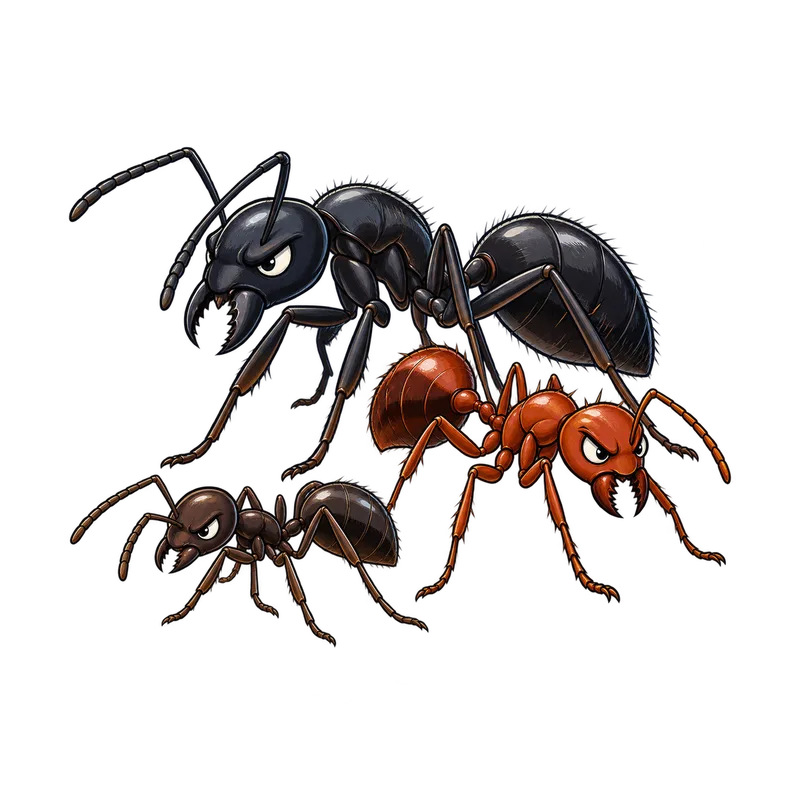
Carpenter ant workers are wingless, sterile females that forage for food and carve nesting galleries in wood, and they never grow wings. Winged carpenter ants are sexually mature males and virgin queens, about twice the size, that a mature colony releases once a year to mate and start new colonies.
What is actually going on
You are standing in the kitchen on a bright Tuesday morning, staring down at a curious little creature crawling near the baseboard. It has a pinched waist and elbowed antennae. Then, a few weeks later, you might spot something completely different near the window sill, an insect twice the size with shimmering, translucent wings. It is easy to assume you are dealing with an entirely different bug invasion, but those two insects are actually members of the exact same household.
The small, wingless ants you see marching across the floor day in and day out are the workers. Think of them as the nonstop maintenance, construction, and supply crew of a bustling city. They are sterile females, and they stay wingless their entire lives. They range quite a bit in size, anywhere from four and a half to eleven millimeters, because colonies produce different physical castes to handle specific chores. Some forage for sweet liquids and insects, while others stay behind to expand galleries inside your wooden framing.
The winged visitors, often called swarmers or alates, are a completely different division. If the workers are the ground crew, these winged versions are essentially specialized space pods launched once a year from a mature metropolis to navigate into the unknown and attempt to start brand-new colonies. They do not forage, they do not chew wood, and they do not care about your pantry crumbs. They are sexually mature males and virgin queens, produced only after a colony has spent three to six years maturing and building up a population of roughly two thousand workers. Once warm spring or early summer weather arrives, they emerge in a synchronized flight to mate, after which the males die and the fertilized females drop their wings to find a damp wooden crevice and lay an initial batch of eggs.
How to tell for sure
People often confuse winged carpenter ants with termites, which can lead to entirely the wrong control strategy. Fortunately, a few reliable physical cues make the distinction clear without requiring a laboratory microscope.
Look closely at the waist. Carpenter ants usually feature a narrow, constricted waist, giving them an hourglass figure, while termites possess a thick, uniform, cylinder-like body with no waist constriction at all. Next, check the antennae. Ant antennae are usually jointed and bent like a tiny hockey stick with a long basal segment, whereas termite antennae look like a straight, delicate string of tiny round beads. Finally, examine the wings if they are present. A winged carpenter ant usually has two pairs of wings where the front pair is noticeably larger and longer than the back pair, while a termite usually has four wings of identical length and shape.
When you find workers instead of swarmers, check what they leave behind. Carpenter ants do not digest wood. They chew through structural framing just to carve out nesting space, pushing the debris out through tiny slit-like openings. This leaves behind piles of clean, fibrous wood shavings that look remarkably like pencil shavings from a hand sharpener. Their galleries inside the timber are exceptionally smooth and sandpapered in appearance, usually free of any mud or soil. Termites, by contrast, pack their galleries with mud and soil. If you spot piles of coarse sawdust beneath a window sill or a door frame, you are looking at the handiwork of carpenter ant workers.
What usually comes next
Finding winged ants indoors during late winter or early spring usually means an established, mature nest is hiding somewhere inside the heated structure of your home, such as a wall void or a crawl space. Finding a single winged ant near a window in the dead of summer, however, might just mean an outdoor traveler wandered inside toward the light.
Your most practical decision centers on locating the nest itself, because spraying foraging workers with a surface insecticide in the kitchen provides only temporary relief and leaves the egg-laying queen safely tucked away inside her timber cavity. Start by inspecting areas prone to moisture, such as leaky plumbing under sinks, poorly sealed window frames, and damp porch posts. Follow foraging workers at night using a flashlight to track them back to their entry points.
Because carpenter ants usually nest in wood that has already been softened by water leaks or fungal decay, fixing plumbing drips and repairing roof or gutter leaks usually cuts off the appeal of the space. Clear away vegetation touching the house, and store firewood elevated and away from the foundation. When you collect specimens for identification, drop them into a clean container or a vial of rubbing alcohol to inspect their features carefully before deciding on a treatment path.
When to get help
Structural damage from carpenter ants accumulates over years. When an infestation goes unnoticed, workers can hollow out load-bearing wall studs, window headers, and roof rafters until the framing sags or local structural failure occurs.
Call in a professional pest control service when you cannot find the nest despite nighttime tracking, or when you suspect satellite nests are tucked deep within inaccessible wall voids, subfloor crawl spaces, or roof framing. You should also bring in a licensed building contractor or structural engineer if the framing displays visible damage, deflection, or soft spots that require reinforcement.
Where chemical treatments, specialized baiting programs, or direct dust injections into wall voids are necessary, leave the application to a licensed pest control applicator who operates under current regulations and product label guidelines. If you suspect pesticide exposure or experience an adverse health reaction, contact poison control or a clinician immediately.