
What are crazy ants?
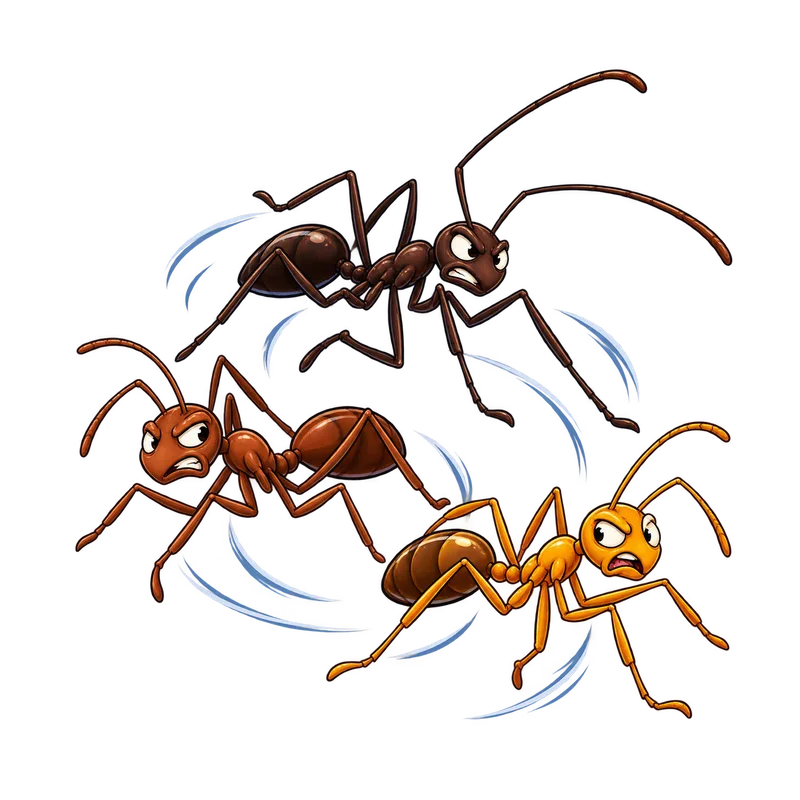
Crazy ants are invasive insects that form massive supercolonies and move in a jerky, erratic sprint. The workers measure about one-eighth of an inch long and feature exceptionally long legs. They spread primarily through colony budding or human transport, and they are known to nest beneath mulch and behind structural siding.
What is actually going on
Imagine stepping out to water the patio on a warm afternoon and noticing a patch of ground that looks like it is vibrating. Closer inspection reveals thousands of tiny brown ants darting back and forth in a frantic, non-linear sprint. They do not march in neat, orderly foraging lines like the sidewalk ants you are used to seeing. Instead, they bounce around like tiny pinballs, moving with a jerky, erratic urgency that makes you wonder if they have lost their minds. That is where they get their common name.
Crazy ants are invasive insects belonging to the subfamily Formicinae, most notably the tawny crazy ant and the longhorn crazy ant. Unlike native species that build neat mounds in the yard, these ants form massive supercolonies containing millions of workers and multiple egg-laying queens. They do not respect property lines or maintain territorial aggression toward neighboring nests. They live as an interconnected megacity beneath your mulch, under patio pavers, inside damp leaf litter, and behind structural siding.
They are remarkably adaptable and have a talent for expanding their territory. Because functional mating flights are rare or nonexistent in invasive populations, they spread primarily through colony budding, where queens and workers simply walk away from the main nest to start a satellite home nearby. Long-distance travel usually happens by accident through human transport. A potted plant, a bundle of pine straw, or a load of landscaping mulch can harbor a hidden founder colony and introduce them to an entirely new neighborhood overnight.
How to tell for sure
Positive identification usually requires a careful look at physical characteristics because several small ant species look similar at a glance. Workers are monomorphic, meaning every single worker in the colony is identical in size, measuring about one-eighth of an inch long. They feature twelve-segmented antennae without a club at the tip, exceptionally long legs, and a single, small petiolar node tucked between the thorax and abdomen.
If you are trying to separate them from other common household invaders, a few reliable cues usually help. Unlike carpenter ants or fire ants, crazy ants lack a venomous stinger at the tip of the abdomen. Instead, they have a small circular opening called an acidopore surrounded by tiny hairs, through which they spray formic acid for defense. If you crush an odorous house ant, you get a sharp smell of rotten coconut or blue cheese. Crazy ants do not produce that scent profile at all.
For an absolute, definitive confirmation of the tawny crazy ant, an entomologist has to look under a microscope at high magnification to verify two pairs of erect macrosetae, which are stiff standing hairs, on a specific part of the thorax. If you need a firm answer before taking action, collecting twenty or so workers in a small vial of rubbing alcohol and dropping them off at a local university extension service is usually the smartest move.
What usually comes next
Finding a bustling trail of these insects across the back porch usually prompts an instinctive reach for a can of household bug spray. Put that can down. Standard consumer sprays and basic barrier treatments applied around the foundation usually fail within a few days because the sheer outdoor population pressure simply overwhelms the treated strip. Worse yet, indoor space sprays often cause a foraging trail to fracture, driving the ants deeper into wall voids and making the infestation harder to manage.
Dealing with an established supercolony requires a multi-tactic approach that starts with habitat modification. You have to remove their preferred shelter by clearing away leaf litter, fallen branches, and unnecessary debris resting directly on the soil near your home. Trim tree branches and shrubs so they do not touch exterior walls, and fix leaky outdoor spigots or broken irrigation heads to cut off the moisture they crave.
Once the yard is cleaned up and dried out, chemical control relies heavily on a coordinated strategy. Placing sweet liquid baits or granular baits in the early spring can intercept foraging workers before populations peak. For severe supercolony pressure, professional pest management companies often apply non-repellent liquid contact insecticides in a wide buffer zone extending well beyond the immediate foundation. If a treatment leaves behind massive piles of dead ants along the patio edges, sweep or blow them away with a broom. Never hose the area down with water, because moisture washes away the residual pesticide and undoes all your hard work.
When to get help
There are moments when a weekend DIY project crosses the line into territory that requires outside intervention. If you notice massive foraging trails four inches wide, or spot worker ants streaming relentlessly into your air conditioning unit, well pump switches, or circuit breaker panels, call a professional immediately. Crazy ants have a bizarre attraction to electrical equipment, and the accumulation of dead bugs inside switches can cause short circuits, equipment failure, and expensive repair bills.
From a health standpoint, crazy ants do not vector human blood-borne pathogens and they cannot deliver a venomous sting. However, their sheer numbers can cause immense psychological distress, and the formic acid they spray can occasionally cause skin or eye irritation. Never attempt to self-diagnose skin marks or bites as belonging to crazy ants based on a photograph or a description alone. Anyone experiencing persistent skin irritation, secondary infections from scratching, or signs of an allergic reaction should consult a qualified clinician or medical professional right away.
Remember that all pesticide applications are strictly governed by product label law. Trying to solve a major supercolony invasion with off-label chemical mixtures or unapproved application methods is illegal and dangerous. When an infestation feels too large to handle or resists basic sanitation and baiting efforts, reach out to a licensed pest control operator who can deploy specialized non-repellent chemistry safely and effectively.