
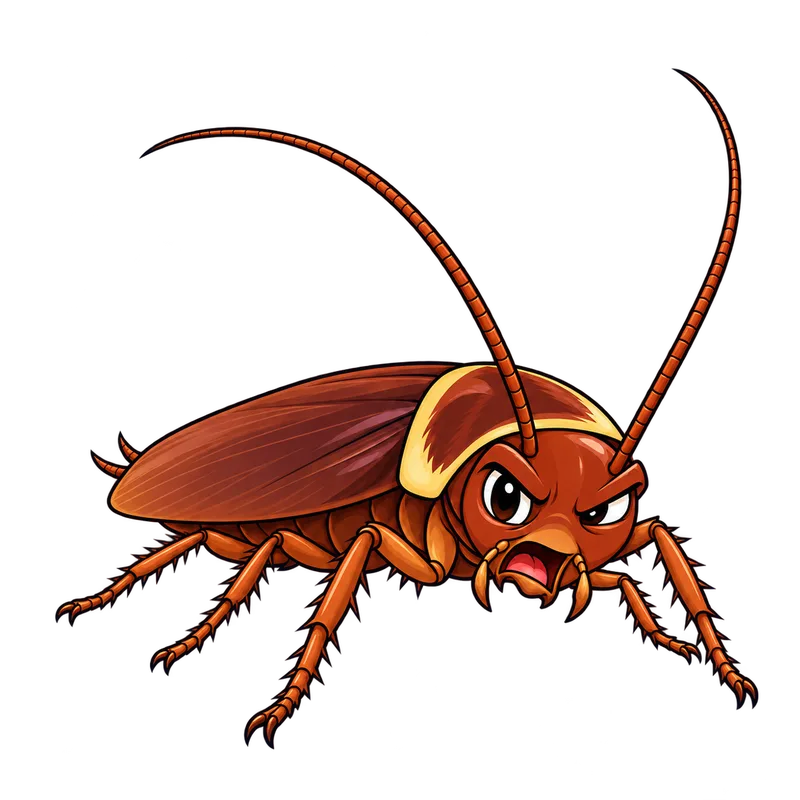
American cockroach
Periplaneta americana
- Size
- 1 1/2 to 2 inches (38 to 51 mm)
- Color
- Reddish brown, pale yellow pronotal border
- Habitat
- Warm, damp basements, drains, sewers
- Diet
- Omnivorous scavenger; decaying matter, starches, glue
- Life cycle
- Egg, nymph, adult; often over 1 year
The American cockroach, Periplaneta americana, is a true cockroach despite the water bug nickname, and the one you meet indoors has often come up from a drain, sewer line, boiler room or damp basement rather than out of a dirty kitchen. It is built for warm, wet hidden places, which is why it can appear in a spotless house after heavy rain or a heat wave and still say nothing useful about your housekeeping.
Identity
The first thing to look for is the shield behind the head, the pronotum: reddish chestnut in the middle with a pale yellow rim, like someone outlined it with a highlighter. On an adult this is visible from a few feet away in decent light, and the insect is plainly too broad and too glossy to be one of the little tan kitchen roaches.
Both sexes have full wings that cover the abdomen or reach just past its tip, but the wings are mostly for downhill travel. Adults run very fast on spiny legs and usually glide from a wall, tree or ceiling rather than flying up at you like a wasp. If one seems to launch itself across the room, the usual story is that it lost altitude badly, not that it has become a fly.
The fine print needs a hand lens. The last segment of each cercus, the paired tail feelers at the rear, is about twice as long as wide at roughly 10x magnification. That tiny proportion matters because the very similar brown cockroach has a shorter final cercus segment, and nobody wants their identification to hinge on a guess.
The egg case is another good clue if you find one glued in a crack: a symmetrical purse shaped capsule, brown when fresh and turning dark brown to black within a day. The female carries it for only around 24 hours before sticking it somewhere protected, unlike the German cockroach that hauls hers almost to hatching.
Habitat & behaviour
This species likes warm, dark, damp air, especially places around 82 degrees Fahrenheit (28 degrees Celsius) and above: floor drains, sump pits, pipe chases, laundry rooms, boiler and furnace rooms, steam tunnels, storm drains and municipal sewers. Outdoors in warm months it uses mulch beds, leaf litter, woodpiles, garbage areas, outbuildings and manholes, then moves inward when weather turns hostile.
Extreme heat and drought push it toward moisture. Flooding pushes it upward out of submerged drains. Dry floor drain traps and unsealed utility penetrations are basically open doors, which is why a ground floor bathroom can produce a specimen even when the kitchen is clean enough to perform surgery in.
It is strictly nocturnal. Seeing one in daylight usually means the population is crowded, the harborage was disturbed, or a lone wanderer got caught out after sunrise; context matters more than panic. At night it forages as an omnivorous scavenger with a weakness for decaying and fermenting material, but it will also work through starch sizing, wallpaper paste, envelope glue, book bindings, soap, hair, fabrics and ordinary food crumbs.
The pace of life runs slow for this insect. Nymphs molt many times, often taking most of a year or more indoors, and can stretch that timeline much further when temperatures drop, air dries out or food runs short. An adult female can live long enough to drop a small series of egg capsules, which is why a few sightings near floor drains deserve attention even when the kitchen counter is spotless.
Visual variations
Adults are the glossy reddish brown beetles with the yellow edged shield behind the head and full leathery forewings. Males and females look much alike from above, so reliable sexing requires turning the bug over to inspect the tail end, where males sport a pair of small appendages called styles that females lack.
Nymphs are wingless, oval and spiny legged, starting as a dull grayish brown after hatching and turning shinier reddish brown through each growth stage. Late nymphs show little wing pads instead of functional wings, which keeps them from being confused with fully grown adults. Freshly molted nymphs stay stark white for several hours while the new outer shell hardens, a ghostly phase that homeowners often mistake for a rare albino roach.
The egg capsule changes appearance as well, starting light brown and shifting to nearly black as the shell cures. Because the female drops the package quickly, you find these cases tucked into tight crevices, behind stored cardboard, near drains and along masonry rather than attached to the mother.
Why it matters
Its primary indoor impact involves contamination and allergy rather than structural damage to wood or drywall. It can carry bacteria such as Salmonella, Shigella, Staphylococcus and Streptococcus from dirty spots to kitchen surfaces, while its shed skins, saliva and droppings turn into hidden allergenic dust, and certain roach proteins can trigger cross reactions with shrimp and dust mite allergies. Anyone dealing with severe breathing trouble, suspected food poisoning or a bad reaction should consult a clinician or poison control rather than relying on a reference page.
Accurate identification counts because these large reddish cockroaches tend to get lumped together. The Australian cockroach wears a bright yellow streak on the side of each front wing that the American lacks, the smoky brown cockroach is uniformly dark with no pale shield border, the German cockroach stays much smaller and tan with two dark stripes, the Oriental cockroach is darker with short wings and no flight, and the brown cockroach gives away its identity only under a hand lens. In commercial kitchens, apartment buildings, hospitals or stubborn sewer invasions, sorting out the species and handling the treatment belongs with licensed professionals following product labels. For an ordinary homeowner, the main takeaway is straightforward: check your plumbing, drains and entry points for moisture before blaming the crumbs.
Similar species
 Oriental cockroachBlatta orientalis
 Brown-banded cockroachSupella longipalpa
 Smokybrown cockroachPeriplaneta fuliginosa
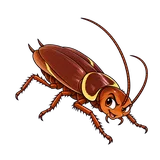 Australian cockroachPeriplaneta australasiae
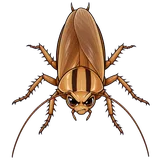 Asian cockroachBlattella asahinai
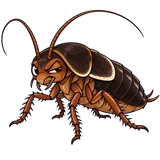 Turkestan cockroachShelfordella lateralis / Blatta lateralis / Periplaneta lateralis