
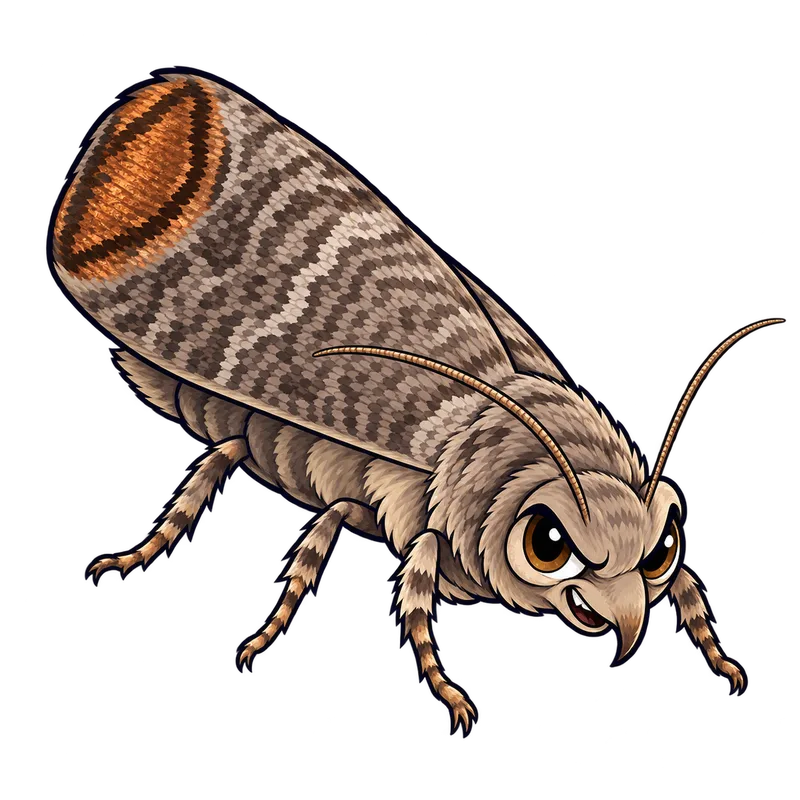
Codling moth
Cydia pomonella
- Size
- Approximately 1/2 inch long
- Color
- Pinkish-white body with a brown head
- Habitat
- Orchard tree canopies and surrounding wild host trees
- Diet
- Cultivated apples and wild host fruits
- Life cycle
- Two to three generations per year
The codling moth, scientifically known as Cydia pomonella, is an agricultural pest whose larval stage is the creature behind the familiar sight of a caterpillar tunneling through the core of an apple. You will typically run into this insect while harvesting or inspecting fruit in backyard orchards and commercial growing regions where apple trees are cultivated.
Identity
The field marks that separate this species from its look-alikes. What a reader can actually see, and at what distance or magnification.
When you cut open a ruined apple, the creature you find is a pinkish-white caterpillar that reaches approximately 1/2 inch in length when mature, featuring a distinct brown head capsule. Unlike legless fly maggots or beetle grubs, this caterpillar possesses functional legs, which gives it away as a member of the Lepidoptera order. Telling it apart from similar insects requires looking closely at the damage and the anatomy. The oriental fruit moth and the lesser appleworm cause nearly identical internal boring injury, making it impossible to separate them by sight alone without species-specific pheromone monitoring traps. Other fruit pests leave different calling cards. The plum curculio is a snout beetle whose larvae are legless grubs, and the adult female leaves a distinctive crescent-shaped cut on the young fruit skin. The apple maggot, on the other hand, is a headless fly larva that leaves winding brown decay trails throughout the flesh rather than a clean burrow leading to the core. Leafrollers also chew on apples, but they tend to feed externally on the surface skin and fold leaves over with silk, whereas the codling moth heads straight for the interior.
Habitat & behaviour
Where it lives, when it is active, and what draws it in.
Winter is spent as a mature larva tucked inside a protective silken cocoon hidden beneath loose tree bark flakes or among plant debris on the ground. When spring arrives and the apple trees bloom, those overwintering larvae pupate, and adult moths emerge to mate and start the cycle anew. Depending on the region, such as Virginia, these moths complete two to three generations a year. Getting the timing right for management requires tracking degree-day heat unit models alongside sticky traps baited with synthetic pheromones to catch the exact moment adults emerge. Unmanaged alternate hosts like wild apple trees or hawthorns growing in nearby hedgerows or abandoned plots act as reservoirs. Mated female moths fly easily from these wild border areas into cultivated blocks, which explains why an isolated backyard tree can suffer heavy damage even if the owner takes careful precautions.
Visual variations
Nymph, adult and winged forms, and any difference between sexes or castes. The page reserves illustration slots for these, so describe what changes between them.
There is no social caste system here, as these insects live solitary lives until mating. The sexes are dioecious, and while males and females look alike at a glance, males are readily distinguished in field monitoring by their response to specific synthetic sex pheromone lures. The eggs are laid directly on foliage and fruit surfaces, though their microscopic details are easily missed without magnification. The most striking transformation occurs as the tiny newly hatched larva bores into the fruit, feeding and growing into a plump, pinkish-white caterpillar with a prominent brown head. After finishing its internal meal, it leaves the apple to spin a silken cocoon in a protected nook under the bark or in soil debris.
Why it matters
Damage, health notes, and when precise identification is required. One or two sentences on what its presence means, not a treatment guide.
An unmanaged infestation can destroy more than 95% of an apple crop by allowing larvae to tunnel deep into the fruit tissue and ruin the harvest. The presence of this pest means that fruit protection measures must be timed carefully around local biofix dates and flight periods. When biological treatments like the host-specific baculovirus Cydia pomonella Granulovirus are applied, larvae may still try to enter the apple before succumbing within 3 to 7 days, leaving behind small, shallow entry holes that heal over into corky spots known as stings.
Similar species
 Spongy mothLymantria dispar
 Browntail mothEuproctis chrysorrhoea
 Box tree mothCydalima perspectalis
 BagwormThyridopteryx ephemeraeformis
 Eastern tent caterpillarMalacosoma americanum
 Forest tent caterpillarMalacosoma disstria