
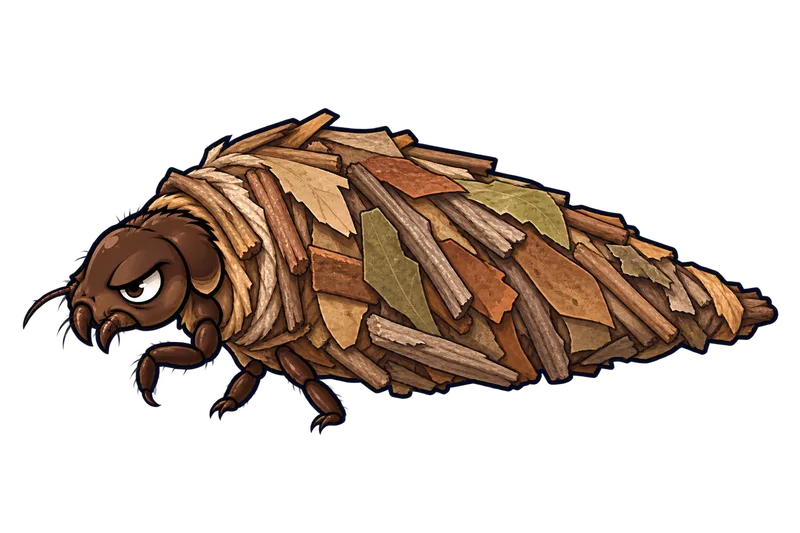
Bagworm
Thyridopteryx ephemeraeformis
- Size
- 1 to 2 inches long
- Color
- Brown, grey, or green depending on camouflage
- Habitat
- On deciduous and evergreen host trees
- Diet
- Leaves and needles of woody plants
- Life cycle
- One generation per year
What looks at first glance like a bit of dropped pine needle or a stray piece of dead twig hanging from your arborvitae is actually a portable housing unit. Bagworms are the caterpillars of certain moths in the family Psychidae, and they spend nearly their entire immature life inside a tough, spindle-shaped bag they spin themselves. Instead of building a fixed nest, the caterpillar drags its home everywhere it goes, sticking bits of host foliage, needles, and bark to the outside for camouflage. When it needs to feed or move, it simply sticks its head and front legs out of the front door, leaving its softer rear half safely tucked away inside. If you spot these hanging cases on your conifers or deciduous ornamentals, you are looking at an insect that has essentially turned your landscape plantings into both its grocery store and its hardware supply warehouse.
Habitat & behaviour
These caterpillars are remarkably unfussy eaters, though they show a definite preference for evergreen conifers like cedar, arborvitae, juniper, pine, and spruce, alongside plenty of deciduous trees like maple, birch, and apple. They chew through leaf tissue and evergreen needles, leaving behind ragged foliage and, in heavy infestations, entirely stripped branches that can kill a vulnerable evergreen because those species rarely flush new growth from bare wood. Their entire life revolves around a strict calendar. Overwintering eggs hatch into tiny larvae in late spring, usually arriving around late May in coastal regions and early to mid-June as you move inland. Once out, they start building their miniature bags immediately. By mid- to late summer, feeding slows down as the larvae mature, anchor their bags securely to twigs, and prepare to transform, making late-season interventions largely pointless because the occupants have effectively locked their doors and stopped eating.
Visual variations
The creatures go through a striking transformation that changes not just their shape, but their entire way of life. It starts as an overwintering egg tucked safely inside the mother's old bag, hatching into a tiny larva that immediately constructs a microscopic protective case. As the caterpillar grows through the summer, it continually enlarges its spindle-shaped bag, weaving in fresh bits of whatever plant it happens to be munching on at the moment. By the time it is fully grown, that portable shelter can reach lengths where prompt action is required, though the exact adult moth stage is an entirely different story. Adult males eventually emerge as winged, functional moths that leave their bags to find a mate, while adult females in many common species are wingless, legless, and never leave the protective casing at all, living out their days as little more than egg factories inside the very bag they inhabited as larvae.
Why it matters
Finding these spindle-shaped bags in your yard means you are dealing with a pest capable of turning a prized privacy hedge into a graveyard of brown, skeletonized twigs. If you catch them early when the bags are under half an inch long, you can often manage them by hand-picking or applying targeted biological controls like Bacillus thuringiensis, a natural bacterium that caterpillars must ingest to be effective. However, hand-picking comes with a hidden trap: you have to make sure you cut or peel away the tough band of silk the caterpillar wrapped around the twig to anchor its home. If you leave that silk ring behind, the branch will keep growing in thickness, but the tight band will act like a tourniquet, cutting off nutrients and killing the branch downstream all on its own. For large trees where hand removal is impossible, or when infestations cover entire canopies, timing your approach to match that early spring vulnerability window is the only way to keep your landscape intact.
Similar species
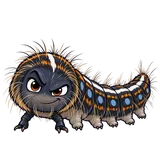 Eastern tent caterpillarMalacosoma americanum
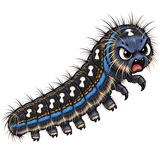 Forest tent caterpillarMalacosoma disstria
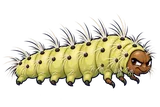 Fall webwormHyphantria cunea
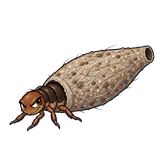 Household casebearer (plaster bagworm)Phereoeca uterella
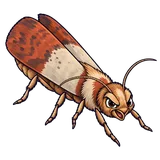 Indianmeal mothPlodia interpunctella
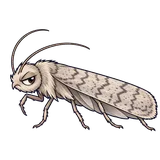 Mediterranean flour mothEphestia kuehniella