
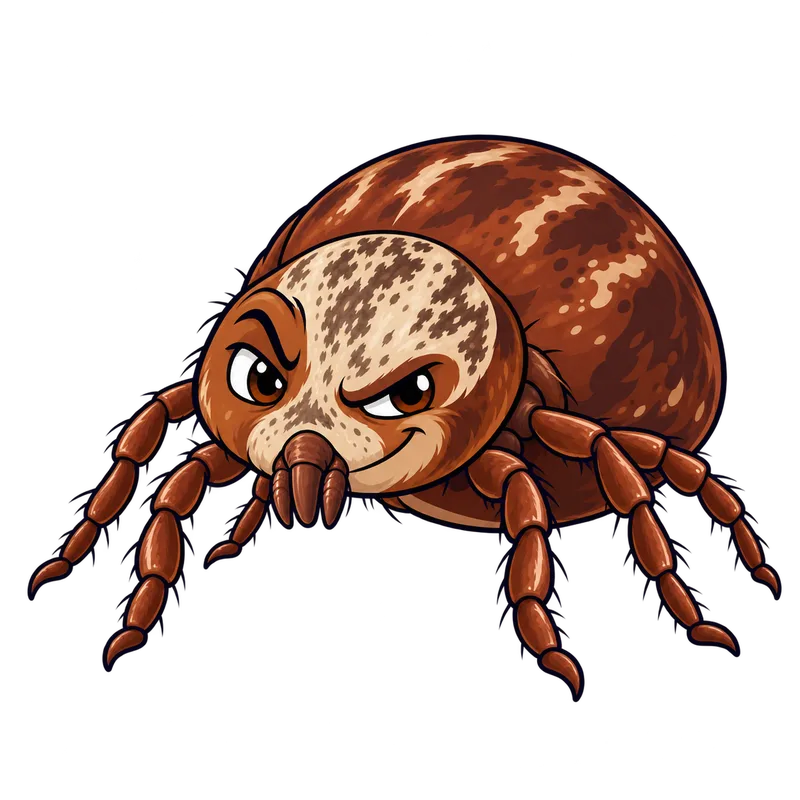
American dog tick
Dermacentor variabilis
- Size
- Variable by feeding stage; unfed to engorged up to 200x
- Color
- Reddish-brown with white and black ornamental markings
- Habitat
- Open brushland, tall grass fields, and shrubby pastures
- Diet
- Obligate blood-feeding ectoparasite across all active stages
- Life cycle
- Egg, larva, nymph, and adult requiring three separate hosts
The American dog tick is a hard-bodied arachnid, scientifically known as Dermacentor variabilis, that spends its life waiting in tall grass and overgrown brush for a large mammal to brush past. You will typically run into one on a domestic dog or on your own clothing after walking through a field or along a woodland edge. When you spot one, you are looking at an adult tick equipped with short mouthparts that anchor directly into the skin of its host.
Identity
Under modest magnification, physical identification relies on several distinct features. Adult females feature a prominent white dorsal shield, known as a scutum, located directly behind the mouthpart assembly, contrasting against an un-ornamented dark reddish-brown flexible body cuticle. Adult males wear their decoration differently, sporting a silver-white and black patterned shield that covers their entire back. Both sexes show dark brown legs marked with small white bands.
Telling this species apart from others comes down to those mouthparts and shields. The blacklegged tick, often called the deer tick, features a solid black shield, uniformly black legs, and noticeably longer mouthparts, and it is capable of transmitting Lyme disease. The American dog tick does not transmit Lyme disease. The lone star tick carries a single bright white dot right at the back of its shield and possesses long mouthparts. The brown dog tick lacks white markings entirely, opting for a uniform dark reddish-brown appearance and a habit of infesting indoor structures. A photograph or a glance at a skin mark cannot confirm a tick species, so positive identification requires looking at a physical specimen under magnification using formal taxonomic keys.
Habitat & behaviour
This tick is strictly an outdoor resident. You will not find it setting up housekeeping in your skirting boards or indoor pet beds. It prefers open brushland, tall grass fields, shrubby pasture margins, and overgrown road edges where wild animals and domestic pets cross paths.
Instead of hunting, these ticks practice patience. An adult climbs to the tip of a blade of grass or a low shrub, stretches out its front legs, and waits. Special sensory organs on those legs detect carbon dioxide, body heat, and physical vibrations from passing hosts. When a dog or a human brushes against the vegetation, the tick lets go of the plant and crawls upward in search of skin.
Activity peaks during the spring and summer months across the United States east of the Rocky Mountains and in specific parts of the Pacific Coast. Because they rely on ambient warmth to stay active, questing stops entirely when temperatures drop below forty-five degrees Fahrenheit or when snow covers the ground.
Visual variations
Since ticks belong to the arachnid family rather than the insect world, you can forget about finding any wings on them at any point in their lives. They do not build colonies or live in organized groups either, but their shapes shift in startling ways as they move through a four-stage life cycle made up of eggs, larvae, nymphs, and adults.
The microscopic larva crawls out with only six legs and immediately sets its sights on small wild rodents. Once it finishes a meal, it sheds its skin and turns into an eight-legged nymph. Both the larval and nymph stages stay exclusively on small animals, which explains why you will never pull an immature American dog tick off yourself or your children. Only the adult stage develops the size and eight-legged build needed to bother larger mammals like family dogs, livestock, and humans.
Adult males and females look quite different from each other. Females sport a small white shield on their front end and a stretchy rear section, which lets a mated female swell up to one or two hundred times her normal weight while feeding. Males wear a hard shield all the way across their backs, meaning they stay flat and never expand the way the females do after a heavy meal.
Why it matters
Spotting an American dog tick around your yard means your family's outdoor routes overlap with tick territory, which brings a few serious health risks to keep in mind. This species is known primarily for carrying Rocky Mountain spotted fever and tularemia, alongside a rare condition called tick paralysis that comes from a nerve poison found in their saliva during long feeding sessions. You usually have a bit of time because a tick needs to stay latched on for several hours before it can pass along certain infections.
If you discover a tick already biting, leave the matches, nail polish, and petroleum jelly alone. Grab a pair of fine-tipped tweezers, pinch the tick right against your skin, and pull straight up with a firm and steady pull without twisting or crushing the bug. Anyone who comes down with a fever, a pounding headache, sore muscles, or a strange rash after a tick encounter needs to check in with a doctor right away. As for keeping them off, sprays containing permethrin work well on clothing or as registered treatments for dogs, but keep in mind that permethrin is extremely toxic to cats and should never touch them.
Similar species
 Brown dog ticksRhipicephalus sanguineus
 Gulf Coast tickAmblyomma maculatum
 Rocky Mountain wood tickDermacentor andersoni
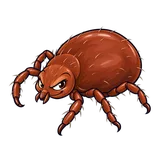 Asian longhorned tickHaemaphysalis longicornis
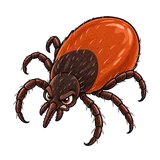 Castor bean tickIxodes ricinus
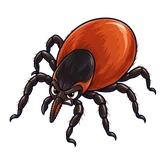 Blacklegged tickIxodes scapularis