
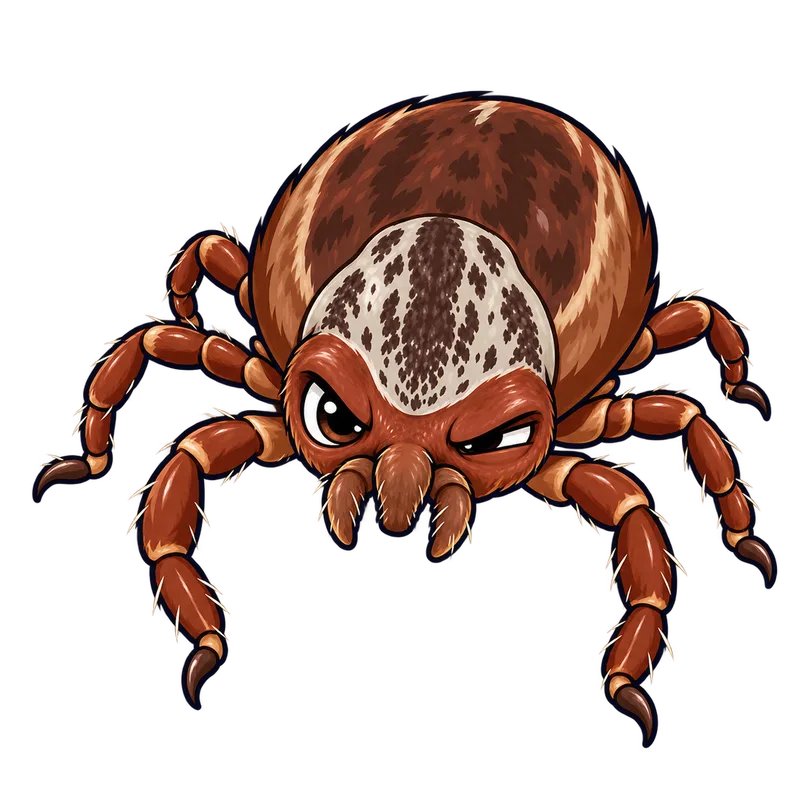
Rocky Mountain wood tick
Dermacentor andersoni
- Size
- 3 mm to 6 mm unfed
- Color
- Dark brown with silver-gray or cream patterns
- Habitat
- High-altitude brushlands and mountain meadows
- Diet
- Blood from mammals
- Life cycle
- Three-host cycle lasting up to 3 years
The Rocky Mountain wood tick is a hard-bodied arachnid, which means its upper surface features a hard, leathery shield known as a scutum. If you happen to trap one crawling up your sock after a hike in the mountains, you are looking at a creature built like a tiny, flat, oval-shaped shield. Adults measure between 3 mm and 6 mm long when unfed, though females expand into a swollen, mahogany-red balloon reaching up to 15 mm once they fill with blood.
Identity
To tell this tick apart from others, you need to look at its mouthparts and its back. The mouthparts are short and blocky, unlike the elongated mouthparts you see on deer ticks. The scutum on its back is ornamented with striking cream-white or silver-gray patterns over a dark brown base.
You cannot identify this species reliably from a blurry photograph or a red mark on your skin. Different bugs cause identical skin reactions, and many people bitten by ticks never develop a visible mark at all. If you want a definitive identification, you need a physical specimen examined under a magnifying lens or a microscope by someone who knows ticks.
Habitat & behaviour
This creature lives exclusively outdoors in rugged, elevated terrain. You will find it in high-altitude brushlands, shrubby mountain pastures, forest edges, and grassy meadows, generally sitting at elevations between 4,000 and 10,000 feet in western North America. It does not establish self-sustaining populations inside homes, so if you find one indoors, it hitchhiked inside on clothing or a pet.
The tick does not jump, fly, or drop from tree branches onto unsuspecting walkers. Instead, it practices questing. It climbs up low stems of grass or brush, usually staying under 20 inches from the ground, and holds its front legs out in the air. Specialized sensory organs on those front legs detect carbon dioxide, body heat, and vibrations from passing hosts. When you brush against the vegetation, the tick transfers directly to your clothing or skin.
Activity follows a strict seasonal calendar. As snow melts in early spring and temperatures climb above 45 degrees Fahrenheit, adult ticks wake up and start questing. Activity peaks through April, May, and June, then drops off sharply by mid-summer as dry conditions and heat drive the ticks into dormancy.
Visual variations
Because this species goes through four distinct life stages, what you find on a pet or your skin changes quite a bit depending on its age and sex. Larvae hatch from eggs with only six legs and are tiny, translucent, and difficult to spot without close inspection. Nymphs have eight legs and are larger than larvae, but they still lack functional reproductive organs.
Adults also have eight legs, but males and females look noticeably different once you put them under a hand lens. The adult male has a hard scutum that covers his entire back, decorated with a complex, mottled silver-white pattern. Because his back is completely covered in hard plate, the male cannot stretch or engorge significantly during feeding.
The adult female takes a different approach. Her scutum covers only the front third of her back, right behind her head. The rest of her dorsal surface is made of a soft, stretchable skin called the alloscutum. This design allows her to expand to many times her original weight when she feeds. Unmated females feed only a little, while mated females trigger a massive final surge in size, transforming from a flat brown disc into a bloated, cigar-shaped sac where the original shield looks like a tiny stamp stuck to the front end.
Why it matters
Finding one of these ticks on your skin means you have spent time in the right outdoor habitat at the right time of year, but it is not a reason to panic. The real concern stems from the pathogens some individuals carry. The Rocky Mountain wood tick can transmit the bacteria responsible for Rocky Mountain spotted fever and tularemia, along with the virus that causes Colorado tick fever, and toxins that can occasionally trigger tick paralysis after several days of feeding.
Crucially, this species does not transmit Lyme disease. That illness is carried by entirely different ticks found in other regions.
When you find an attached tick, prompt removal is your best defense. Grab it close to your skin with fine-tipped tweezers and pull straight up with steady pressure. Do not bother with old tricks like dabbing it with petroleum jelly, touching it with a hot match, or painting it with nail polish. Those methods only stress the tick and may cause it to regurgitate fluids into the bite. If you develop a fever, severe headache, muscle aches, or a rash in the weeks following a tick bite, consult a healthcare provider right away.
Similar species
 Asian longhorned tickHaemaphysalis longicornis
 Castor bean tickIxodes ricinus
 Blacklegged tickIxodes scapularis
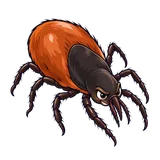 Western blacklegged tickIxodes pacificus
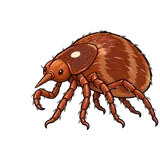 Lone star tickAmblyomma americanum
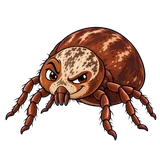 American dog tickDermacentor variabilis