
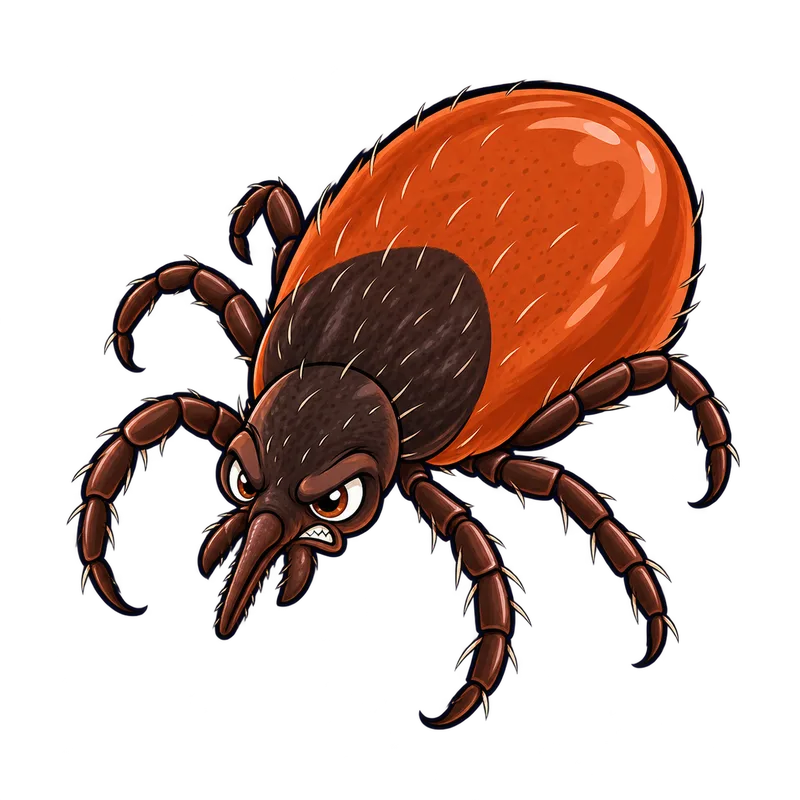
Castor bean tick
Ixodes ricinus
- Size
- Unfed female 3 to 3.5 mm, engorged up to 11 mm
- Color
- Orange-brown to reddish-brown, shifting to slate-grey when engorged
- Habitat
- High-moisture terrestrial environments, woodlands, heathlands, and damp brush
- Diet
- Obligate blood-feeding ectoparasite on vertebrates
- Life cycle
- Mandatory 3-host life cycle taking approximately 3 years
The castor bean tick is an exophilic, three-host arachnid that spends most of its existence waiting in low vegetation rather than actively hunting. Unfed adult females measure roughly 3 to 3.5 mm in length, sporting an orange-brown to reddish-brown posterior section paired with a dark brown or black shield just behind the mouthparts. Unfed males stay slightly smaller at 2.5 to 3 mm, featuring a uniform dark reddish-brown dorsal surface that covers nearly the entire back. To confirm identity in the field or laboratory, you need at least a 10x hand lens magnification for a preliminary genus check, while a proper species-level distinction demands microscopic examination at 40x magnification or higher. Look-alikes vary by region, causing endless confusion for hikers and gardeners. In the United Kingdom and Europe, the castor bean tick shares its environment with the hedgehog tick and the taiga tick, the latter of which serves as a vector for the Tick-Borne Encephalitis Virus across Eastern Europe and Asia. In North America, the ecological equivalent for Lyme disease transmission is the blacklegged tick in the East and the Western blacklegged tick on the Pacific Coast. Crucially, a photograph of a bite mark, a skin lesion, or a host animal can never confirm the specific tick species. Definitive identification requires a preserved physical specimen examined under a stereomicroscope by a trained entomologist using an authoritative taxonomic key.
Habitat & behaviour
This species thrives in high-moisture terrestrial environments such as deciduous and mixed woodlands, woodland margins, grazed rough pastures, heathlands, moorlands, and damp brush. You can also run into them in urban parks, suburban nature reserves, and wildlife-accessible gardens. Because they are highly susceptible to drying out, they require microhabitats where the relative humidity at the soil and leaf-litter interface stays consistently above 80 percent. Castor bean ticks do not jump, fly, or drop from high tree canopies. Instead, they climb to the tips of low vegetation, usually under 50 cm in height, and adopt a questing posture. They extend their front legs, utilizing specialized sensory organs known as Haller's organs to detect environmental cues like carbon dioxide, body heat, moisture, physical vibrations, and host shadows. When a passing animal or human brushes against the foliage, the tick grips the host with its tarsal claws. Once on a host, the tick crawls to a feeding site, pierces the skin with its chelicerae, and inserts its barbed hypostome. During the first 5 to 30 minutes of attachment, it secretes a proteinaceous adhesive cement plug from its salivary glands to anchor its mouthparts securely in the dermal tissue. Its saliva contains a cocktail of anticoagulants, immunosuppressants, and local anesthetics designed to keep you from noticing its arrival.
Visual variations
Living as a solitary, blood-drinking hitchhiker, this species does not bother with colonies or social ranks. Its body changes dramatically as it grows, making it look like an entirely different creature at each stage. Larvae hatch out as minuscule, six-legged babies measuring less than 1 mm, practically the size of a single grain of sand. They start out pale and uninspired before latching onto a small mouse, bird, or lizard for their first and only meal in that stage. Nymphs grow up to eight legs and stretch out to roughly 1.5 mm, sitting comfortably at the size of a poppy seed. Because they are so small, nymphs slip past notice with ease and cause a surprising share of human bites. Adults also carry eight legs, but the sexes look distinctly different. Females wear a small, hard shield just behind the mouthparts, leaving the rest of their body as a stretchy, leathery pouch that can expand wildly during a heavy meal. After a full feed, an adult female can swell up to 10 or 11 mm long, multiplying her body weight by 100 to 200 times and shifting into an olive, slate, or bluish-grey shape that looks remarkably like the castor bean seed it is named for. Males keep a tough, rigid plate over their entire back, which stops them from swelling up the same way. Adult males have shorter mouthparts, barely bother with blood meals, and spend their time searching out females for mating. No matter what stage you look at, the castor bean tick lacks wings entirely and never learns to fly.
Why it matters
Finding one of these ticks means you have bumped into a committed blood-feeder that can carry serious human and animal diseases. Across the UK and Europe, it stands as the main vector tick, linked to the germs behind Lyme disease, Tick-Borne Encephalitis, anaplasmosis, babesiosis, and alpha-gal syndrome, which can spark a delayed allergic reaction to red meat. While the thought of a tick-borne illness causes plenty of worry, most individual bites do not end in infection. The clock works differently depending on the germ. The bacteria that cause Lyme disease usually need 24 to 48 hours or more of feeding to move from the gut to the salivary glands, meaning quick removal stops a lot of trouble. On the other hand, the Tick-Borne Encephalitis virus can move much faster, sometimes passing into the host within 15 to 30 minutes of attachment through infected saliva. If you spot a tick already hooked into your skin, the fix is simple: grab it right next to the skin using fine-tipped tweezers or a specialized removal tool, and pull straight up without twisting or crushing it. Leave the old kitchen tricks involving petroleum jelly, alcohol, or hot matches alone, as irritating the tick only makes it push more fluid back into the wound. Anyone who develops a spreading red rash around the bite, an unexplained fever, body aches, or odd allergic signs in the weeks following a bite needs to see a doctor right away. If you have pets, check with a licensed veterinarian for treatments, and remember that some flea and tick products safe for dogs, such as permethrin, are poisonous to cats.
Similar species
 Blacklegged tickIxodes scapularis
 Western blacklegged tickIxodes pacificus
 Lone star tickAmblyomma americanum
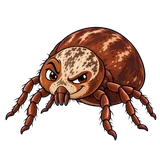 American dog tickDermacentor variabilis
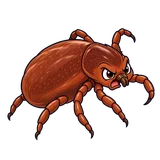 Brown dog ticksRhipicephalus sanguineus
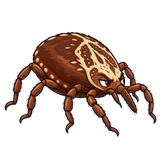 Gulf Coast tickAmblyomma maculatum