
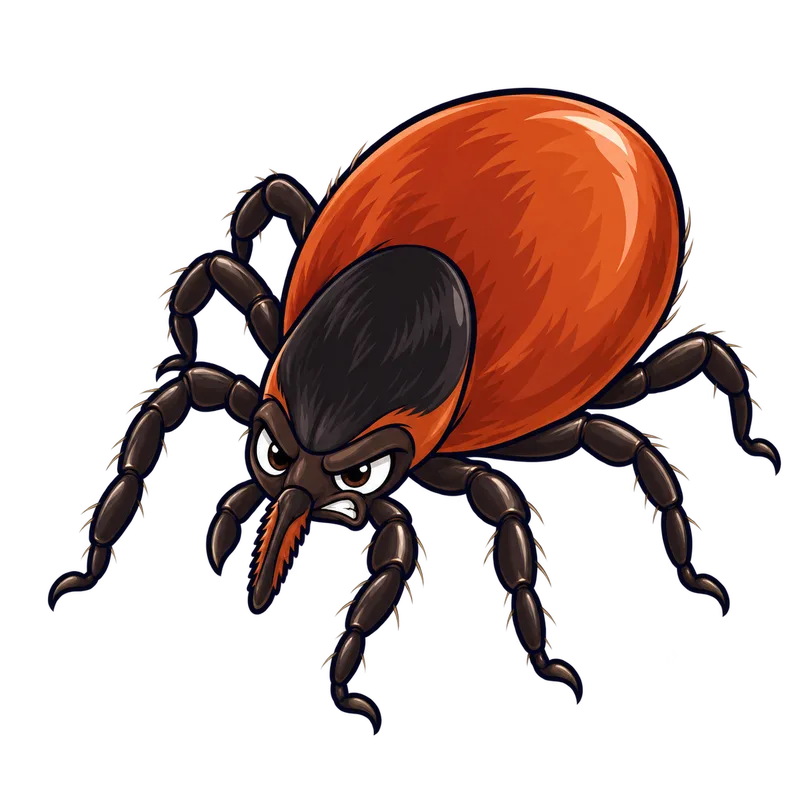
Blacklegged tick
Ixodes scapularis
- Size
- 1 to 9 mm depending on stage
- Color
- Orange-brown to reddish-brown with black scutum
- Habitat
- Damp leaf litter and woodland borders
- Diet
- Vertebrate blood
- Life cycle
- Egg, larva, nymph, and adult
The blacklegged tick, scientifically known as Ixodes scapularis and historically called the deer tick, is a tiny arachnid that most people only notice after a walk through the woods or while checking a pet. You do not need a laboratory to tell an adult female apart from other ticks if you look closely at her back. She features a solid black scutum, which is the hard dorsal shield just behind her head, contrasting sharply with an orange-brown to reddish-brown posterior abdomen. Her legs are uniformly black, and her mouthparts are long and narrow compared to the blunt, short mouthparts of dog ticks.
Identity
Size is your next best indicator. An unfed adult female measures 5 to 7 mm, which is roughly the size of an apple seed, but she can swell up to 9 mm or more once she feeds. Males are noticeably smaller, under 5 mm, and their dark brown to black shields cover almost their entire backs. If you run into a nymph, however, you are dealing with something the size of a poppy seed, measuring only 1.5 to 2.5 mm. Larvae are even smaller at roughly 1 mm and possess just six legs instead of the eight found on nymphs and adults. All stages are entirely wingless, as arachnids never have wings, and they cannot jump or fly.
Confusion often arises with the American dog tick, but you can separate it easily because the dog tick has a silvery-white ornate pattern on its back, short mouthparts, and distinct rectangular folds called festoons along its lower margin. The blacklegged tick lacks these festoons entirely, keeping its rear margin smooth and rounded. If you are on the Pacific Coast of the United States, you might encounter the western blacklegged tick, which looks identical to its eastern counterpart but lives exclusively west of the Rocky Mountains. In Europe, the castor bean tick fills the same ecological role and shares a similar shape, though it occupies a completely different continent.
Habitat & behaviour
You will not find blacklegged ticks living their best lives in dry, sun-baked lawns or soaring through forest canopies. They need high relative humidity, usually 80 percent or greater, to keep from drying out. They spend their time hiding in damp leaf litter, brushy woodland borders, overgrown pastures, and the shady perimeters where a manicured backyard meets the woods.
One of the most persistent myths about these creatures is that they drop down from high tree branches onto passing hikers. In reality, they are strictly ground-level climbers. They practice a behavior called questing, where they crawl onto low-lying vegetation like grass blades, leaf litter, or twigs under 50 cm high. They extend their front legs into the air, waiting for a host to brush past. Specialized sensory organs on their forelegs, known as Haller organs, detect body heat, carbon dioxide, moisture, and vibrations. When an animal or a human makes contact, the tick simply clings on and crawls upward to find a place to feed.
Their activity depends heavily on the calendar and the thermometer. Nymphs are most active from May through July, while larvae take over the questing duties in August and September. Adults emerge in late autumn and stay active through the winter and spring whenever temperatures climb above 45 degrees Fahrenheit and snow is absent. Because they do not establish permanent indoor populations, bringing one inside on clothing or a pet usually spells doom for the tick, as household air is simply too dry for them to survive long.
Visual variations
Life for a blacklegged tick is divided into four distinct stages, and each one looks remarkably different from the last. The process starts as a pearl-white, oval egg measuring about 1 mm, safely cemented in clusters of roughly 2,000 on moist soil or damp leaf litter. When those eggs hatch, the resulting larvae measure just 1 to 1.5 mm and have only six legs. Before a meal, they look translucent or light tan, but a single blood meal turns them dark red or brown.
Moving up to the nymphal stage, the creature grows to 1.5 to 2.5 mm, roughly the size of a poppy seed, and gains its fourth pair of legs for a total of eight. Nymphs sport a dark shield and a brownish abdomen. They are the stage most people miss entirely due to their minute size, which explains why they are responsible for the vast majority of human encounters during the summer months.
Adults show a clear split between the sexes. The female has a distinct two-tone look, with her small black shield sitting on the front third of her body while the rest of her orange-brown abdomen waits to expand. Once she feeds and mates, that flexible abdomen stretches enormously into a cigar-like, dark olive-grey cylinder reaching 9 mm or more, while her small black shield stays the exact same size right behind her long mouthparts. Males stay smaller and flatter because their dark brown shield covers nearly 100 percent of their back, preventing that massive expansion. Males do not take a heavy blood meal, choosing instead to mate and then die.
Why it matters
Finding a blacklegged tick on your skin or clothing means you have crossed paths with an obligate blood-feeder that serves as the primary carrier for several notable pathogens in the northern United States. The presence of a tick is not an immediate emergency, but it does call for calm, prompt action. If you find one attached, safe removal requires pulling straight up with fine-tipped tweezers without twisting, crushing, or burning it with matches, and definitely without smothering it in petroleum jelly or nail polish, which only causes the tick to regurgitate its contents into the host.
Not every tick carries disease, and transmission takes time. For Lyme disease, the bacterium usually requires at least 36 hours of continuous feeding to pass from the tick to the host. Discovering and removing a tick within that window dramatically lowers your risk. However, other pathogens like the Powassan virus can transmit much faster, sometimes within 15 to 30 minutes of attachment.
Bite marks and skin rashes can never identify a tick because human immune responses vary wildly. If you develop an expanding rash, fever, or flu-like symptoms after a bite, professional medical evaluation by a clinician is essential. For property management, keeping grass short, clearing leaf litter, and establishing a wide woodchip barrier between your lawn and the woods will help reduce the local tick population, while chemical treatments around the yard require a licensed professional to ensure safe application.
Similar species
 Western blacklegged tickIxodes pacificus
 Lone star tickAmblyomma americanum
 American dog tickDermacentor variabilis
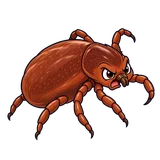 Brown dog ticksRhipicephalus sanguineus
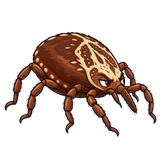 Gulf Coast tickAmblyomma maculatum
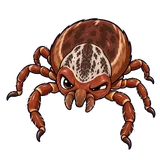 Rocky Mountain wood tickDermacentor andersoni