
Tick nymph vs adult tick: why is size alone insufficient?
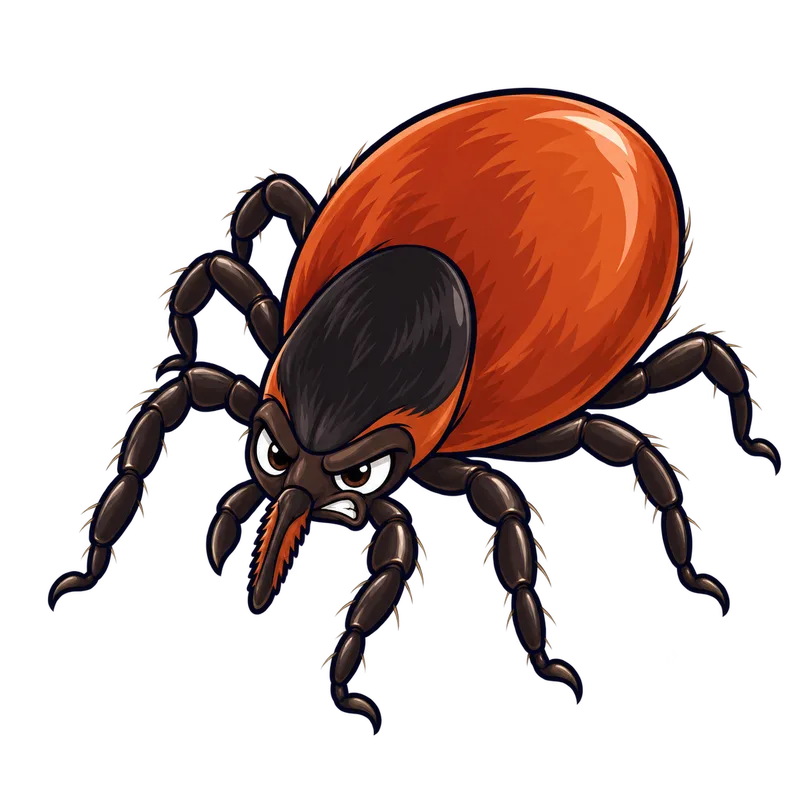
Size alone is insufficient for identifying a tick life stage because blood feeding causes a massive body expansion that creates a heavy overlap in total body length between engorged nymphs and unfed adults. An unfed nymph of the blacklegged tick sits around 1.5 to 2 mm long, while an unfed adult female measures about 2 to 3 mm, yet a fully fed nymph can balloon up to 4 mm.
What is actually going on
You come home from a long walk through the tall grass at the edge of the woods, drop your backpack in the hallway, and sit down to pull off your hiking boots. Later that evening, while changing for bed, you spot a tiny dark speck tucked behind your knee. You squint at it in the bathroom mirror and wonder if it is just a young tick or an adult that somehow got shrunk in the wash of your imagination. It is tempting to look at that little creature and guess its age simply by how big it is, but size alone will steer you entirely wrong.
Determining a tick life stage based on physical dimensions is fundamentally unreliable because blood feeding causes a massive body expansion. An unfed nymph of the blacklegged tick sits around 1.5 to 2 mm long, roughly the size of a poppy seed. If you find an unfed adult female of the same species, she measures about 2 to 3 mm, which is barely larger. But once a tick attaches and starts feeding, everything changes. A female hard tick can expand her body mass up to 200 times her unfed weight, and an immature nymph increases significantly in length and width over several days of feeding.
This feeding-induced swelling causes a heavy overlap in total body length between engorged nymphs and unfed or partially fed adult females. A fully fed nymph that balloons up to 4 mm can easily be mistaken for an adult tick by anyone relying on size alone. Ticks do not grow steadily like caterpillars. Instead, they transform between distinct stages, and their skins stretch to accommodate a massive single meal at each step. If you judge age by length, you will misidentify the exact visitor clinging to your skin.
How to tell for sure
Accurate stage differentiation relies on fixed morphological structures that do not change with feeding, though you usually need a magnifying glass to see them clearly. Larvae possess six legs and lack a hard dorsal shield, which is the plate on the back known as a scutum. Nymphs graduate to eight legs and a partial dorsal scutum covering only the upper shoulders, but they lack a functional ventral genital aperture on their underside. Adult females also have eight legs and a partial scutum, but they are uniquely distinguished from nymphs by the presence of a fully developed genital pore located between the bases of their legs.
Think of that dorsal scutum as a hard leather vest. In adult males, the vest covers the entire back like a solid shield, which prevents the dramatic ballooning expansion you see in females. In females and nymphs, that vest only covers the front upper half, leaving the rest of the body free to stretch like an expanding balloon during a meal.
This distinction matters because nymphs are the primary drivers of human vector-borne disease transmission, accounting for the vast majority of human Lyme disease cases. Their tiny unfed size allows them to crawl unnoticed into hidden body folds, like behind the knees, along the waistband, or under the armpits, where they easily stay attached past the crucial twenty-four to thirty-six hour window required for bacteria transmission.
What usually comes next
When you spot an attached tick, your immediate goal is safe mechanical removal rather than a lengthy debate over its exact age or species. Use fine-tipped tweezers or a purpose-designed removal tool, grab the mouthparts as close to your skin surface as possible, and pull straight upward with steady, even pressure. Do not twist, jerk, or squeeze the body, and leave the petroleum jelly, nail polish, and hot matches alone. Stressing the tick with home remedies often causes it to regurgitate stomach contents directly into the bite wound, which only increases the risk of pathogen transmission.
Once the tick is out, disinfect the bite site and your hands with soap and water or rubbing alcohol. You might wonder if you should drop that tiny creature into a plastic baggie and mail it off to a commercial testing lab for answers. Public health agencies generally advise against relying on tick testing to guide clinical treatment decisions. A positive test result does not prove the tick transmitted an infection, and a negative test can offer false comfort if another unobserved tick was also attached. Clinical decisions are based on symptoms, exposure history, and signs of illness rather than the contents of a test tube.
When to get help
Certain signs mean it is time to skip the guesswork and contact a clinician or seek urgent medical care. Watch for an expanding circular or oval rash larger than two inches appearing one to four weeks after exposure, especially if it clears in the middle like a bullseye. Unexplained fevers, severe headaches, stiff neck, profound fatigue, or joint and muscle pains also require professional medical evaluation.
If you live in an area where Lyme disease is common, a single dose of oral doxycycline may be prescribed by a doctor if a blacklegged tick was attached for thirty-six hours or longer and treatment can start within seventy-two hours of removal. For rare but severe emergencies like rapidly progressing muscle weakness or breathing difficulties following a tick bite, seek immediate hospital care because certain species can inject neurotoxins that cause tick paralysis. When precise species identification is necessary for a public health risk assessment, preserve the specimen in rubbing alcohol and submit it to a university extension service or a national health surveillance scheme instead of relying on a smartphone photograph.