
Which tick product is appropriate for a dog or cat?
The right tick product for a dog or cat depends entirely on the specific animal, because dogs and cats process chemicals through completely different biological pathways. You must never share products between species. For safe selection, match the treatment to your pet with a veterinarian, factoring in the animal's age, weight, and lifestyle.
What is actually going on
Picture coming home on a Sunday evening after walking the dog through the tall grass at the edge of the park. You toss your keys on the counter, call the dog over for a quick ear scratch, and your fingers catch a strange, smooth bump near the collar line. You lean in under the kitchen light and realize it is not a scab. It is a tick, anchored tightly and already swelling up with a meal.
Choosing the right tick product for a dog or cat is not simply a matter of grabbing whatever looks strongest at the grocery store. It requires looking closely at the animal sitting in front of you. Dogs and cats process chemicals through entirely different biological pathways. Active ingredients that work wonders on a healthy canine can spell disaster for a feline.
This happens because cats lack a specific liver enzyme pathway known as glucuronidation. Without it, they cannot break down certain synthetic pyrethroid chemicals, such as permethrin, which are common and safe ingredients in many dog-formulated spot-on treatments. If a cat gets even a small amount of permethrin on its skin, or grooms a dog that was recently treated, it can suffer severe muscle tremors, seizures, and life-threatening toxicity.
That fundamental biological divide means you cannot share products between species, no matter how convenient or economical it might seem. Beyond species boundaries, you also have to consider geography and local vector risks. Ticks change from one region to another, carrying different pathogens and requiring specific treatment approaches that match the local pest pressures.
How to tell for sure
Finding the right protection usually starts with a trip to the veterinarian, where you can match the product to your pet's age, weight, and lifestyle. But before you even open a box, you need to know what kind of pest you are dealing with on the animal.
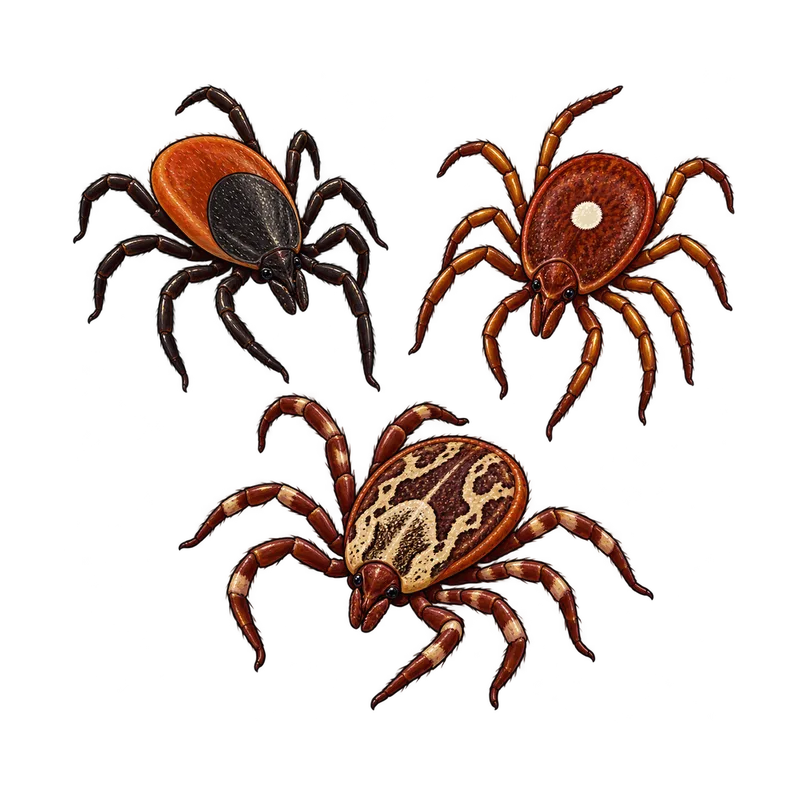
Home observation relies on looking at basic physical traits. Unfed ticks are flat, oval, and tiny, sometimes resembling little moving seeds when they are in their six-legged larval stage. Once they feed, they transform into swollen, greyish, or dark red balloons. As they grow into eight-legged nymphs and adults, they start to look more like miniature arachnids.
You can usually tell the sex of an adult tick by looking at its back. Adult females have a small partial shield behind the head that allows the rest of their body to stretch out during feeding. Adult males carry a hard shield that covers almost their entire back.
Distinguishing between closely related species usually requires specialized equipment, such as a hand lens or a microscope operating at 10x magnification or higher. If you need a precise identification for public health tracking, a photograph will not cut it. You have to collect a physical specimen and send it to an official agricultural extension office or a regional surveillance scheme.
One rule always stands out in pest identification. Never try to identify a tick or confirm an infestation based on a skin bite or a rash. Individual animals and humans react differently to insect saliva, and a red bump can come from anything from a flea to a fabric irritation.
What usually comes next
Your next practical decision usually involves choosing how to apply protection and what to do if you spot a stray tick already attached to the skin.
If you find an attached tick on your pet, the removal method matters. Reach for a pair of fine-tipped tweezers or a specialized tick removal tool rather than using your bare fingers or blunt kitchen instruments. Grasp the tick right at the surface of the skin, catching it by the mouthparts rather than the swollen belly. Pull straight upward with steady, even pressure. Avoid twisting, jerking, or squeezing the body, because crushing the tick can force its stomach contents back into your pet and increase the risk of disease transmission.
There is one major regional exception to that rule. Along the eastern coast of Australia, pets frequently encounter the paralysis tick, which secretes a powerful neurotoxin in its saliva. For that specific pest, local expert guidance recommends applying a permethrin-containing insecticide cream to kill the tick in place before attempting removal, because pulling a live paralysis tick can trigger a dangerous reflex injection of toxins.
After removing any standard tick, thoroughly clean the bite site and your hands with rubbing alcohol or soap and water. Drop the live tick into alcohol or seal it in tape before throwing it away. Never use old folk remedies like petroleum jelly, nail polish, or a hot match head to make the tick back out. Those tricks only stress the arachnid and make it regurgitate faster.
When to get help
Certain situations require immediate veterinary or medical intervention rather than a quick fix at the kitchen table.
Watch your pets closely for warning signs that point toward tick-borne illness or neurotoxins. If your dog or cat develops an unsteady gait, hind-limb weakness, difficulty standing, or an ascending paralysis that creeps up the body, contact a veterinarian immediately. These are classic signs of tick paralysis from feeding pests. Other red flags include sudden lethargy, vomiting, irregular heart rhythms, or sudden collapse, which can accompany conditions like canine Chagas disease.
Human health risks also demand prompt attention. If you or a family member develops an expanding circular rash shaped like a bullseye, a high fever, severe joint pain, or neck stiffness after spending time outdoors, seek medical evaluation right away.
For property-level management, remember that heavy premise treatments around a yard require a licensed pesticide applicator to ensure chemicals do not run off into local waterways or harm beneficial insects like bees. If your yard hosts protected wildlife, such as nesting birds or bats, state conservation laws apply, and you will need to check with local authorities before altering habitats or applying controls.