
What does a lone star tick look like?
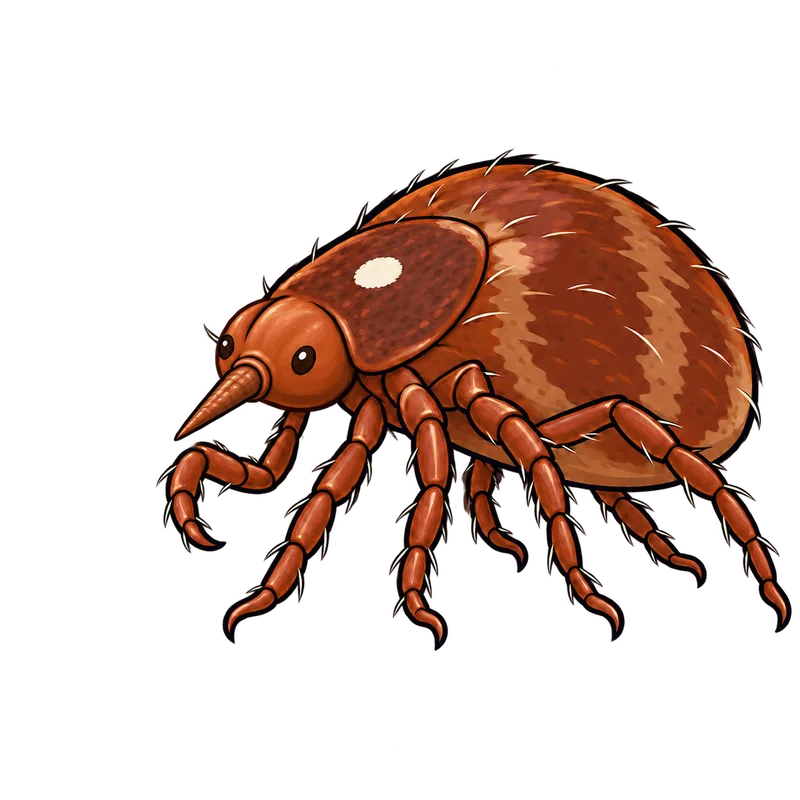
An unfed lone star tick measures 1 to 5 millimeters across and has a chestnut-brown or dark reddish-brown body. The adult female stands out with a bright white or silvery spot on her back. Adult males lack this spot and instead show faint pale ornamentation or horseshoe-shaped patterns along their outer back edges.
What is actually going on
You are sitting on the back porch after a walk through the tall grass at the edge of the woods, and you spot a tiny dark speck crawling up your sock. You brush it off onto a piece of paper towel to take a closer look, wondering if it is just a bit of burr or something that requires immediate attention. If you happen to be dealing with a lone star tick, that small arachnid usually measures anywhere from 1 to 5 millimeters across when unfed, and it features a distinctive chestnut-brown or dark reddish-brown body.
What makes the adult female stand out from almost every other tick you might encounter in the yard is a single, remarkably bright white or silvery spot right in the middle of her back, near the rear edge of her hard dorsal shield. Think of it as looking like a solitary dab of white paint or a tiny silver sequin glued to a dark brown jacket. That single mark gives the lone star tick its entire name, and it makes identification quite straightforward if you catch an adult female before she has started feeding.
Things change quite a bit once these ticks start taking a blood meal. An engorged female swells up enormously, stretching her expandable body into an olive-gray or dark reddish-gray oval balloon that can reach up to 12 millimeters in length. While her abdomen balloons to many times its original weight, that signature white spot on her back stays the exact same physical size. On a fully engorged tick, the spot ends up looking proportionally tiny, almost vanishing among the tight folds of stretched skin, which frequently trips people up when they try to identify what they just pulled off a pet or a family member.
How to tell for sure
Looking for a white dot on every tick you find is actually a great way to make mistakes, because only the adult female carries that feature. Adult males are roughly the same size, but they usually lack the central white spot entirely, showing instead some faint pale ornamentation or horseshoe-shaped patterns along their outer back edges. If you only look for a white dot, you will likely mistake a male lone star tick for a completely different species.
Immature ticks add another layer of confusion to the mix. Nymphs are about the size of a poppy seed or a small freckle, and larvae are even smaller with only six legs instead of eight. Neither nymphs nor larvae have the white spot, usually appearing as plain, light brown or reddish-tan specks that require magnification to examine properly. Beyond color markings, lone star ticks usually possess characteristically long and narrow mouthparts that stick out prominently from the front of the head, setting them apart from other common ticks that have short, broad mouthparts.
People often try to figure out what bit them by staring at the resulting skin mark, but skin reactions can never reliably identify a tick species. Individual human immune systems respond differently to bites, meaning a simple red bump or an itchy patch will not tell you whether a lone star tick was the culprit. Physical inspection of the actual specimen under good light or magnification is usually the only way to be certain.
What usually comes next
When you have a tick sitting on a piece of paper in front of you, the smartest move is to get a positive identification before you throw it away or start worrying. Grab a pair of fine-tipped tweezers, grip the tick right against your skin if it is still attached, and pull straight up with steady pressure without twisting. Skip old wives' tales about petroleum jelly or hot matches, since irritating the tick can make it regurgitate fluids right into the bite site.
Once the bug is off, wash the spot thoroughly with soap and water or rubbing alcohol. If you want a real answer on what you are dealing with, drop the specimen into a small sealed plastic bag or a vial with a little rubbing alcohol, jot down the date and where you found it, and reach out to a local university extension office or public health agency. They usually have experts on staff who can check the mouthparts and back patterns under a microscope for an accurate ID.
It helps to know that lone star ticks do not carry Lyme disease, which brings a bit of relief if you live where other ticks are everywhere. That said, they can transmit other illnesses like Ehrlichiosis, STARI, Heartland virus, and Tularemia, and their bites can sometimes trigger Alpha-gal syndrome, which is a red meat allergy that makes your body react hours after you eat a burger or a pork chop.
When to get help
You should talk to a doctor promptly if you start feeling unwell in the weeks after a bite. Keep an eye out for an expanding circular rash, a high fever, severe headaches, muscle aches, or swollen lymph nodes, since those signs mean you need a medical evaluation.
Get emergency medical care right away if you develop hives, severe stomach cramps, vomiting, or trouble breathing a few hours after eating red meat or dairy, which can point to a serious allergic reaction connected to Alpha-gal syndrome.
If lone star ticks are turning up all over your yard, keeping them down usually means dealing with local wildlife, especially the white-tailed deer that carry them into your grass. When heavy tick numbers stick around your house even after you clear out brush and tall weeds, talk to a licensed pest control professional or your local vector control agency to figure out the right way to manage your property.