
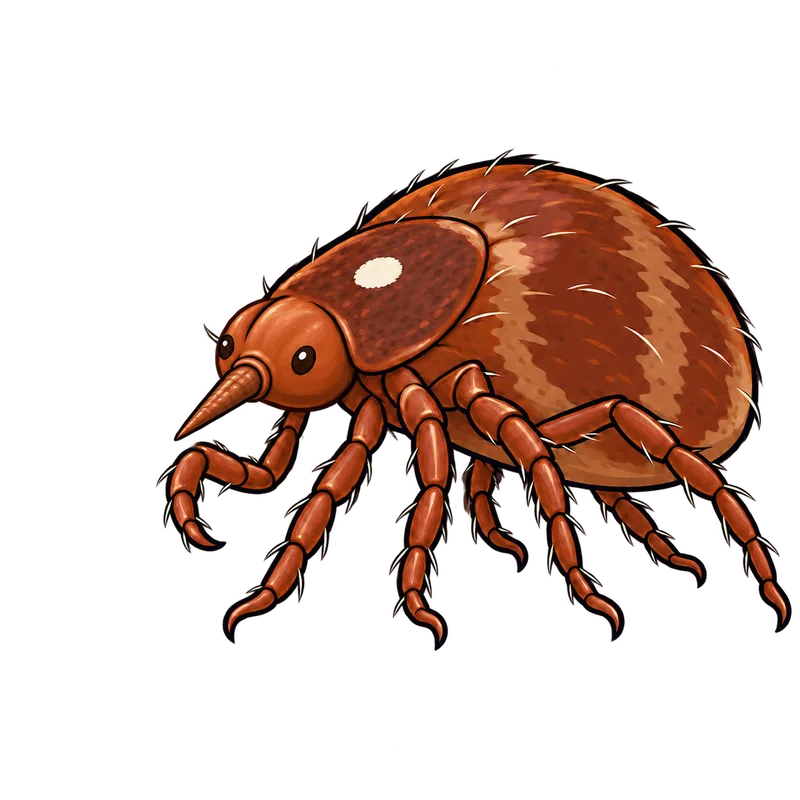
Lone star tick
Amblyomma americanum
- Size
- Not established
- Color
- Dark brown with a solitary white spot on females
- Habitat
- Dense vegetation, woodland edges, and tall grasslands
- Diet
- Obligate blood-feeding ectoparasite across all active stages
- Life cycle
- Obligate three-host life cycle with four developmental stages
You are dealing with a hard-bodied arachnid known widely as the Lone star tick, recognized scientifically as Amblyomma americanum. This creature bears a physical signature that makes the adult female almost unmistakable. If you spot a mature female on your clothing after a walk through the woods, look closely at her upper back, which entomologists call the dorsal scutum. Right at the rear tip of that shield sits a solitary, bright white dot that looks remarkably like a single star, giving the species its common name.
Identity
Adult males look rather different. They lack the white dot entirely, sporting instead a dark brown shield covered with pale or white scalloped markings along the rear edge. Both sexes feature dark brown legs marked with faint, pale bands and elongated mouthparts that extend well past the front of the body. Larvae start out with 6 legs, while nymphs and adults possess 8. You can easily make out the female's white spot or the male's marginal markings with the naked eye or a standard 10x magnification hand lens. Trying to identify immature nymphs or damaged specimens without magnification, however, usually requires a specialist to examine the tiny mouthpart structures under a microscope.
Habitat & behaviour
This tick is an outdoor creature that thrives in environments featuring dense, low-level vegetation, brushy fields, forest understories, and overgrown woodland edges. You will not find them breeding inside clean homes or offices. If one turns up indoors, it is merely an accidental hitchhiker that rode in on your socks, your hiking pack, or your dog.
They locate hosts through a behavior called questing. A questing tick climbs onto a blade of grass or a twig, usually no higher than 50 centimeters off the ground, and extends its front legs into the air. Specialized sensory organs on those legs detect carbon dioxide, body heat, and vibrations from a passing animal or human. They cannot fly, jump, or drop from the overhead tree canopy. They wait patiently on low plants until you brush past them, after which they crawl upward for up to 2 hours looking for a place to attach. Their seasonal activity peaks during the warmer months, generally from spring through early autumn, though they become entirely inactive when temperatures drop below 45 degrees Fahrenheit or when snow covers the ground.
Visual variations
As arachnids, these ticks skip the wing phase entirely in every chapter of their lives. You will not find any social hierarchy here, meaning every single specimen operates as an independent parasite hunting down its next host. The life cycle moves through 4 distinct chapters: the tiny egg, the 6-legged larva, the 8-legged nymph, and finally the 8-legged adult.
Once they reach adulthood, the differences between the sexes become glaringly obvious. The female wears a hard shield only across the front part of her back, leaving the rest of her body flexible enough to stretch massively once she starts feeding. The male wears a rigid shield across his entire back, which limits how much blood he can take in and keeps his body size fairly uniform. Because nymphs and larvae do not sport the signature white markings of the adults, telling them apart from other tick species usually takes a trained eye and a microscope.
Why it matters
Spotting this tick on your clothing means you have recently walked through brush or timber where deer and other mammals spend their time. The actual bite rarely hurts because their saliva packs natural numbing agents, but the health risks down the line are real. Unlike blacklegged ticks, these ones do not carry the bacteria responsible for Lyme disease. Instead, they can pass along the germs that cause Ehrlichiosis, Southern Tick-Associated Rash Illness, Heartland virus, Bourbon virus, and Tularemia.
Their saliva can also introduce a sugar molecule called alpha-gal into your bloodstream, which occasionally triggers a peculiar allergy to mammalian meat known as Alpha-gal Syndrome. If you find one clamped onto your skin, grab it with fine-tipped tweezers and pull straight out without twisting, burning, or smearing products like petroleum jelly on it. Reach out to a doctor right away if you develop an expanding rash, fever, or other flu-like symptoms after a bite. Any pesticide treatments for your livestock or pets need the advice of a licensed veterinarian, and treating your yard is a job best left to a licensed pest control professional.
Similar species
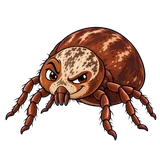 American dog tickDermacentor variabilis
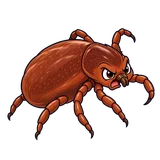 Brown dog ticksRhipicephalus sanguineus
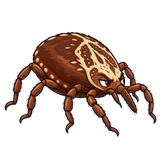 Gulf Coast tickAmblyomma maculatum
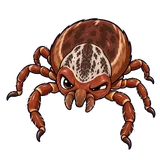 Rocky Mountain wood tickDermacentor andersoni
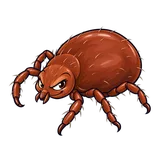 Asian longhorned tickHaemaphysalis longicornis
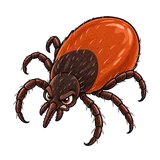 Castor bean tickIxodes ricinus