
Are European starlings invasive?
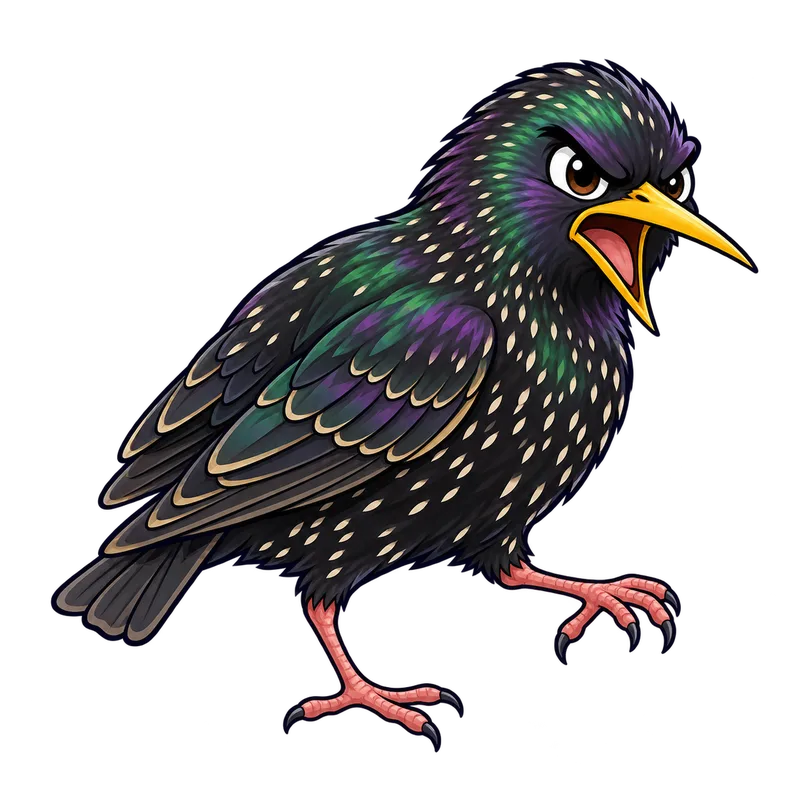
Yes, European starlings are classified as non-native invasive pest birds in North America and other introduced regions. They do not enjoy federal protection like native songbirds do. Instead, they act as aggressive squatters that force native cavity-nesting birds out of their natural tree hollows and backyard birdhouses.
What is actually going on
You are standing on your back patio on a crisp April morning, sipping coffee, when you notice a steady stream of dark, medium-sized birds darting into a tiny gap behind your roof soffit. They are loud, chattering away while dragging dry grass and twigs into your house. A friend drops by, glances up, and casually mentions that you should just put up a plastic owl because those birds are protected migratory wildlife. Before you start worrying about federal fines or wildlife permits, let us clear up what you are actually looking at.
In North America and several other introduced regions around the globe, European starlings are classified as non-native invasive pest birds. That means your friend has it backward. While native songbirds enjoy strict federal protection under laws like the Migratory Bird Treaty Act, starlings do not. They were brought over from Europe in the nineteenth century, and without their natural predators to keep them in check, they settled in and made themselves entirely too at home.
They are remarkably resourceful, which is a polite way of saying they are aggressive squatters. They force native cavity-nesting birds right out of natural tree hollows and backyard birdhouses. Come spring and summer, they wedge themselves into any opening in your home as small as a quarter of an inch, building nests that block ventilation systems and create serious fire hazards near hot flues. When winter rolls around, they trade their nesting sites for massive communal roosts in urban trees and industrial structures, leaving behind layers of foul-smelling droppings that can stain siding and ruin agricultural equipment.
How to tell for sure
Never trust a suspicion alone when dealing with nuisance animals. Before you start blocking vents or setting traps, you want to be sure you are actually dealing with starlings and not a protected native species that happens to look similar from a distance.
Starlings usually appear as medium-sized birds with dark plumage that usually shimmers with purplish-green gloss in the sunlight. When you are looking at nesting sites, check for cavities in building soffits, attic vents, louvers, chimney voids, and pipe openings. The nests themselves are usually messy piles constructed from dried grass, twigs, and assorted debris.
If you are looking at the ground, bird droppings have a distinct look. They usually feature a bright white uric acid cap or a white liquid coating over darker fecal material. When you find tracks in soft mud, sand, or snow, remember that a starling track usually exhibits three toes pointing forward and one pointing backward. This is a helpful detail because woodpeckers, which also hang around building exteriors, usually display two toes forward and two backward. Confirming these physical signs ensures you do not inadvertently target a lookalike protected native bird.
What usually comes next
Once you spot those starlings nesting in your eaves, you face a straightforward choice about what to do next. Relying on a plastic owl decoy to scare them off is a bit like setting up a mannequin on the lawn, because after a few days the birds figure out it never moves and start using its head as a perch. Wildlife gets used to stationary objects in a hurry, so any trick you try usually needs a mix of shifting locations, changing sounds, and different timing to keep the birds guessing.
Securing a lasting fix means leaning on physical exclusion and cleanup instead of just hoping temporary scares will do the job. Think of it like shutting the front door during a pouring rain. Chasing the birds away from your soffit without blocking their entry point is just like mopping the kitchen floor while leaving the window wide open. You will want to seal every structural gap and crack measuring a quarter of an inch or larger with tough, lasting materials. Cover vents, louvers, and exhaust outlets with heavy gauge, rust-proof wire mesh, and pop a sturdy stainless steel cap on any open chimney.
Remember to look at your yard food sources, too. Leaving seed scattered across the lawn or keeping open feed troughs out in the open is like rolling out a welcome mat for hungry flocks. Secure your garbage cans, dry up standing water, and sweep up dropped pet food so your property stops acting like a neighborhood diner.
When to get help
There are moments when a weekend DIY project turns into something you should hand over to an expert. If those starlings decided to nest high up on a steep gable or a multi-story roof, hauling out an extension ladder to work at awkward angles invites a serious fall that you can easily live without.
You also need to treat safety with caution when you find piles of dried droppings inside a closed attic or a tight crawlspace. Breathing in dust from accumulated bird waste can expose you to harmful fungi and bacteria. If you have to tackle a cleanup like that, gear up correctly before you start. Mist the mess lightly with water to keep the dust from floating into the air, and pull on a properly fitted particulate respirator mask along with rubber gloves, protective coveralls, and rubber boots.
Bring in a licensed pest control operator if you are dealing with a massive agricultural flock that calls for specialized traps, if the structure needs major repairs way up high, or if the attic cleanup demands full biohazard removal. Whenever you consider chemical deterrents or specialized pest control products, remember that a licensed professional must follow the product label instructions to the letter. Never guess at application rates, never brew custom chemical mixes, and always know when the job is too big for a Saturday afternoon.