
Do carpet beetles bite?
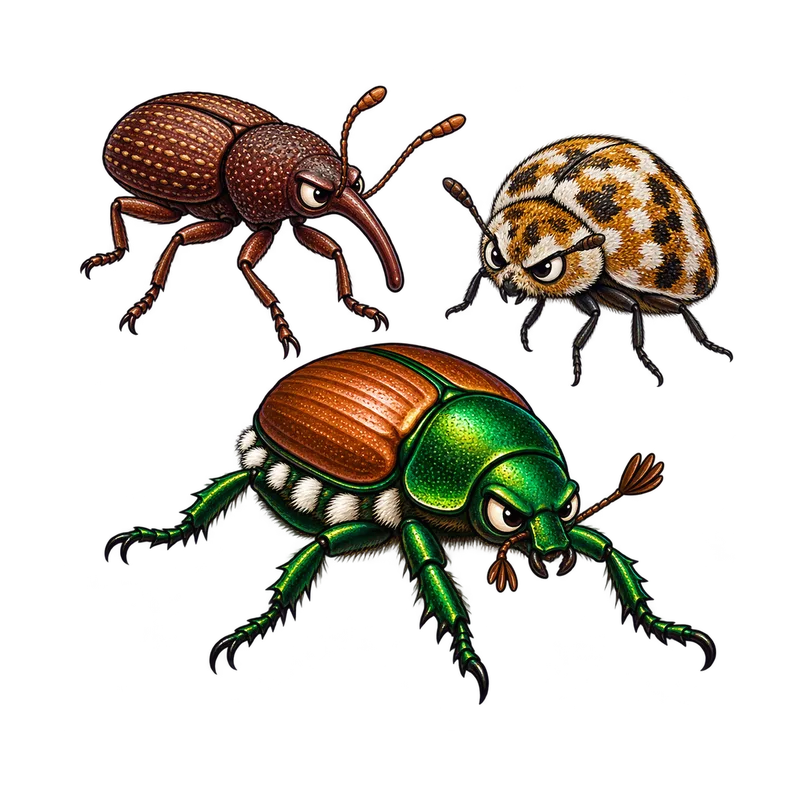
Carpet beetles do not bite humans because neither the adults nor the larvae possess blood-sucking mouthparts. Instead, itchy red bumps happen when stiff, sharp hairs covering the fuzzy larvae break off, accumulate in household dust, and mechanically irritate the skin.
What is actually going on
You wake up on a Tuesday morning, scratch an angry red bump on your arm, and immediately start lifting the sheets in a panic. You check the mattress seams for tiny dark specs, convinced something was feeding on you while you slept. But when you look closer along the windowsill or down by the baseboard, you spot a tiny, fuzzy little bug crawling along the dust. Naturally, you put two and two together and assume the bug bit you.
Here is the short answer. Carpet beetles do not bite humans. Neither the adults nor the furry little larvae possess blood-sucking mouthparts, and they have zero interest in your blood. If you are waking up with itchy red papules that look suspiciously like bed bug or flea bites, the culprit is not a bite at all.
What is actually happening involves microscopic defense mechanisms rather than midnight feeding. Carpet beetle larvae are covered in dense tufts of stiff, sharp hairs called setae. As these insects crawl through your rugs, nest in your winter sweaters, or shed their hollow outer skins in dark floor cracks, those tiny bristles break off and accumulate in household dust. When you press your skin against infested bedding or pull a neglected wool blanket from the back of the closet, those microscopic hairs dig into your skin.
This physical contact triggers a mechanical irritation or a mild allergic reaction known clinically as carpet beetle dermatitis. The red, itchy bumps you see are your skin reacting to the prickly armor of an insect that walked across your fabrics hours earlier. It feels entirely like a bite, which explains why so many homeowners chase phantom parasites before discovering the real source in a forgotten corner of the closet.
How to tell for sure
Before you start tossing out furniture or buying pest control products, you need to find out what is actually living in your house. Never assume you have carpet beetles, or any other pest, based purely on a skin rash or an itchy mark, because skin reactions are notoriously non-specific. You usually have to look for the physical evidence left behind by the insects themselves.
Adult carpet beetles are quite small, usually measuring between 2 and 6 millimeters, which makes them about the size of a pinhead or a small seed. Depending on the species, you might spot a dark, solid black beetle or a smaller, oval-shaped one patterned with mottled scales of white, yellow, and brown. In the spring and early summer, you will usually find them crawling slowly along sunlit windowsills as they try to make their way outside to feed on flower pollen.
The larvae are the ones doing the damage to your textiles, and they look entirely different. They usually grow up to 12 millimeters long, appearing as slow-moving, carrot-shaped or fuzzy grubs packed with brownish hairs. If you use a 10x magnification hand lens, you can often spot the distinct brush-like tail or hair bundles on their rear segments. You will usually find them tucked away in dark, undisturbed areas like the edges of carpets, beneath heavy furniture, inside air ducts, or deep within closets where woolens, feathers, fur, and leather are stored.
Along with the live insects, you will usually spot translucent, hollow cast skins that look like tiny shed husks. These empty exoskeletons pile up in lint and floor cracks, continuing to shed irritating hairs long after the larvae have moved on. You might also notice irregular, grazed patches missing from natural fibers, accompanied by tiny, salt-sized fecal pellets.
What usually comes next
Once you have identified the pest by spotting larvae, cast skins, or adults rather than guessing based on skin marks, your single most practical decision is to choose between treating the items yourself through physical care or calling in professional help. If the issue is confined to a few wool sweaters in a drawer or a localized area under a rug, you can usually handle the situation with thorough physical cleaning and thermal management.
Vacuuming every nook, baseboard, and closet perimeter is your primary line of defense. You must empty the vacuum canister or throw away the bag outside immediately so the larvae cannot crawl back out into your home. For washable garments or linens showing signs of damage, hot water laundering usually solves the problem.
When you are dealing with delicate natural fabrics that cannot stand hot washing, thermal deinfestation is a reliable path forward. You can wrap infested woolens tightly in a polyethylene bag and place them in a freezer set to negative 20 degrees Fahrenheit for 3 days, or negative 18 degrees for a couple of weeks. Make sure to let the bag thaw gradually at room temperature for a full day before opening it, which prevents moisture from condensing and ruining delicate fibers.
If you decide to take the non-chemical route, remember that chemical sprays should never be applied directly to clothing, sheets, or bedding. Reserve any residual surface treatments strictly for empty closet shelves, baseboards, or floor crevices, and always read the product label from start to finish before opening a container.
When to get help
There are moments when a household cleaning routine is simply not enough, and you need to hand the problem over to someone else. If your skin irritation is severe, persistent, or worsening despite your cleaning efforts, stop trying to diagnose the rash at home and schedule an appointment with a qualified clinician or dermatologist. If anyone in the house accidentally ingests a pesticide or shows signs of chemical exposure, contact your local poison control service immediately without waiting for symptoms to develop.
Regarding the insects themselves, you should call a professional pest control operator if the infestation is widespread across multiple rooms, entire apartment units, or large commercial properties. DIY methods rarely succeed when carpet beetles have established themselves deep inside inaccessible wall voids, complex heating and cooling ductwork, or heavy subfloors where your vacuum cannot reach.
You also need outside help if you suspect you are dealing with high-consequence quarantine pests, such as the khapra beetle, which can turn up in imported agricultural goods, maritime cargo, or commercial grain storage. Those situations require specialized regulatory notification, commercial fumigation, or industrial heat chambers that only licensed operators and agricultural authorities are authorized to handle.