Skip to content
The Pest Guide logo: an orange ant behind a magnifying glass The PestGuide

Millipedes

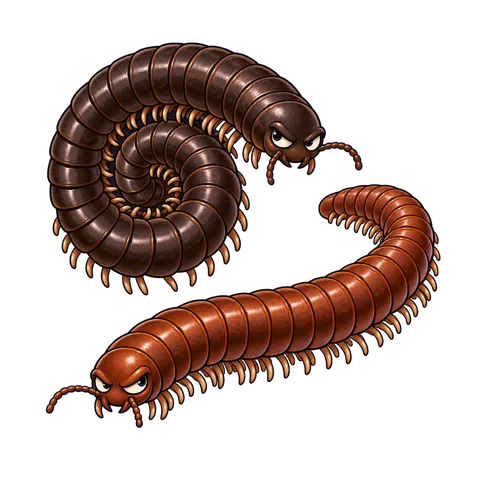
Stylized illustration of millipedes

Updated · The Pest Guide · Editorial policy

If you have ever found a slow-moving, segmented crawler curled into a tight spiral on your basement floor, you are almost certainly looking at a millipede. What groups these creatures together is their distinctive, double-legged body plan where most segments carry two pairs of jointed legs rather than one, creating a cylindrical, worm-like shape that moves with a steady, wave-like crawl. Despite their name, they do not have a thousand legs, but they do have at least thirty pairs, and they prefer to spend their time outdoors munching on rotting leaves and damp mulch rather than bothering anyone inside your house.

People often mix them up with centipedes or pillbugs, but telling them apart is straightforward once you know what to look for. Centipedes are fast-moving, flat-bodied hunters with only one pair of legs per segment and venom claws behind the head, while pillbugs and sowbugs are short, crustacean-like creatures with a flattened armor shell and only seven pairs of legs. Millipedes stand out by being entirely round in cross section, moving with a deliberate glide, and curling up defensively whenever you touch them, making them easy to distinguish from the speedy or armored pests that share their damp habitats.
Explore millipedes

Illustration of MillipedesMillipedesClass Diplopoda

Questions about millipedes

MillipedesHow do you get rid of millipedes in a house?Learn how to get rid of millipedes in a house using mechanical removal, structural exclusion, and exterior habitat management.MillipedesHow do you deal with millipedes in a basement?A practical, straightforward guide on how to identify and handle millipedes invading a basement, focusing on exclusion, moisture control, and physical removal.MillipedesAre millipedes poisonous?An informative guide explaining whether millipedes are poisonous, how to identify them, and how to safely manage indoor invasions.MillipedesDo millipedes bite?Millipedes cannot bite: they have no fangs, stinger or venom. Learn how to tell them from centipedes (which do bite), what their defensive fluid does to skin, and how to keep themMillipedesAre millipedes dangerous?An informative guide explaining whether millipedes are dangerous, how to identify them, and how to manage occasional indoor migrations safely.MillipedesWhat do millipedes eat?Discover what millipedes eat, why they enter homes during weather extremes, and how to keep them out of your yard and foundation.MillipedesAre millipedes insects?Are millipedes insects? Learn why these multi-legged crawlers belong to a different scientific class, how to identify them, and how to manage them safely.MillipedesAre millipedes bad for plants?Learn whether millipedes harm plants, how to identify them, and how to manage them safely around your home and garden.MillipedesHow can you prevent millipedes from entering the house?Learn how to prevent millipedes from entering your home through moisture control, landscaping barriers, and structural exclusion.MillipedesDo millipedes really have 1,000 legs?An informational blog post exploring whether millipedes truly have one thousand legs, backed by clear identification cues and practical management steps.MillipedesDo millipedes breed inside a house or wander indoors?Learn whether millipedes breed inside houses or simply wander indoors, how to identify them, and what practical steps stop them from getting in.MillipedesCentipede vs millipede in a basement: which features differ?Learn how to tell centipedes and millipedes apart in your basement, what causes them, and how to keep them out safely.