
Do millipedes bite?
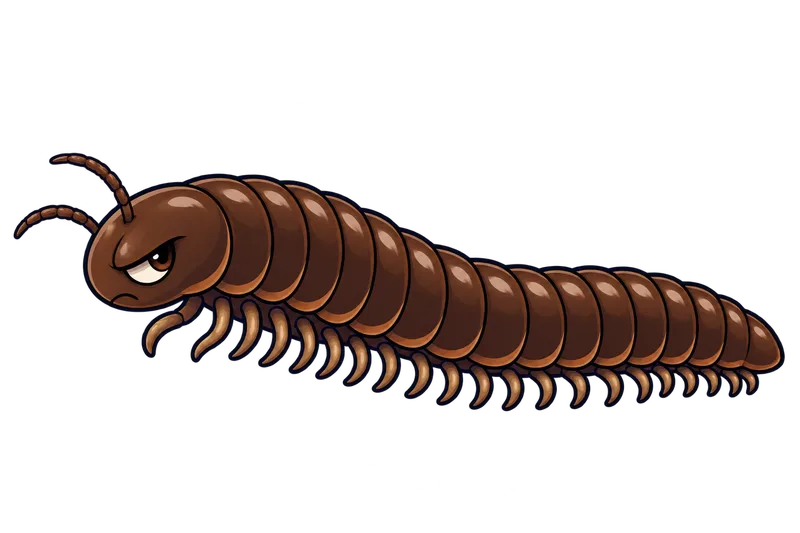
No, millipedes do not bite, and they physically cannot because they have no fangs, stinger, or mouthparts capable of piercing skin. Their jaws are built exclusively for scraping and chewing rotting leaves and decaying plant matter.
What is actually going on
Picture a Tuesday night after a hard rain. You head down to the basement for a roll of paper towels, flip the light, and there it is on the concrete floor: a dark, slow, many-legged thing gliding along the baseboard like a tiny armored freight train. Your first thought is not "what a fascinating recycler of dead leaves." It is "can that thing bite me?"
Short answer: no. Millipedes do not bite, and they physically cannot. They have no fangs, no stinger, no venom glands, and no mouthparts capable of piercing skin. Their jaws are built for one job, which is scraping and chewing soft, rotting leaves and decaying plant matter. A millipede's mouth is basically a compost shredder. Your arm is not on the menu, and even if it wanted a taste, it has no equipment to get one.
What it does have is a defense strategy, and this is where the confusion starts. When a millipede feels threatened, it curls into a tight spiral, tucking its legs and soft belly inside a hard shell of segments. That is plan A. Plan B is chemical: glands along the sides of its body release a foul-smelling fluid when it is crushed or seriously stressed. That fluid is not venom, and the millipede does not inject it into anything. It simply oozes out. On most people it does nothing worse than smell bad and maybe leave a yellowish or brownish stain on the skin. On sensitive skin, or if it gets into your eyes, it can cause real irritation, which is why the sensible rule is simple: do not pick one up barehanded, and do not crush one against your skin.
So the thing in your basement is not a threat to you. It is not even happy to be there. Millipedes live in damp soil, mulch, leaf litter and compost, and they only show up indoors when the weather pushes them: heavy rain floods their ground cover, drought bakes it dry, or autumn cold sends them hunting for shelter. Your basement is a wrong turn, not an invasion plan.
How to tell for sure
Here is the part that actually matters, because most "millipede bites" turn out to be a case of mistaken identity. The animal people confuse it with is the centipede, and centipedes genuinely can bite. They have a pair of venom-injecting claws right behind the head, and a bite from one is usually compared to a bee sting: sharp pain, redness, some swelling. Not fun. So before you file your basement visitor under "harmless," it is worth knowing which one you are looking at.
The easiest check is the legs. Look at one body segment somewhere in the middle of the animal. A millipede has two pairs of legs per segment, so the underside looks densely packed, almost like a brush. A centipede has one pair per segment, with the legs sticking out to the sides. If the animal is tiny, a cheap 10x hand lens makes this obvious.
Movement gives it away too. A millipede glides slowly and smoothly, legs rippling in waves, like that freight train on tracks. A centipede moves like a sports car: fast, darting, faintly alarming. The house centipede, the pale one with absurdly long legs that sprints across your bathroom tile at midnight, is the classic culprit behind "I saw a millipede and it moved like lightning." No, you did not. You saw a centipede, and yes, that one can bite if you grab it, though it would much rather run away from you.
Behavior seals it. Touch a millipede gently with something (not your finger) and it usually coils into a spiral. A centipede will bolt. For very small or immature specimens, the differences can be genuinely hard to see with the naked eye, and in that case "usually a millipede" is as far as you should go without a closer look. One more caution: never try to identify what bit you by matching a creature to a mark on your skin. A welt or a rash tells a doctor something about your skin, not reliable information about which animal caused it.
What usually comes next
Now for the practical part, and here is the rare bit of genuinely good news in pest control: you probably do not need to do much of anything. Millipedes cannot last long inside a normal house. Their thin outer layer leaks moisture fast, and the air in a typical home, especially one that is heated or air-conditioned, is a desert to them. Most indoor millipedes dry out and die within 24 to 48 hours, usually curled up by a baseboard, having harmed nobody and eaten nothing. They do not chew wood, they do not damage fabrics, and they do not reproduce indoors. Your house is not turning into a millipede nursery, no matter what the panicky part of your brain insists at midnight.
For the stragglers you actually see, a vacuum is the cleanest answer. Suck them up, then take the bag or canister contents outside, seal them in a trash bag, and put them in the outdoor bin, because a vacuum bag full of damp organic matter is not something you want sitting around indoors. A cup and a piece of paper works fine for a single one if you would rather carry it out to the garden, where it is honestly doing useful work breaking down dead plant material. Sweep up the dead ones along the baseboards too. Leaving piles of dead insects lying around can attract scavengers like carpet beetles, which is trading one non-problem for a real one.
If millipedes keep turning up in numbers, the fix is not a bigger spray can. It is moisture and access. Indoors, that means a dehumidifier keeping basement humidity below 50% and fixing any leaks. Outdoors, it means pulling mulch, leaf litter and woodpiles back from the foundation, ideally leaving a bare or gravel strip about 2 to 3 feet wide, sealing cracks and pipe gaps in the foundation (mesh finer than 1/8 inch for vents), and fitting door sweeps. Do those things and the problem usually solves itself, because you have taken away both the invitation and the door.
When to get help
There are a few situations where "wait for them to dry out" is not the right answer. If you are seeing millipedes by the dozens or hundreds, pouring in after storms, getting into wall voids or subfloors, that points to a serious moisture problem or a major entry route, and a licensed pest control professional can find it and treat the exterior perimeter properly. Any chemical barrier work along a foundation belongs to a licensed applicator working from the product label anyway, so that decision is off your plate by design.
On the health side, the lines are clear. If defensive fluid got in someone's eyes, if skin that touched a crushed millipede is blistering or badly inflamed, or if anyone shows signs of a broader allergic reaction, that is a call to a clinician or, in the United States, to Poison Help at 1-800-222-1222. Do not try to treat a chemical exposure with guesswork and whatever happens to be in the bathroom cabinet.
And if what bit someone was fast and long-legged and the pain felt like a sting, you are probably dealing with a centipede, in which case the wound deserves the same common sense as a bee sting: watch it, and get medical advice if the reaction is severe or spreading. For everything else, the slow little freight train in your basement, the answer stays the same. It cannot bite you, it does not want to be there, and it will be gone shortly. The only thing it asks is that you not pick it up.