
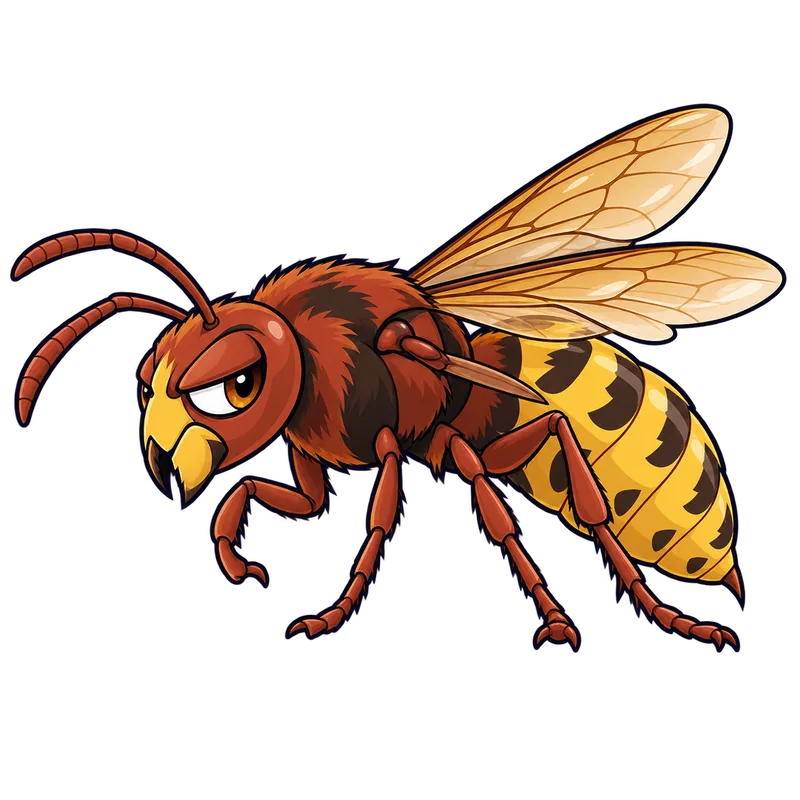
European hornet
Vespa crabro
- Size
- 1 to 1.5 inches
- Color
- Reddish-brown head and thorax, yellow and black abdomen
- Habitat
- Enclosed cavities, hollow trees, and wall voids
- Diet
- Tree sap, fruit, nectar, and insects
- Life cycle
- Annual colony founded by a single queen in spring
The European hornet is a large, stout social wasp that often startles homeowners simply by showing up where it is not invited. Spotting one usually involves watching a rusty-red and yellow insect blunder against a lighted kitchen window after dark or peel strips of bark off a backyard birch tree. It measures 1 to 1.5 inches long, with queens reaching roughly 1.4 inches, putting it squarely in the middle of the wasp size spectrum. The head and thorax carry a distinct reddish-brown tone, while the abdomen features a bright yellow background patterned with bold black teardrop-shaped spots. A solid dark band wraps around the base of the abdomen right behind the narrow waist. Unlike some of its high-profile cousins, its legs are a uniform brown without any bright yellow markings on the feet.
Habitat & behaviour
Unlike yellowjackets that build subterranean fortresses or paper wasps that glue open umbrellas of comb beneath a porch overhang, this species prefers the deep dark of enclosed spaces. Naturally, they choose hollow trees or abandoned animal burrows. Around human properties, they favor wall voids, dark attics, empty sheds, and deep barn corners where they construct large, swirled paper nests made from chewed wood and saliva that can swell to the size of a basketball by autumn.
Behaviorally, they break the standard wasp mold by being aggressively nocturnal. While most stinging insects tuck themselves away at sunset, European hornets treat porch lights and illuminated living room windows as beacons. Foraging workers spend daylight hours stripping tree bark for nest cellulose, hunting caterpillars and large insects for their developing larvae, and sipping fermenting sap or fallen fruit juices. They generally ignore people wandering through the yard, but they turn fiercely protective if vibrations or accidental impacts rattle their hidden nest cavity.
Visual variations
Colony life runs on a strict caste system that shifts shapes and duties across the calendar. The story begins in spring when a single overwintered queen emerges from leaf litter or rotting wood, looking massive at up to 1.4 inches long as she builds the first paper cells alone. By summer, her first batch of female workers takes over foraging and expansion, measuring slightly smaller than the queen but armed with functional, smooth stingers capable of delivering multiple thrusts without losing the weapon.
Late summer brings a demographic shift. The colony produces winged males, known as drones, alongside a new generation of future queens. These males lack stings entirely and exist solely to reproduce before cold weather sets in. Through all these adult variations, the signature reddish-brown head and thorax remain constant, anchoring the insect's identity regardless of whether it is a founding queen working solo in May or a worker bumping against a screen door in September.
Why it matters
The presence of these hornets usually means they have claimed an uninvited spot inside a structure, such as an exterior wall void or an attic crawlspace. Because workers defend their nesting territory vigorously, vibrations from mowing near a hidden wall nest or accidentally trapping a night-fliers against skin can trigger painful stings. The non-barbed stinger allows a single hornet to strike repeatedly, causing immediate sharp pain and localized swelling.
Severe allergic reactions, including breathing difficulties or widespread hives, require immediate clinical evaluation or a call to poison control. Because treating an active colony hidden inside a wall void carries a high risk of mass envenomation and structural damage, nest removal in enclosed spaces is a job best left to a licensed pest control operator.
When telling this species apart from lookalikes, homeowners frequently panic over the mistaken belief that every large insect is an invading northern giant hornet. The northern giant hornet is substantially larger, reaching up to 2 inches, and features a solid orange head with a dark thorax, whereas the European hornet stays under 1.5 inches and sports that rusty reddish-brown front end. Another potential mix-up is the yellow-legged hornet, an invasive species featuring a dark thorax and bright yellow lower leg segments, which contrast sharply with the plain brown legs and yellow-and-black teardrop abdomen of the European hornet.
Similar species
 Yellow-legged hornetVespa velutina
 European paper waspPolistes dominula
 Paper waspsPolistes species
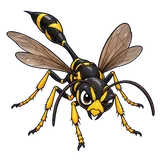 Mud daubersSceliphron and Chalybion species
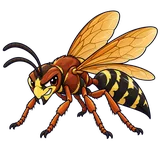 Eastern cicada killerSphecius speciosus
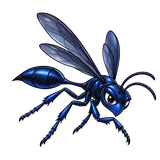 Blue mud dauberChalybion californicum