
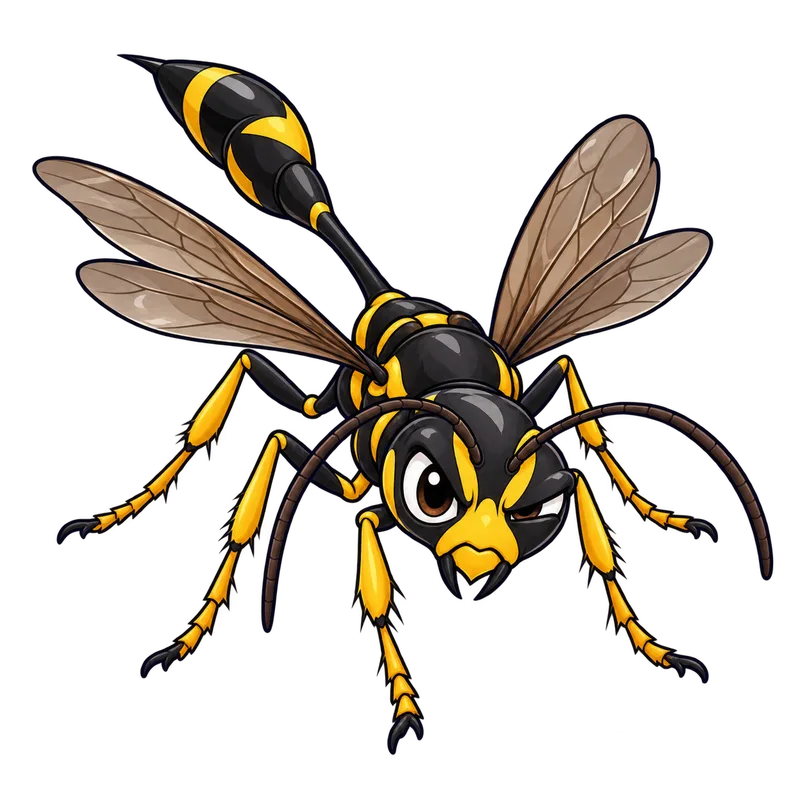
Mud daubers
Sceliphron and Chalybion species
- Size
- 13 to 25 mm long
- Color
- Black and yellow, metallic blue, or solid black
- Habitat
- Sheltered walls, porches, and outbuildings
- Diet
- Spiders for larvae, nectar for adults
- Life cycle
- Complete metamorphosis over one year
Mud daubers are not a single species of insect, but rather an informal grouping of several solitary hunting wasps belonging to the families Sphecidae and Crabronidae. When you look closely at one resting under a porch eave, you will notice three distinct varieties depending on where you live. The black and yellow mud dauber wears striking yellow stripes across a black body, while the blue mud wasp sports an all-over metallic blue-black sheen with dark iridescent blue wings. The pipe organ mud dauber stays solid, shiny black. All three share a remarkably thin, thread-like waist called a petiole that connects the thorax to the abdomen, giving them a stretched-out look quite unlike the thick-bellied yellowjackets people often confuse them with.
Identity
Unlike fuzzy bees, their smooth and shiny exoskeleton features almost no body hair, making them look somewhat like polished glass or dark metal under direct sunlight. You can easily spot the thread-like waist without a magnifying glass, though you might need to get within a few feet to notice the color details on their legs and thorax.
Habitat & behaviour
These wasps favor dry, sheltered locations out of the reach of heavy rain and wind, which is why porch ceilings, open barns, storage sheds, and the undersides of outdoor bridges serve as prime real estate for their nests. You will typically see them flying between March and October, peaking during the warm summer months when females actively hunt for prey and gather building materials.
What draws them to a house is not your dinner or sweet drinks, but the combination of sheltered wall surfaces for nesting and nearby damp soil or puddles where they collect balls of wet clay in their mandibles. A female wasp makes dozens of trips back and forth to a muddy puddle, molding the damp earth into neat cylindrical cells that eventually dry into hard rock. Unlike social wasps that guard a colony with aggressive swarming, mud daubers are strictly solitary creatures. They do not maintain guards, they do not defend their nests against passing humans, and they go about their construction work with a singular, quiet focus.
Visual variations
Because mud daubers do not live in colonies, you will never find queens, workers, or soldiers here. Every adult female operates entirely on her own, building her nest, hunting spiders, and laying eggs without any assistance. Both males and females are fully winged with two pairs of membranous wings, and they look nearly identical in size and color, though females carry a modified egg-laying organ that functions as a stinger for paralyzing prey.
Their life cycle moves through complete metamorphosis from a tiny egg to a worm-like, cream-colored larva, then into a resting pupa inside a silky cocoon, and finally out into the open air as a winged adult. Early summer eggs turn into active adults within weeks, while those laid late in the season hunker down inside their sealed mud cells as full-grown larvae, waiting out the winter in a state of suspended development until spring warmth triggers them to pupate and emerge.
Why it matters
Finding a mud dauber nest on your siding or garage door means a solitary wasp has chosen a safe spot to raise its young, packing each mud cell with paralyzed spiders to feed the developing larva. They do not bore into wood, chew through drywall, or compromise the structural integrity of your home in any way, meaning their presence is purely cosmetic unless their mud tubes block a small vent or utility opening.
While they can sting if accidentally crushed against your skin, their venom is mild, and they lack the defensive temperament of social wasps. Furthermore, they act as beneficial predators in the garden by keeping local spider populations in check, including venomous species like the black widow. If a nest sits in an inconvenient spot near a doorway, you can simply scrape it away with a putty knife when the wasp is absent, leaving the rest of the property to benefit from their quiet presence.
Similar species
 Eastern cicada killerSphecius speciosus
 Blue mud dauberChalybion californicum
 German yellowjacketVespula germanica
 Eastern yellowjacketVespula maculifrons
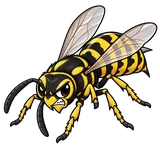 Western yellowjacketVespula pensylvanica
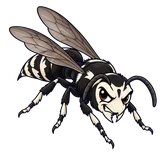 Bald-faced hornetDolichovespula maculata