
Are mud daubers aggressive?
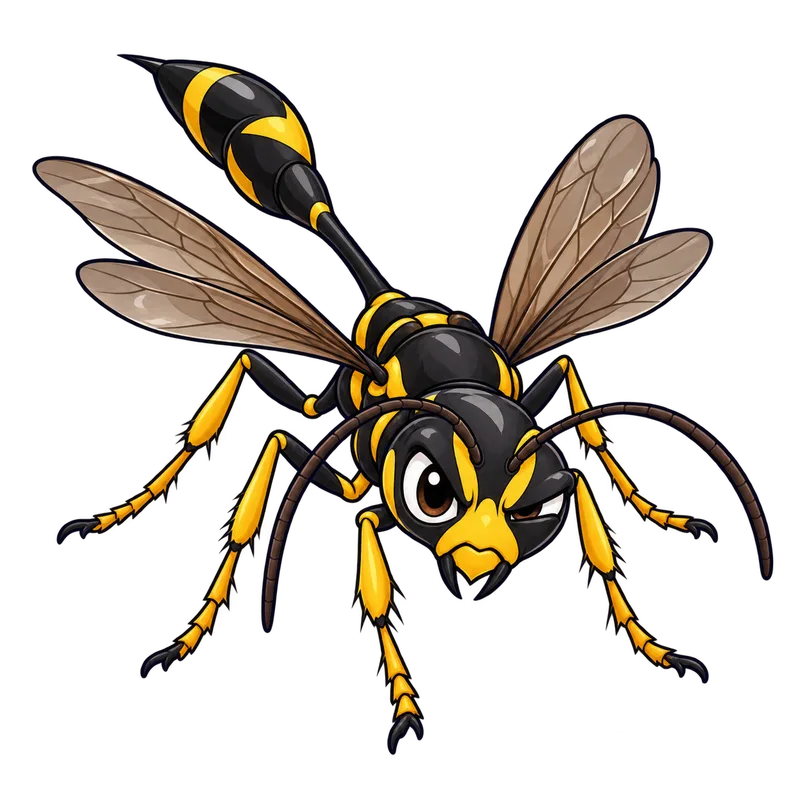
No, mud daubers are not aggressive insects and they almost never sting humans unless they are physically trapped, squeezed, or handled bare-handed. Because these solitary wasps have no queen or colony to defend, walking right past a nest will usually cause a female to fly away or ignore you completely.
What is actually going on
You are standing on your back porch with a morning cup of coffee, looking up at the wooden eaves where a rough, lumpy patch of gray mud has appeared overnight. Maybe it looks like a miniature cluster of clay tubes, or perhaps a small fist-sized blob. Your immediate instinct might be to reach for a can of pesticide, picturing an angry cloud of stinging insects ready to defend their territory. After all, we have all learned to treat any paper-nesting wasp with a healthy dose of caution.
Fortunately, mud daubers are entirely different characters. No, mud daubers are not aggressive. They are solitary hunters that have zero interest in defending their nests, and they almost never sting humans unless they are physically trapped, squeezed, or handled bare-handed. Imagine a solo mason building a home for a single child with no team, no queen, and no army to back her up. A female mud dauber works completely alone to construct, provision, and seal her mud cells. Because she receives no help from nestmates, engaging a potential predator poses an existential risk to her own survival. If you walk right past her nest, she will likely fly away or ignore you completely.
This lack of aggression stems from basic biology. Social insects like yellowjackets or hornets live in large colonies with sterile worker castes whose sole job is to protect the queen and the brood at all costs. Mud daubers have no such collective defense mechanism and do not possess alarm pheromones. Their stings are strictly a tool for hunting spiders to feed their young, not a weapon designed to chase off curious humans. When people do get stung, it is almost always because a wasp became accidentally trapped inside a shirt sleeve, pressed tightly against bare skin, or stepped on barefoot on the back patio. Even then, their venom ranks low on standard pain scales, producing a mild, localized discomfort comparable to a fire ant sting rather than the fiery agony of a social hornet.
How to tell for sure
Before you decide what to do with that lump of clay on your wall, you need to verify who actually lives there. Identification usually comes first, and a quick glance tells you whether you are dealing with a harmless solitary visitor or a social wasp that requires more care. Look closely at the insect itself and the structure it leaves behind.
Mud daubers usually fall into three common types across North America. Black and yellow mud daubers are about 25 to 30 mm long, featuring a glossy black body marked with yellow on the thorax, banded legs, and a very thin waist. They build fist-sized clusters of cylindrical mud cells smoothed over with an outer layer of clay. Blue mud wasps have a metallic blue-black or dark blue sheen with iridescent wings and a slender waist. Interestingly, they usually do not build raw mud nests from scratch. Instead, they carry water to soften and reuse abandoned nests left behind by other wasps, and they are well known for hunting black widow spiders. Pipe organ mud daubers are robust, shiny black wasps that construct long, parallel mud tubes that genuinely look like miniature organ pipes tucked under roof eaves or bridge overhangs. While shaping their mud, they emit a distinctive, audible buzzing sound.
If the nest you are looking at is made of gray paper with open hexagonal cells, or if it forms an enclosed paper envelope with active workers buzzing back and forth, you are usually not looking at mud daubers. That points to paper wasps or yellowjackets, which do defend their territory aggressively. Mud daubing nests are strictly made of hard, dried mud.
What usually comes next
Once you have confirmed that you are sharing your porch with harmless mud daubers instead of social hornets, you have a straightforward decision on your hands. Because these wasps ignore people, hardly ever sting, and spend their days hunting down garden spiders, agricultural extension services usually suggest leaving them be if they are tucked away out of high traffic zones. Picture them as quiet, free pest control running a one-person operation right above your head.
If the nest sits right above your front door or in a spot where kids and dogs play, leaving it alone might not feel like an option. In that case, you generally do not need to bother with chemical sprays. Wait until the adult wasp is away, which usually happens as dusk settles or while she is out hunting, and use a stiff broom or a putty knife to scrape the dry mud right off the wall, tossing the debris in the trash. Clearing out old or empty nests stops other insects or new generations from moving into the same real estate later.
To keep them from returning next season, focus on simple home maintenance and yard upkeep. Seal small cracks and wall gaps with caulk, check that your window and door screens fit snugly, and sweep away spider webs regularly around your foundation and eaves. Clearing away the webs cuts off the food supply that attracts hunting female mud daubers in the first place, pushing them to set up housekeeping out in the woods or the back acreage instead of your porch.
When to get help
Even though mud daubers are remarkably mellow, certain situations call for stepping back and letting someone else handle the job. If anyone in your household has a known history of severe insect sting allergies, or if you find a nest tucked inside a wall void, an attic, or near electrical equipment, trying to remove it yourself is simply not worth the risk.
For ordinary stings where an accidental squeeze does happen, wash the spot with soap and water, put a cold pack on it for 15 to 20 minutes to bring down the swelling, and elevate the limb if needed. However, you must seek immediate emergency medical care by calling your local emergency number if the victim shows signs of a systemic allergic reaction. Red flags include trouble breathing or swallowing, chest tightness, throat itching, swelling of the lips or face, spreading hives, dizziness, or a sudden drop in blood pressure.
Keep in mind that any puncture wound from an insect stinger or a spider interaction can introduce bacteria, so it is smart to check your tetanus vaccination status if it has been more than 5 to 10 years since your last booster. If you ever suspect that the flying insects around your house are actually aggressive social hornets rather than solitary mud daubers, stop what you are doing and reach out to your local agricultural extension office or state department of agriculture for help with proper identification and professional removal.