
Bald-faced hornet vs paper wasp: how can you tell?
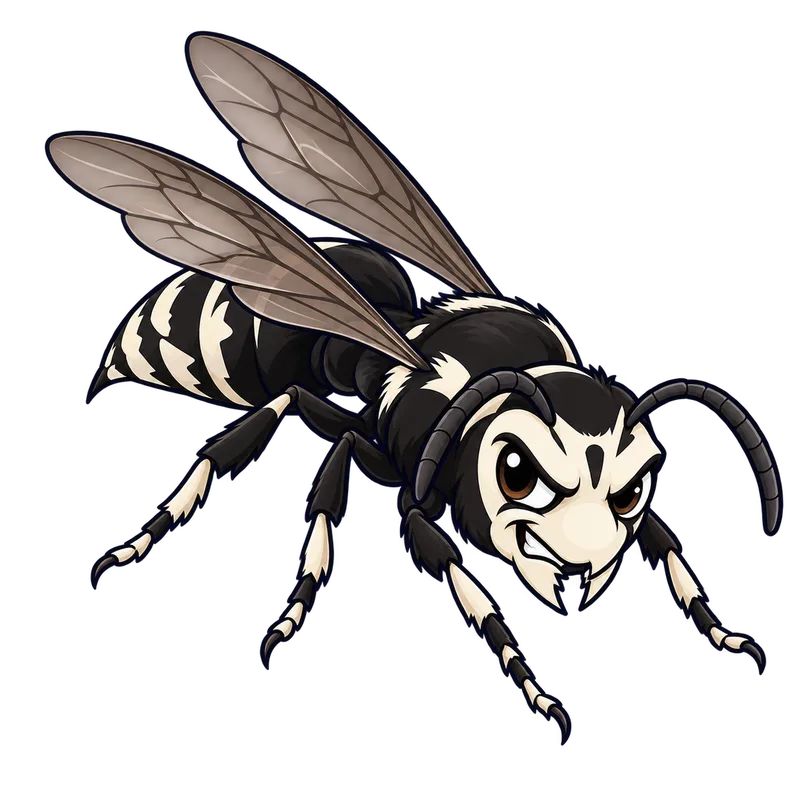
You can tell a bald-faced hornet from a paper wasp by looking at their nests, body colors, and flight styles. Bald-faced hornets feature a stout black-and-ivory body and build enclosed football-shaped nests high in trees. Paper wasps are slender with brownish or reddish bands, and they build open umbrella-shaped nests under eaves.
What is actually going on
You walk out to your front porch to sweep away some scattered leaves, glance up at the wooden overhang, and notice a small, gray structure hanging right above the door. It looks like an upside-down umbrella made of papier-mâché, with tiny hexagonal rooms staring right back at you. Or maybe you spot a large, smooth paper ball swaying from a high oak branch in the backyard. Naturally, you want to know who moved in before you get any closer. You are likely looking at either a paper wasp or a bald-faced hornet, and while both belong to the broad wasp family, their building styles, body paint, and general attitudes are entirely different.
People often mix them up because both insects chew wood pulp and saliva to build paper nests. But the similarities pretty much end there. A bald-faced hornet is actually not a true hornet at all, despite the name. It is a stout, heavy-bodied aerial yellowjacket wearing a stark black-and-ivory tuxedo. Paper wasps, on the other hand, are much slenderer creatures with narrow waists that look pinched by a belt, sporting warmer shades of brown, yellow, and reddish-orange.
Understanding who shares your yard usually comes down to spotting a few clear physical and architectural traits from a safe distance. You do not need a microscope or an entomology degree to figure it out. Once you know what to look for, you can tell them apart in seconds, which helps you decide whether to ignore them, leave them be, or call in backup.
How to tell for sure
Telling these two apart relies on three straightforward clues: the shape of the nest, the insect's colors, and how they fly. You can usually make a confident call from about 10 to 15 feet away if you know what details matter.
First, look at the nest. Paper wasps build open combs that completely lack a protective outer shell. Every single brood cell is exposed to the elements, looking very much like a miniature, upside-down showerhead hanging by a single stalk under an eave, porch ceiling, or deck railing. Bald-faced hornets build entirely different structures. Their nests are large, fully enclosed spheres made of multiple layers of gray paper that resemble a football or a Chinese lantern, usually hanging high in a tree branch or a tall shrub with just one small entrance hole near the bottom.
Second, check the coloration if you get a closer look from a few feet away. Bald-faced hornets feature a mostly black body with striking, pale ivory-white markings across their face and the tip of the abdomen. Paper wasps have a much more varied palette, usually showing off brownish, reddish, and yellow bands on a slender frame.
Third, watch their flight behavior. Paper wasps fly with a slow, hovering style and let their long, spindly legs dangle noticeably beneath them like trailing ribbons. Bald-faced hornets move with a much more rapid, compact flight profile, tucking their shorter legs neatly beneath their bodies as they zip through the air.
Of course, if the nest is tucked deep inside a wall void or a dark cavity where you can only see an occasional insect flying in and out, visual identification becomes impossible at home. In those tricky situations, or if you happen to find a crushed specimen that is too damaged to examine, you will not be able to guess the species reliably.
What usually comes next
After you figure out who lives in the yard, you need a plan. When a paper wasp nest sits quietly under a back porch roof where nobody walks, you can often just let the colony live out its natural season until winter ends the cycle.
If that nest hangs right over the main entrance or blocks a busy garden path, waiting is no longer an option. Store-bought aerosol sprays give you a way to handle smaller, reachable nests yourself, but the product label is the final authority on how to use them. Never make up your own mixtures, bump up the strength, or use the spray in ways the manufacturer did not write down on the tin.
Protecting local wildlife matters just as much as clearing out pests. Never spray insecticides onto open flowers, blooming trees, or garden beds where honeybees and native bees gather food. When a nest sits too high up, needs special gear, or calls for professional-only products that require a commercial license, leave the ladder alone and hire an expert.
When to get help
Most backyard encounters pass without trouble, but some locations and situations call for an expert hand or emergency care. Call a licensed pest professional if a bald-faced hornet colony sets up camp near doorways, children's swing sets, or crowded walkways. Because bald-faced hornets fiercely guard their paper globes from a distance of 15 feet and launch en masse when provoked, taking down a large nest dangling from a tree branch demands heavy-duty protective suits and specialized removal gear.
Medical emergencies call for a very different response. Both wasps and hornets have smooth stingers, meaning they can sting repeatedly if someone gets too close to home. For a standard local reaction like minor redness and swelling, washing the skin with soap and water, adding a cold pack, and applying an over-the-counter itch cream generally manages the discomfort.
If a sting victim develops widespread itching, hives away from the bite, dizziness, swelling in the face or tongue, wheezing, or a tight throat, they could be facing a severe allergic reaction called anaphylaxis. Treat this as an immediate medical crisis. Call 911 or reach out to poison control right away at 1-800-222-1222. Anyone with a known insect allergy should use an epinephrine auto-injector without hesitation and get to an emergency room immediately.