
What is the habitat of a bald-faced hornet?
The bald-faced hornet builds its large, enclosed paper nests out in the open, suspending them high in deciduous trees or thick shrubs, or sometimes under the eaves of buildings. These native North American social wasps prefer to construct their homes above ground rather than underground or inside wall voids.
What is actually going on
Picture yourself out in the yard on a warm July afternoon, trimming back an overgrown privet hedge or clearing some low branches near the garden shed. You reach up to pull down a stray twig, and suddenly you freeze. Dangling right there from a branch at eye level is a massive, slate-gray paper structure that looks like a giant, hanging lantern. You step back in a hurry, wondering what on earth has moved into your yard.
You are looking at the home of the bald-faced hornet, which is not actually a true hornet at all, but rather a large, aerial-nesting social wasp native to North America. You will find them across much of the continent, though they show up most frequently in the Southeastern United States. Instead of building underground or hiding inside hollow wall voids like typical yellowjackets, these insects prefer to construct their distinctive enclosed paper nests out in the open. They usually suspend them high in deciduous trees or thick shrubs, or sometimes tuck them up under the eaves of buildings.
To build these homes, the workers chew up weathered wood pulp and mix it with their saliva, manufacturing a durable paper. The colony operates on an annual cycle. A fertilized queen emerges from hibernation in the spring to build a small, thumb-sized nest and lay her first eggs. As the summer rolls on, the worker population explodes, and that tiny initial egg chamber expands into a massive structure the size of a basketball. Once late fall hits, the active colony dies off, and only the newly mated queens survive the winter by finding shelter under leaf litter, bark, or loose soil.
How to tell for sure
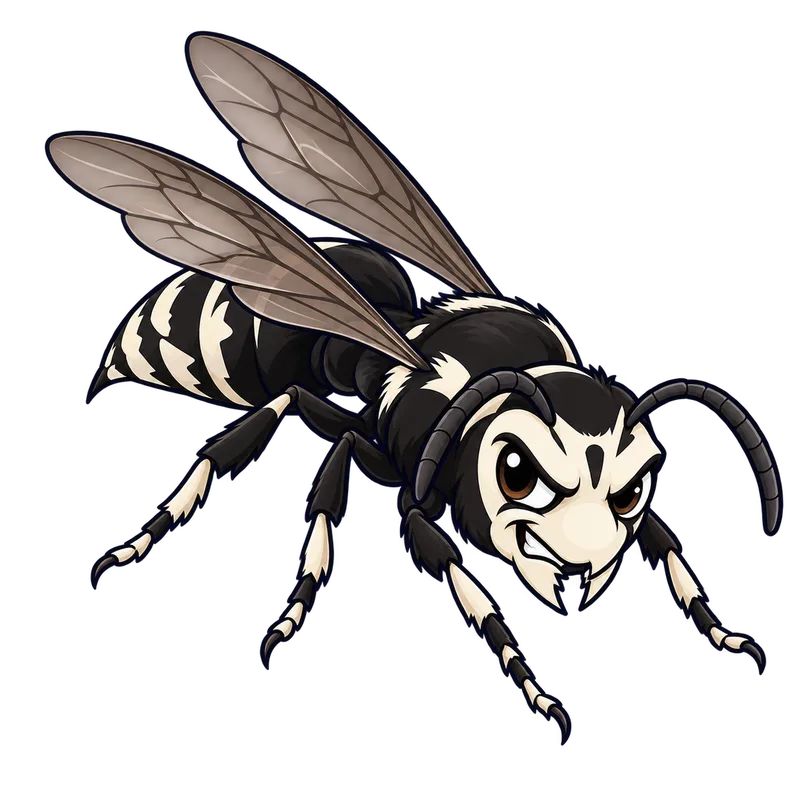
Spotting the insect itself usually clears up any confusion. An adult bald-faced hornet typically measures between one-half and three-quarters of an inch long, putting it noticeably larger than a standard yellowjacket. Its body features a striking, high-contrast black-and-white pattern, especially across the face and the end of the abdomen, completely lacking the bright yellow stripes you see on typical stinging insects.
The nest itself serves as the most reliable field marker. It is a closed, multi-layered paper envelope usually colored in shades of gray. This sets it apart from the reddish, muddy-brown nests built by some invasive wasps or the tan, swirled paper structures created by the European hornet.
You can usually identify a bald-faced hornet from a safe distance of 10 to 15 feet just by looking at its size, its stark black-and-white face, and that hanging gray lantern nest. If you need to check finer details, like specific wing venation or facial plates, an entomologist has to look at a physical specimen under a hand lens with ten times magnification. Do not try to catch one to check, though.
What usually comes next
When you discover an active nest hanging right above your walkway or right beside your back door, you have to decide whether to leave it alone or deal with it. If the nest is sitting far away from human traffic, high up in a remote woodland tree where nobody goes, the most sensible choice is often to leave it in place. These insects act as effective native predators that hunt down other garden pests, and they provide minor pollination services as they forage for nectar and tree sap.
However, a large colony perched right above your deck railing changes the math entirely. These hornets defend their territory aggressively if anyone vibrates their supporting branch or gets too close to the entrance hole. If the nest occupies a high-risk spot near where children play or people walk, you cannot simply ignore it and hope for the best.
When you decide a nest has to go, remember that chemical control products are strictly governed by the product label under federal law. Never exceed listed concentrations or alter application methods. If a nest sits high up on a structural peak or requires specialized gear to reach safely, that job belongs to a licensed pest control operator who has the proper protective equipment.
When to get help
Stings happen, and when they do, they usually bring local pain, redness, and swelling. Wash the area, apply a cold pack, and keep an eye on how your body responds.
You need to seek professional medical help immediately if someone suffers a severe allergic reaction, which shows up as difficulty breathing, swelling of the tongue or throat, dizziness, or widespread hives. For severe symptoms or accidental exposure questions, contact emergency medical care, an urgent care clinician, or Poison Control at 1-800-222-1222. Anyone who gets stung should also check their tetanus vaccination status with a clinician to be safe.
Leave the physical removal of large or awkwardly placed nests to the professionals. Trying to knock down an active overhead colony with a broom handle or spraying it with a household garden hose usually triggers a furious defensive counterattack, landing you right in the middle of an aggressive swarm.