
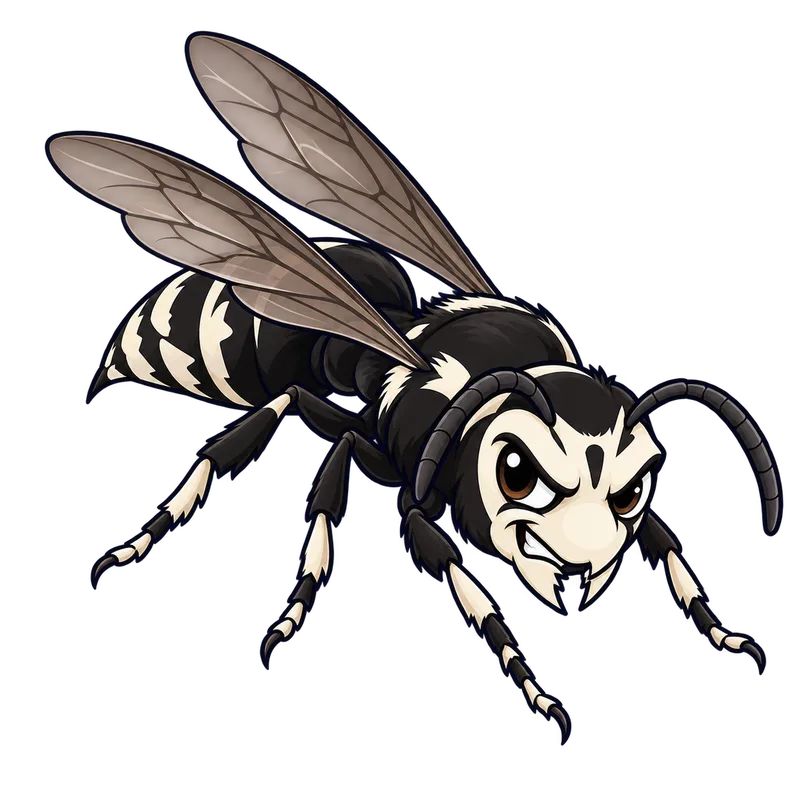
Bald-faced hornet
Dolichovespula maculata
- Size
- .5 to .75 inches
- Color
- Mostly black with prominent white markings
- Habitat
- Above ground in trees, shrubs, and structures
- Diet
- Flower nectar, plant sap, and insects
- Life cycle
- Annual social cycle from spring queen emergence to winter die-off
The bald-faced hornet is a native North American insect that is actually a large aerial yellowjacket belonging to the genus Dolichovespula rather than a true hornet of the genus Vespa. You will usually run into one near an aboveground nest attached to tree branches, shrubs, utility poles, or the eaves of buildings, especially in the Southeastern United States where they are most commonly encountered.
Identity
The adult body measures between .5 and .75 inches in length, making it slightly larger than standard ground-nesting yellowjackets. The insect displays a striking black-and-white color scheme, featuring a mostly black abdomen with crisp white markings and a well-defined wasp waist separating the thorax and abdomen. When compared against lookalike species, the bald-faced hornet is easily told apart from the northern giant hornet, which reaches a massive 1.5 to 2 inches long with a solid yellow or orange head. It also differs from the yellow-legged hornet, which grows up to 1 inch long and features bright yellow lower leg segments. European hornets are larger at 1 to 1.5 inches with a reddish-brown head and thorax, while standard yellowjackets show bold yellow and black banding instead of white markings. If an insect lacks a wasp waist entirely, such as the elm sawfly, it is something else altogether.
Habitat & behaviour
Colonies run on a strict annual cycle. A single overwintered queen wakes up in the spring, scrapes some weathered wood to chew into pulp with her saliva, and builds a modest, pear-shaped starter nest. She lays the first eggs, feeding the resulting grubs herself until they mature into female workers. By the time summer arrives, those workers take over the chores. They forage for food, expand the papery walls, and leave the queen free to focus entirely on laying eggs.
Adults survive on flower nectar, plant sap, and fruit juice for their own energy, but they hunt other insects to feed the larvae back home. Activity peaks when late summer rolls around, and the colony grows quite defensive of its gray paper envelope. Once cold weather hits, the original queen, the males, and the workers all die off. Only newly mated young queens survive the winter, tucking themselves into leaf litter or rotting logs until spring warms things up again.
Visual variations
These insects go through complete metamorphosis, meaning they transform through egg, larva, pupa, and adult stages inside a society divided into castes of reproductive queens, female workers, and males. Both the adult workers and the queens wear the same signature black-and-white color scheme and narrow waist, though you will notice subtle size differences if you inspect them closely. The nest undergoes its own transformation across the seasons, starting as a small, open-faced paper comb in the spring and ballooning into a massive, fully enclosed, football-shaped gray paper structure by late summer.
Why it matters
As native predators, these hornets do a great job keeping other insect populations in check across natural and suburban yards, and they leave structural timber alone because they build with pulp rather than boring into wood. Still, they will defend their homes fiercely if you get too close or accidentally bump into their nest. Their stings hurt badly, and anyone who shows signs of a severe allergic reaction, systemic symptoms, or trouble breathing needs to get medical help right away or call the Poison Center Helpline at 1-800-222-1222. You have to confirm the exact species before making any decisions, ensuring you do not mix up a native beneficial insect with an exotic invader. Remember that product labels govern any pesticide use, and whenever an active nest sits too close to high-traffic areas, let a licensed pest control professional handle the removal.
Similar species
 European hornetVespa crabro
 Yellow-legged hornetVespa velutina
 European paper waspPolistes dominula
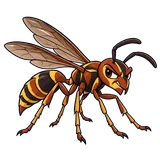 Paper waspsPolistes species
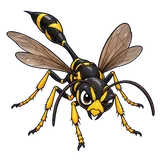 Mud daubersSceliphron and Chalybion species
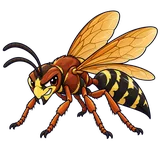 Eastern cicada killerSphecius speciosus